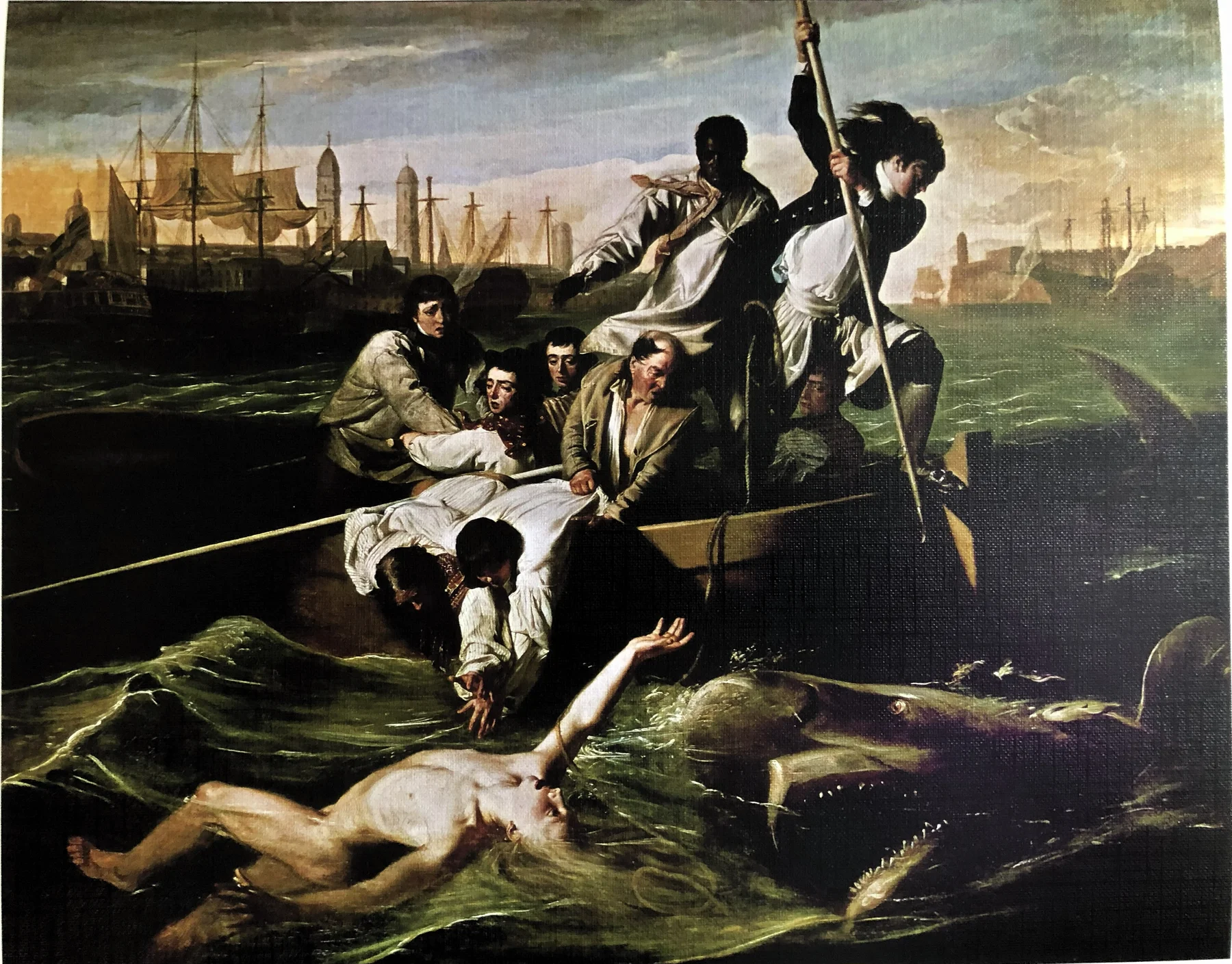
WATSON AND THE SHARK
John Singleton Copley
- Artist
- John Singleton Copley (1738–1815)
- Date
- 1778
- Dimensions
- 182 x 230 cm
- Medium
- Oil on canvas
- Location
- National Gallery of Art, Washington DC, USA
John Singleton Copley is now regarded as the finest American painter of the 18th century. He established his reputation as a portrait painter in Boston, Massachusetts, and then, shortly before the War of Independence, in 1774, he crossed the ocean and began a new artistic career in England. Although he did not give up portraiture, his attention turned to history painting: his highly original and dramatic Watson and the Shark was his first successful venture into the world of historical depiction.
An Unusual Commission
In 1778 the London merchant Brook Watson commissioned Copley to record one of the memorable events of his life. Watson, who wore a wooden leg, asked the painter to commemorate a terrible shark attack of which he had been the victim. Almost thirty years earlier, at the age of 14, Watson had been swimming in the harbour of Havana, Cuba, when a shark attacked him. The predator first bit a piece out of his calf, and then tore off his foot at the ankle. On its third attempt, however, it could no longer reach its victim, because the crew of a rescue boat hurrying to Watson’s aid managed to drive the animal away, saving the boy’s life.
Copley gladly accepted the unusual commission. During his Boston years he had become a first-rate portrait painter, but after moving to London he wanted to compete with Benjamin West, creator of The Death of General Wolfe (1770) and the leading history painter of the English capital. Watson and the Shark was Copley’s very first history painting, but, like West’s works, it marked a radical departure from the world of traditional history painting, since it depicted a relatively recent event and dressed its figures in contemporary clothing rather than antique costume — all within the framework of a classical composition.
Three Versions
At the 1778 exhibition of the Royal Academy of Arts three of Copley’s works were shown, of which Watson and the Shark was received favourably by the public and critics alike. As a result of this artistic success, Copley was elected a full member of the Royal Academy in February of the following year. Brook Watson bequeathed the painting to Christ’s Hospital in the English town of Horsham, and today it can be seen at the National Gallery of Art in Washington. In 1778 Copley painted a copy of the picture for himself in the same size, which he kept in his studio until his death in 1815. This second oil painting is on view at the Museum of Fine Arts in Boston, while a third version — a smaller, upright-format canvas from 1782 — is exhibited at the Detroit Institute of Arts.
Early Sketches
As preliminary studies for Watson and the Shark, John Singleton Copley made a good number of figure sketches, including his Study of the Harpooner and Oarsman, drawn in black and white chalk on grey paper. The sketch was a mirror image of the final oil painting, in which he swapped the dynamic poses of the standing harpooner and the seated oarsman. Copley had never been to Cuba, so he had to research every available source in order to depict faithfully the harbour of Havana that serves as the background of his picture. One such source was probably Peter Canot’s engraving A View of the Entrance of the Harbour of the Havana, with the shipwrecks, in which Morro Castle is clearly visible, as it is in Copley’s painting to the right of the harpooner. The models for the boatmen are unknown, but Copley’s well-executed Head of a Black Man (c. 1778) may have served as the model for the figure standing behind the harpooner. Some have criticised Copley’s shark, which, with its huge protruding eyes, does not belong to any known species, but it is undeniably shark-like and very frightening.
Shark Attack!
In his final composition Copley balances the dynamism of the vertical line of the harpoon with the boy in the foreground, the shark and the boat, and the strong verticality of the townscape on the horizon in the background. The attacked boy, laid on his side, is a mirror image of the statue of the Borghese Gladiator (now in the Louvre in Paris) by the ancient Greek sculptor Agasias of Ephesus.
This extraordinary painting makes a great impression on the viewer, because Copley is able to evoke the excitement and danger of a past event. He captures the moment when the shark approaches the boy with its jaws open to bite, while the sailors rush to his aid with outstretched hands, and the harpooner is just about to plunge his sharp weapon into the bloodthirsty predator. This heightened emotional world of history painting was taken up by the generation of French Romantic painters who came after Copley.
- Sir Brook Watson as Lord Mayor of London in 1796
- John Singleton Copley
- Benjamin West: The Death of General Wolfe
- Head of a Black Man
- Borghese Gladiator
- A version of Watson and the Shark