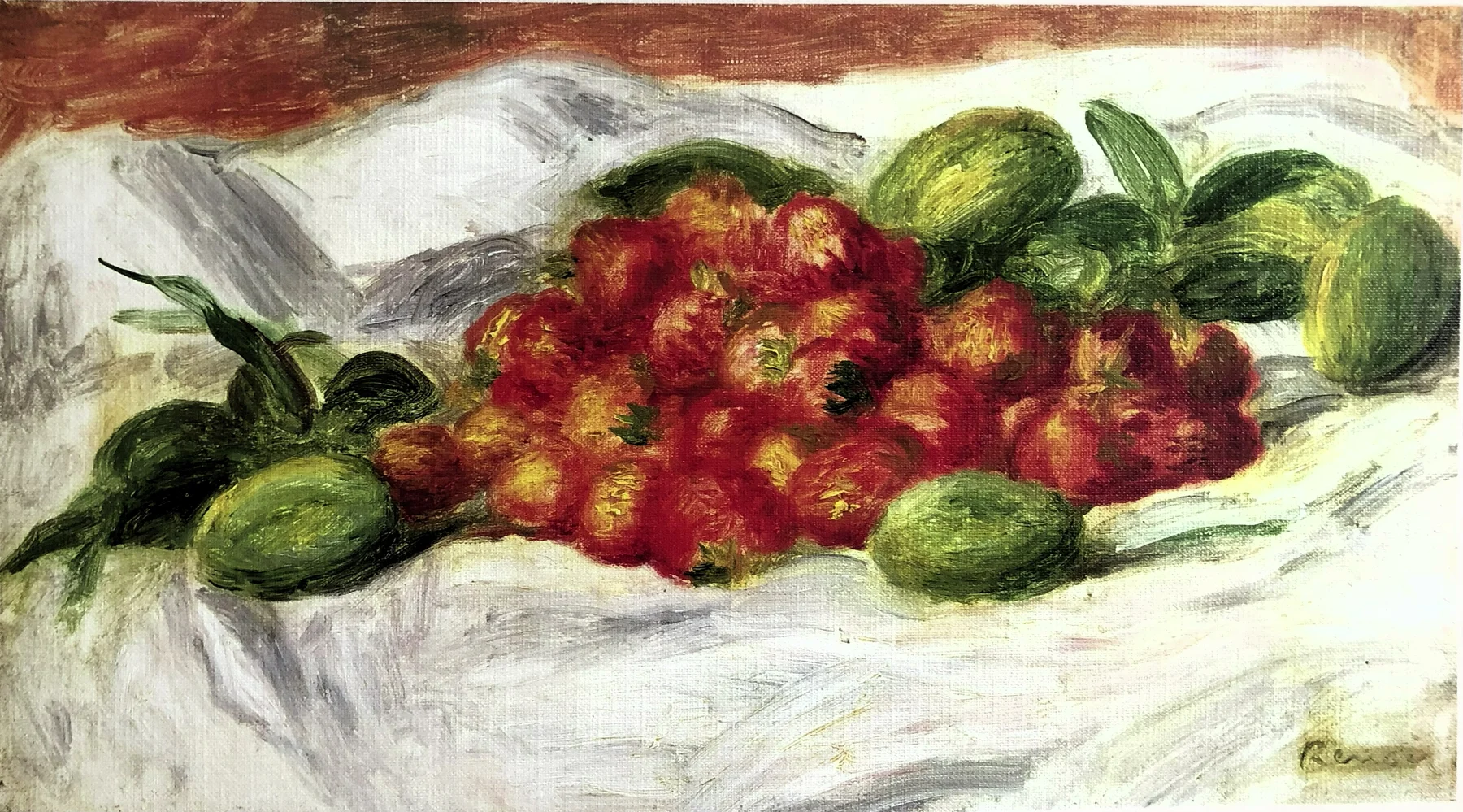
STRAWBERRIES AND ALMONDS
Pierre-Auguste Renoir
- Artist
- Pierre-Auguste Renoir (1841–1919)
- Date
- c. 1900
- Dimensions
- Unknown
- Medium
- Oil on canvas
- Location
- The Barnes Foundation, Merion, Pennsylvania, USA
Renoir is one of the most popular painters of all time; today many of his sun-drenched landscapes and captivating figure paintings hang on the walls of museums and galleries all over the world. Renoir, the committed Impressionist, painted passionately out of doors, drawing his subjects directly from nature, which is why his pictures give a sense of spontaneity and immediacy. But this was not the only way he worked: throughout his artistic career he was just as prolific in the studio; he created a surprising number of beautiful and expressive still lifes, such as Strawberries and Almonds. Although these paintings are less well known than some of his signature works, they are just as significant and give a faithful picture of the stylistic stages of his long and successful career.
An Unusual Subject
After long years of struggle, Renoir made his mark on the world of painting with masterpieces such as Dance at the Moulin de la Galette (1876) and Luncheon of the Boating Party (1882). Each of these pictures is a breathtaking feat in its own way: besides their monumental size and startling novelty, Renoir depicted movement, painted light and created atmosphere with his characteristic flair. Knowing these masterly works, it is hard to imagine why Renoir devoted so much time and energy to painting “modest” still lifes, especially since some of his pictures, such as Luncheon of the Boating Party, contain finely worked still lifes. Moreover, the official institutions looked on the genre with disapproval: the French Academy, for instance, regarded it as a shallow, uninspired relic of 17th-century Dutch painting. For Renoir and most of the Impressionists, however, still-life painting had its own special artistic merits.
A Particular Charm
Renoir painted still lifes throughout his career, and as a result they differ greatly in style. His earlier works, such as Still Life with Lemons and Oranges (1881), are decidedly Impressionist, while Strawberries and Almonds, painted two decades later, is a typical example of the soft brushwork and blurred visual effect characteristic of Renoir’s mature style.
As can be seen in Strawberries and Almonds, Renoir placed the emphasis primarily on the colourful arrangement of flowers or fruit, and these subjects attracted him for two reasons. The first, in Renoir’s own words, was purely therapeutic: “When I paint flowers, I let my brain rest. I don’t feel the same tension as when I am facing models.” When creating still lifes, Renoir also had the opportunity to experiment with tones and colour values without “losing the picture”. There was, however, a more practical reason for turning to still lifes: they sold well. At a time when Impressionism met with rigid rejection from the art establishment, Renoir’s still lifes were much more popular with buyers. These works, such as Still Life with Peaches (1881), shown at the 1882 exhibition, provided the artist with a comfortable living.
Artistic Freedom
Renoir’s still lifes, although popular, were far from conventional depictions. In this, one of the most traditional genres, aesthetics mattered above all, and it was crucial that the picture should appeal not only to the eye but also to the stomach. Artists therefore often built their compositions from fruits that went well together. Renoir, by contrast, ignored this unwritten rule and concentrated only on forms and colours. An excellent example of this is his Fruits of the Midi from 1881. Presenting an improbable combination of lemons, pomegranates, aubergines and peppers, the painting is in fact a finger exercise in contrasting textures. In Strawberries and Almonds too, Renoir was primarily interested in the differences in tone and texture between the plump, juicy red strawberries and the fuzzy green husks of the freshly picked almonds. The complementary colours almost glow in the picture and lend the composition a fresh, surprisingly vivid effect.
Illness
There were two periods in Renoir’s life when the number of his still lifes increased significantly. The first dates to the early 1880s, when he suffered a creative crisis that eventually led to his break with Impressionism and to his so-called “dry” style. The second period coincided with the creation of Strawberries and Almonds and began with a different kind of crisis. In 1897 Renoir was cycling from his home in Essoyes to a picturesque but distant small town, Servigny, to “see what the poplars look like under a stormy sky”. On the way, however, he fell off his bicycle and broke his right arm. For a few months afterwards he had to paint with his left hand, and although the bone healed, he was tormented by such agonising arthritis that he was often unable to hold a brush. As his mobility declined, Renoir turned to more accessible subjects: he painted his family and created still lifes of fruit from his garden. His works, including Strawberries and Almonds, thus brought changes in the rhythm and imagery of Renoir’s art, yet even these late paintings show nothing of the pain and despair the painter felt. Until his death in 1919 he painted with the charm and joie de vivre that a contemporary critic summed up as follows: “the only great painter who never painted a sad picture.”
- Renoir’s studio in Essoyes
- Still Life with Lemons and Oranges
- Renoir in illness