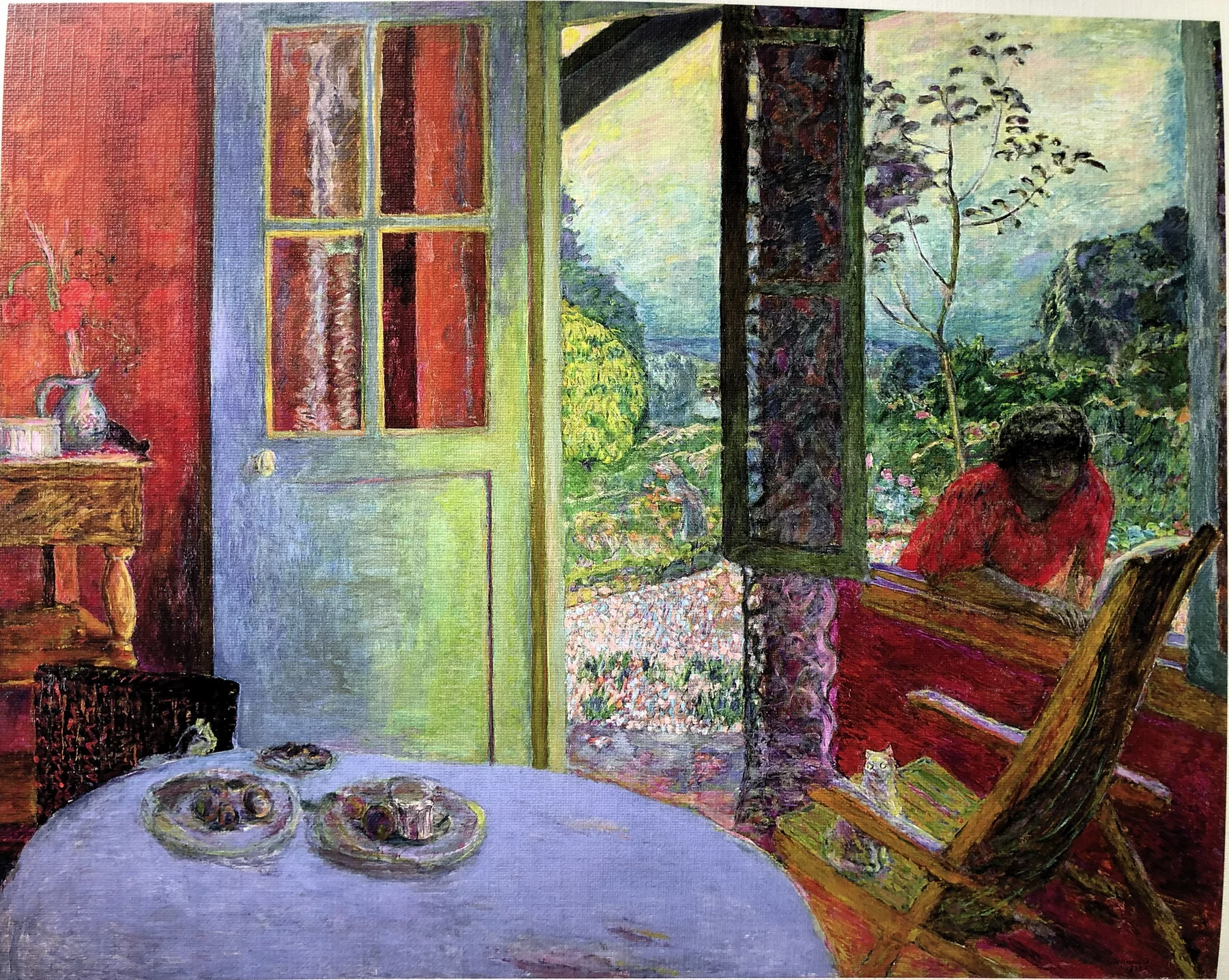
THE COUNTRY DINING ROOM
Pierre Bonnard
- Artist
- Pierre Bonnard (1867–1947)
- Date
- 1913
- Dimensions
- 161 x 203 cm
- Medium
- Oil on canvas
- Location
- Minneapolis Institute of Arts, Minneapolis, Minnesota, USA
The French artist Pierre Bonnard began his career as a poster designer and book illustrator. Because of his passion for colour and light he later called himself “the last Impressionist”. Bonnard captured simple images of everyday life, such as bright, sunny rooms. The paintings of this excellent artist with a unique vision alternate largely between intimate interiors and more decorative compositions. The Country Dining Room, a masterpiece created in his mid-forties, marked a decisive turning point in his artistic career.
Painting from Memory
Pierre Bonnard painted The Country Dining Room in 1913. As the setting of his picture he chose his country house, called “Ma Roulotte”, which he had bought a year earlier in Vernonnet, a village in the Seine valley. Although he made three sketches of his dining room, it cannot be said that the final version was painted on the spot, since he preferred to paint from memory. Bonnard described his working method in simple words: “All the objects in my pictures are close at hand. I go there, look, make notes. Then I go home, and before painting I think and dream.”
In 1913, before painting The Country Dining Room, Bonnard went through a serious creative crisis. In one of his letters to his nephew, Charles Terrasse, he explained that he had to reinterpret his art and learn it anew. Because of the rise of Cubism he feared that his style might become outdated, and that in his stubborn search for colour he had unintentionally sacrificed form and composition.
Back to the Drawing Board
As the idea of painting The Country Dining Room took shape, Bonnard concentrated on drawing. He put the new idea into practice with great enthusiasm: “And after the drawing comes the composition, which must be balanced. A well-composed painting is half done.” Despite the new emphasis in his working method, The Country Dining Room is a lively work, rich in colour. The colours, applied with loose brushstrokes and great expressive power, radiate a joyful mood permeated by a sense of intimacy and freedom. The “warm” reds and oranges of the upper left and lower right edges of the canvas contrast with the “cool” blues of the table and part of the door.
Inside and Out
On the large canvas of The Country Dining Room Bonnard successfully solved many of the problems he was struggling with at the time. The composition is carefully arranged, built around strong horizontal, vertical and diagonal lines, which are, however, softened and linked by a subtle combination of curves and colours. The wide-open door and window create a connection with the outside world. The nature visible in the background enters the intimate atmosphere of the home.
Contrasts
The supple lines of the tree outside break the regular verticality of the window and the door frame. Marthe de Méligny, with whom Bonnard spent most of his life, is outdoors but leans on the windowsill and looks into the room, towards the viewer. The curved back of the deckchair opposite her — empty apart from a cat — breaks the diagonal line of the window, while the gently rounded edge of the pearly-blue table links the inner and outer worlds and also alludes to the blue of the sky. The open blue door, with its warm yellow and green tones, reflects the light of the outdoor scene.
Artistic Connection
Pierre Bonnard was in his early twenties when he joined the group of artists called the Nabis (a Hebrew word meaning “prophets”). In 1890 he moved into a small Paris studio flat at 28 rue Pigalle with his friends Maurice Denis, Aurélien Lugné-Poe (left-hand picture) and Édouard Vuillard (lower picture). In Lugné-Poe’s words, “this is where the Nabis were born — the group of pure-hearted prophets of painting, which branched off like a new shoot from the trunk of the proud tree formed by Signac, Seurat and Pissarro.” These young French avant-garde artists, who were initially under the influence of Paul Gauguin’s work, turned against the naturalistic representation of Impressionism and showed more interest in Symbolism and the decorative arts.
- The Minneapolis Institute of Art