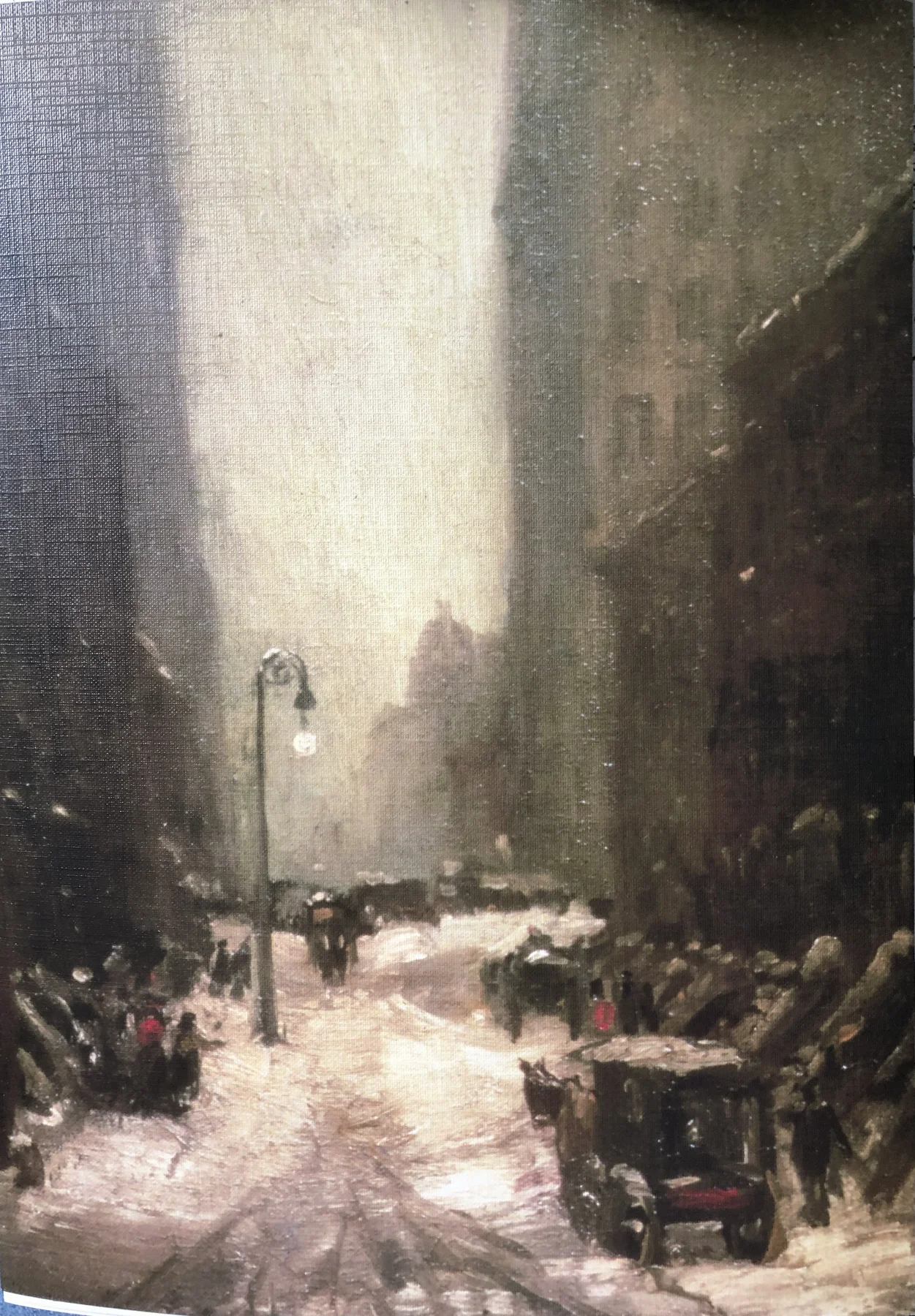
SNOW IN NEW YORK
Robert Henri
- Artist
- Robert Cozad Henri (1865–1929)
- Date
- 1902
- Dimensions
- 81.3 x 65.5 cm
- Medium
- Oil on canvas
- Location
- National Gallery of Art, Washington DC, USA
“I am not interested in any school or movement, nor in art for art’s sake. I am interested in life,” declared the American painter and teacher Robert Henri. Despite the frost and melancholy of the New York winter, Henri depicted a bustling street scene from the city’s heroic age.
Metropolis
At the turn of the 20th century New York was the most modern and exciting city in the world, attracting immigrants not only from the United States but from Europe as well. In 1898 New York City was created by the union of five boroughs (the Bronx, Brooklyn, Manhattan, Queens and Staten Island), linked by a newly built road network. Although it was no longer the administrative capital of the country, it was still the largest city in the United States and its business, industrial, media and cultural centre. A large-scale building programme was launched to keep pace with population growth, which by 1900 had reached 3.4 million, 128 per cent more than in 1890. Westward expansion was over, and all eyes were on this wonderful East Coast metropolis.
New York via Paris
Henri moved to New York in 1900 with his wife, Linda. They were from Philadelphia, but had spent 1898–1900 in France on an extended honeymoon. In 1899 Henri painted Snow, a snowy Paris street scene whose gloomy grey tones are enlivened by the sight of snow-covered roofs. To his great delight, the French state bought the work, which can now be seen in the Musée d’Orsay.
The young couple moved into an East Side apartment overlooking the river, at 512 East 58th Street, from where Robert painted the huge cranes and warehouses, symbols of the city’s pulsating industry.
The Human Factor
It was undoubtedly the successful sale of Snow that inspired Henri at the beginning of 1902 to start painting winter street scenes of New York. Snow in New York, painted in early March, is set on West 55th Street, three blocks from his own apartment. The view faces south-east, towards the intersection with Fifth Avenue. On the street, lit by a single lamp and lined with brownstone houses, people and horse-drawn carriages move along the slushy wheel ruts. Behind them tower the first skyscrapers, which would later define the Manhattan skyline.
Depicted at street level with one-point perspective (all lines converge at a single point on the horizon), the painting is primarily about the people in the picture rather than the distant buildings. Henri deliberately scatters a few eye-catching red spots in the foreground of the composition to draw our gaze there and keep it low. He renders the steps on both sides of the street and the weather-defying people with similarly short, quick brushstrokes, encouraging the viewer to study the details further. By contrast, the skyscrapers loom only as blurred, hazy silhouettes, their upper floors drifting off the canvas, reminiscent of the walls of a steep canyon. The difference in scale — from the human to the monumental — reflects the gulf between the homely old brownstones and the breathtaking but impersonal world of the skyscrapers.
The painting is a mixture of several styles. The vigorous brushwork and restrained colour harmonies recall Impressionism, a legacy of Henri’s student years in Paris and later travels in France. Its dark, gloomy colours signal his admiration for Manet and Velázquez, while the subtle, veil-like rendering of the air alludes to James McNeill Whistler and his thinly painted London nocturnes.
Henri had barely finished Snow in New York when he showed it at his solo exhibition at the Macbeth Gallery, which opened on 1 April, and in the same year it was bought by a private collector. However, he had little success with his landscapes, so from the end of 1902 he switched to portraiture and later painted hardly any landscapes.
Artistic Connection
Henri was the central figure of an informal artistic circle whose members were William Glackens, George Luks, Everett Shinn and John French Sloan. They initially worked as newspaper illustrators in Philadelphia, then followed Henri to New York. They were later dubbed the Ashcan School, because they could see beauty even in discarded rubbish (ashcan = dustbin). “Everything has its beauty if it looks beautiful to our eyes,” Henri declared. In February 1908 he organised the exhibition of “The Eight”, at which the works of three realist painters, Arthur B. Davies, Ernest Lawson and Maurice Prendergast, were shown alongside those of the five Ashcan artists. The event opened at the Macbeth Gallery in New York, after which the exhibition toured America and received great attention everywhere.
- New York street scene around 1900
- West 55th Street and the Avenue of the Americas today