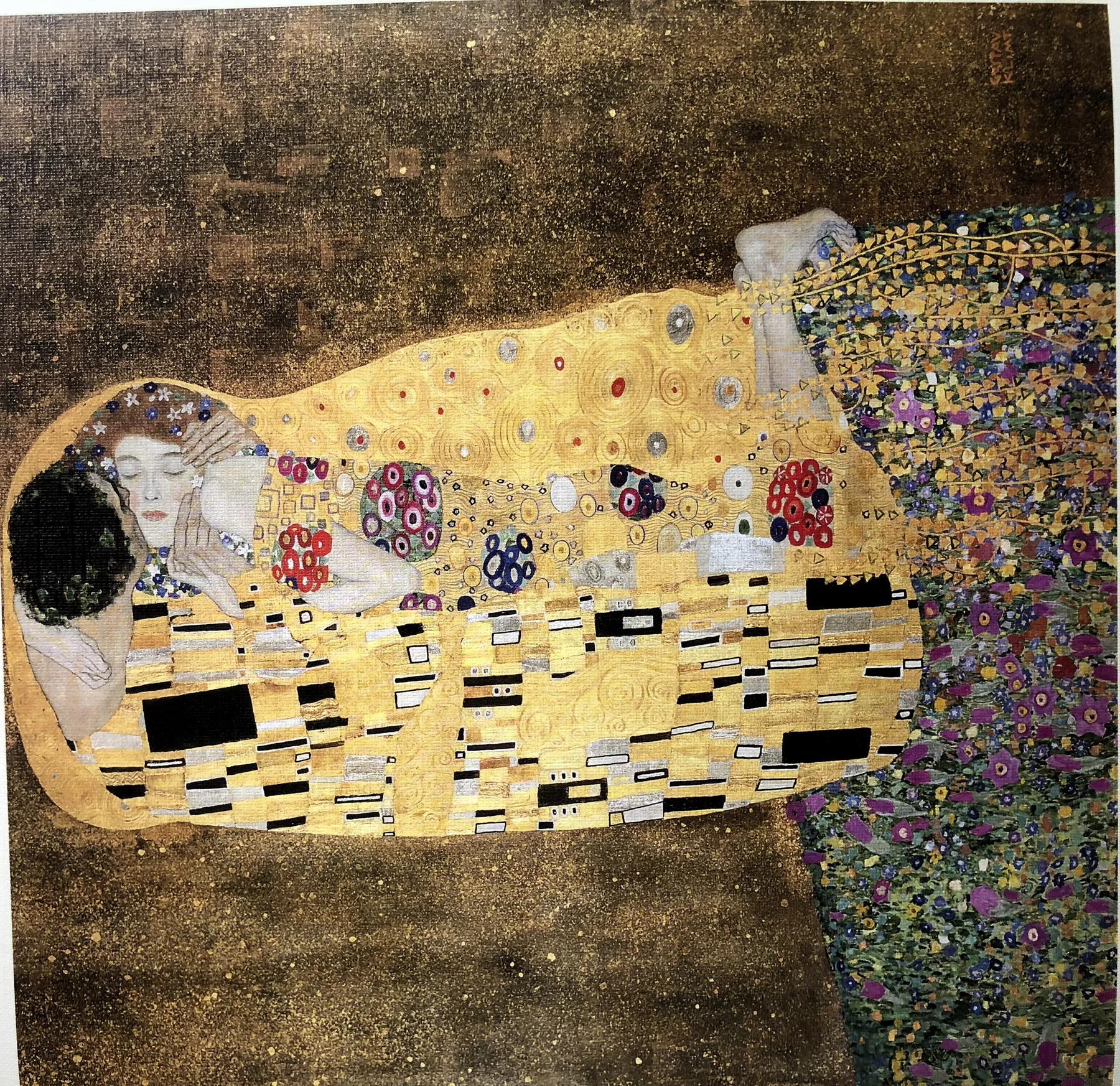
THE KISS
Gustav Klimt
- Artist
- Gustav Klimt (1862–1918)
- Date
- Between 1907 and 1908
- Dimensions
- 180 x 180 cm
- Medium
- Oil and gold leaf on canvas
- Location
- Österreichische Galerie Belvedere, Vienna, Austria
Gustav Klimt’s The Kiss is arguably the most famous loving embrace in the history of art. The erotically charged painting is truly breathtaking: the kissing couple is immersed in dreamlike ecstasy in a swirling sea of richly resplendent gold-leaf patterns. The work, the high point of Klimt’s career, radiates the luxury and decadence of imperial Vienna, the city that Klimt helped make a centre of the art world. Above all, however, the painting is an iconic representation of romance, love and passion.
“Golden Period”
Klimt began The Kiss in 1907, in the middle of the two-year creative phase known as his Golden Period, when he worked almost exclusively on lavishly decorative portraits of the ladies of Viennese high society. The main work of this period is the Portrait of Adele Bloch-Bauer I, commissioned by the sitter’s husband, the wealthy sugar magnate and leading art patron Ferdinand Bloch-Bauer. Klimt was at that time the most sought-after painter in the city, put on a pedestal by the rising upper middle class, while representatives of the fading old aristocracy judged his works shocking and obscene.
The Vienna Secession
After studying at the Vienna Academy of Fine Arts, Klimt began his career as a promising decorative artist and muralist. Soon, however, he incurred the disapproval of the art establishment with a series of allegorical murals made for the University of Vienna in the early 1890s, which were branded pornographic. Klimt realised that he could not fulfil his artistic ambitions through public commissions, so in 1897, in a kind of response, he founded the Vienna Secession, an avant-garde group of painters and applied artists. The movement rejected the traditional approach to painting and sought to create an entirely new artistic philosophy, which found expression primarily in the boldly decorative style of Art Nouveau, then flourishing in Europe. Although Klimt later distanced himself from the Secession and turned increasingly to the lucrative world of private portraiture, he retained his decorative inclination in pictures such as The Kiss.
A Sumptuous Painting
Alongside the Adele Bloch-Bauer portrait, The Kiss marked the culmination of Klimt’s Golden Period. One of the most appealing features of the work is its lavishly gilded surface, whose finely chiselled, richly detailed floral motifs built up from tiny mosaics alternate with layered, kaleidoscopic patterns. The main theme of the painting, the embrace, is very reminiscent of two of Klimt’s earlier works, the Beethoven Frieze (1902) and the Stoclet Frieze (1905–1911), in which the artist depicted a similarly entwined couple. The picture’s splendid decorative system, however, was probably inspired by the Byzantine gold mosaics that Klimt saw in Ravenna, Italy, in 1903. These works made a deep impression on the artist and inspired his entire career.
A Passionate Embrace
Klimt referred to The Kiss as Lovers, and his pictures are indeed almost inexhaustible journeys into the realm of sexuality. With his often openly erotic works Klimt deliberately set out to provoke, and nowhere is this more evident than in Goldfish (1902), whose female figure shows her backside to the viewer — presumably in reply to the artist’s critics — and in Nuda Veritas (1898), above whose frontal nude the following inscription can be read: “If you cannot please everyone with your art, please a few!” The Kiss, by contrast, does not radiate carnality, since Klimt covers the figures with rich ornamentation, yet it exudes an intense, almost explosive passion. The work is often regarded as a symbol of the union of man and woman, but in many respects it is more than that. The dominant male figure towers over the woman, who seems to be pressed down beneath him; her neck, wrists and feet are in unnatural positions, and her posture expresses submission.
A Mysterious Girl
Although the woman in The Kiss has one of the best-known faces in the history of art, her identity remains a mystery. Several possible candidates have been suggested, the most likely of whom is a Viennese girl, Emilie Flöge. Flöge sat for a Klimt picture as an adult in 1902, but the painter had known her since childhood, when he was commissioned to paint her together with her two sisters. One of them, Helene, later married Klimt’s brother Ernst, who died young in 1893. After this Klimt began a relationship with Emilie that lasted until the painter’s death in 1918. It is generally believed that, despite the great difference in age, she was the artist’s lover and muse during this period.
Klimt’s Masterpiece
The Kiss is today regarded as Klimt’s masterpiece, and it is also one of the few pictures to receive widespread recognition in its own time. The work was shown alongside Danaë and Hope II at the Vienna Kunstschau exhibition in 1908, where its indisputable beauty silenced even the artist’s loudest critics. The Kiss was bought by the Austrian state before the exhibition closed, and the picture found a home in one of Vienna’s imposing buildings, the Belvedere Palace, where it is still the main attraction of the fine art collection.
- Klimt with the artists of the Vienna Secession
- Klimt: Goldfish
- Klimt: Emilie Flöge