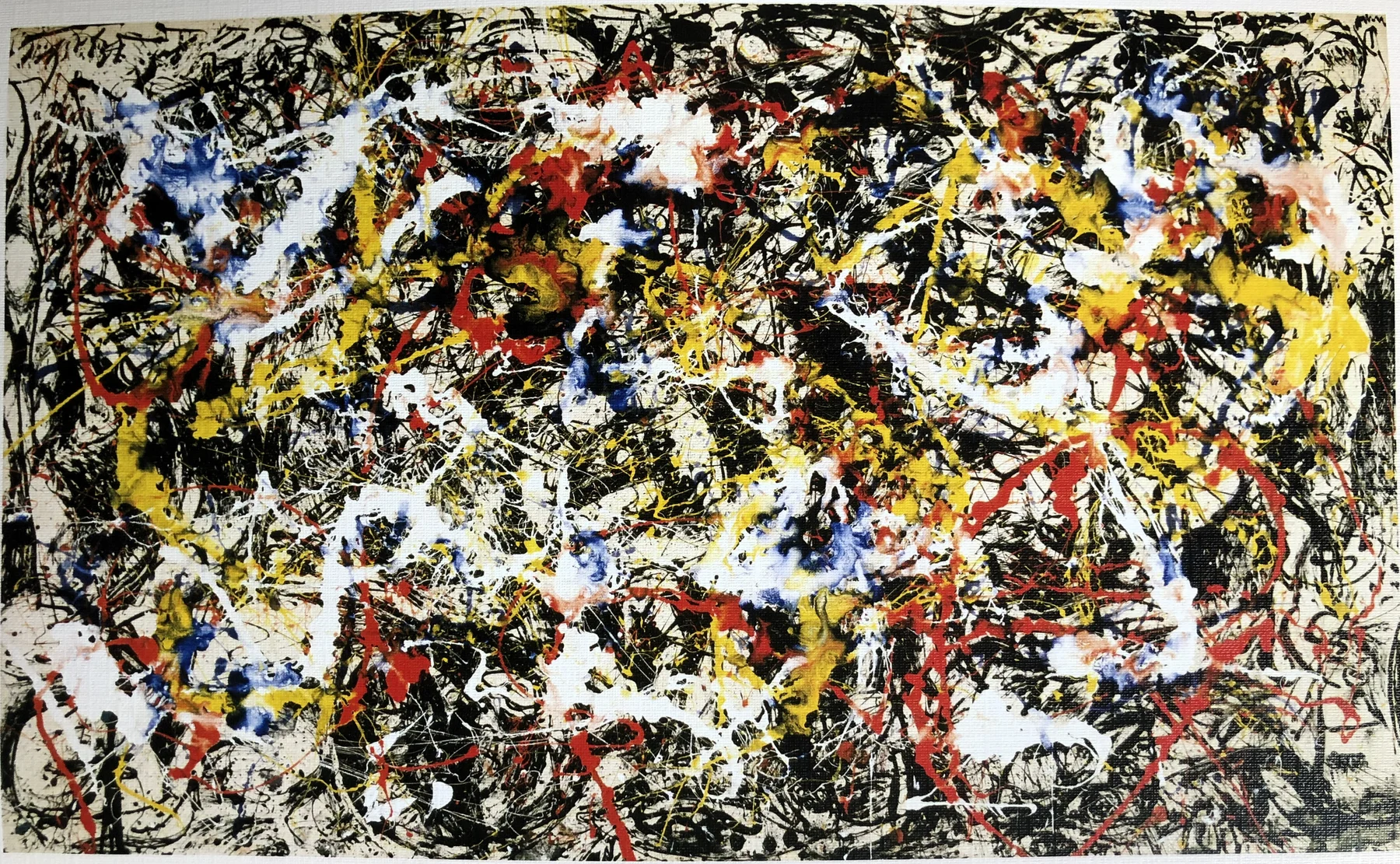
CONVERGENCE
Jackson Pollock
- Artist
- Jackson Pollock (1912–1956)
- Date
- 1952
- Dimensions
- 2.375 m x 3.937 m
- Medium
- Oil and enamel paint on canvas
- Location
- Albright-Knox Art Gallery, Buffalo, New York State, USA
When Jackson Pollock burst onto the New York art scene in the 1940s, his paintings were labelled with choice epithets such as “baked macaroni”, “an exploded shingle factory” or “a disorganised explosion of random energies”. Standing before the monumental canvas of Convergence, some ten square metres in size, the criticism becomes understandable. The picture is disordered, rampant and explosive, yet at the same time a multi-layered visual expression of energy and movement of overwhelming force and exceptional depth. Step back, and we experience its unbridled rhythm, the raging whirl of lines and colours reaching to the edges of the canvas. Move closer, and its complex layering and texture catch the eye. Pollock denied that his work was random or disjointed, and replied to his critics in a telegram: “No chaos, damn it!” He claimed he was perfectly aware of when and how he applied paint to the canvas, and since he felt the critics might misunderstand, he declared: “The result is the work of art… it doesn’t make much difference how the paint is put on.”
Abstract Appeal
Like the artists of the 1940s and 1950s, Pollock sought new means of artistic expression in paintings that did not rely on recognisable forms — hence the term “Abstract Expressionism” — relying instead only on the elements of painting: colour, line, texture and light. This idea sprang from the view that representational art was incapable of expressing the mood of the age, which was defined by the horrors of the Second World War, from the Holocaust to Hiroshima.
“Jack the Dripper”
Pollock began experimenting with liquid paint in the early 1930s and developed his unique “drip” technique, which he also used in Convergence, painted in 1952 in the late phase of his career. He created his most famous drip paintings from 1945, when he finally managed to acquire a spacious studio — a converted barn in the small town of Springs on Long Island, New York — where he had enough room to work on his large canvases.
Pollock’s favourite working method was to fix the canvas directly to the floor, which gave it a hard support. He could approach it and paint on it from every side. He considered it important to be “in the painting”. He dripped, trickled or poured the paint onto the canvas straight from the can. Sometimes he stuck a stick into the can and tipped it so that the paint ran down the stick; at other times he simply punched a hole in the can and let the paint come out through it. Using these methods he could draw long, continuous lines that would have been impossible to paint with a brush. He also liked to use a syringe to apply paint, which was not easy, since he had to watch the flow of the paint and keep the right posture at the same time.
Liquid Paint
For his working method Pollock needed a thin, low-viscosity paint that flowed easily, and he found it in the new synthetic-resin-based lacquer paint, glossy enamel, which had just come onto the market for industrial and domestic use. Pollock thinned the paint to different consistencies depending on the effect he wanted to achieve. He also adapted his movements accordingly: he applied thin lines to the canvas more quickly, thick ones more slowly.
The colours of Convergence bear the hallmarks of his style at the time — mainly black and white, with touches of bright yellow, blue and orange. The beige background of the picture makes the energetic layers of paint visible, yet there are no “positive” or “negative” areas in the painting: no part of the canvas stands out from the rest.
The Years of Decline
From 1951 until his death in a car accident in 1956, Pollock sank ever deeper into the alcoholism he had struggled with since his youth. He worked less and the quality of his work declined, but his fame began to grow as his pictures became known to the public in Europe as well. Convergence was first shown at his solo exhibition at the Sidney Janis Gallery in New York. The painting was bought by Seymour H. Knox, Woolworth heir and art collector, who in 1956 — together with many other works of contemporary art — donated it to the Albright (now Albright-Knox) Art Gallery, where it can still be seen.
Artistic Connection
Pollock met his future wife, Lee Krasner (pictured with Pollock), at a joint exhibition in 1943. Also an Abstract Expressionist, Krasner was herself a highly successful artist, but during their marriage she devoted most of her time to furthering Pollock’s career and, after her husband’s death, to looking after his legacy. Their joint home on Long Island, bought with a down payment from the influential collector Peggy Guggenheim, has been preserved in its original state and opened to the public. Krasner established the Pollock–Krasner Foundation to help artists in financial difficulty. Krasner died in 1984.
- New York in the early 1940s