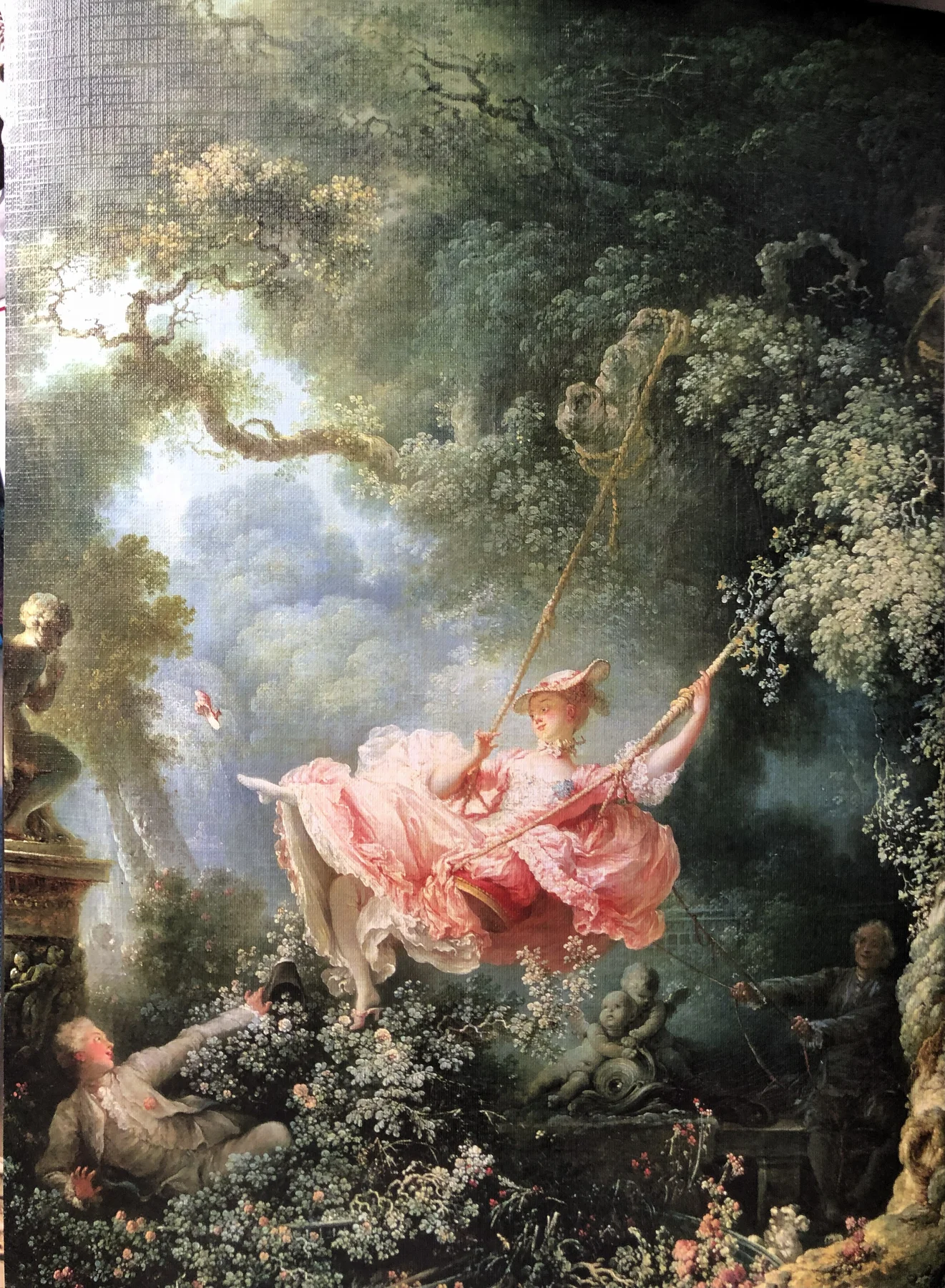
THE SWING
Jean-Honoré Fragonard
- Artist
- Jean-Honoré Fragonard (1732–1806)
- Date
- 1767
- Dimensions
- 81 x 64 cm
- Medium
- Oil on canvas
- Location
- The Wallace Collection, London, England
Jean-Honoré Fragonard was an artist of lyrical temperament whose famously elegant and ornate Rococo paintings faithfully reflected the immoderately frivolous and idle life of the mid-18th century under the French king Louis XV. Fragonard’s most famous work, The Swing, also known as The Happy Accidents of the Swing, created in 1767 under curious circumstances, is a sensual depiction of carefree love and passion.
The Courtier and His Mistress
In 1767 an unnamed “gentleman of the court” offered a commission to the French painter Gabriel-François Doyen. This patron, still unknown today, followed the established tradition of commissioning genre pictures on subjects of his own choosing. What was unusual, however, was the subject of the painting. He asked the artist to depict his beloved “seated on a swing set in motion by a bishop. Place me so that I can see the legs of the lovely lady, and even more if you wish to make your picture more exciting…”
The surprised Doyen refused the commission, but suggested to the patron that in the scene to be painted the woman should kick off one of her shoes, to be caught by playful cupids. The artist passed the commission for The Swing on to Jean-Honoré Fragonard, then regarded as the master of romantic and subtly erotic pictures. Fragonard painted the picture in his own inimitable style, leaving out the figures of the bishop and the cupids but keeping the motif of the flying slipper.
From Private Hands to a Public Collection
Although The Swing was painted as a private commission, Fragonard produced several versions of it, and the image was an immediate success. The original painting later passed into the possession of the Duc de Morny, and in 1865 it was bought by the 4th Marquess of Hertford, Richard Seymour-Conway, who lived in Paris. The picture later became one of the highlights of the magnificent Wallace Collection, where it can still be seen today.
A Light Style
From 1748 to 1752 Fragonard was a pupil of the 18th-century French painter François Boucher (1703–1770), known for decorative works painted in the playfully sensual style characteristic of the Rococo. Fragonard’s own paintings continued the Rococo tradition, but his delicate brushwork surpassed even that of his master. Everything in his painting floats in the air: from the confidently and loosely painted billowing pink dress, through the lushly swirling foliage, to the smoky, rolling quilt of distant blue clouds. Fragonard depicts this outdoor courtship ritual with captivating lightness.
Youth and Innocence
In Fragonard’s composition we see a young man in love positioned beneath his sweetheart’s swing where he can see her legs and garters, while remaining hidden from the young lady’s older admirer, who pushes the swing from the shade of the trees. The centre of the picture is occupied by the sunlit figure of the coquettish woman, her light silk dress blooming like a giant pink rose in the lushly overgrown garden.
Dynamic Movement
Fragonard conveys movement superbly in the swinging young woman, whose momentum is emphasised by her left shoe flying off as she reaches the highest point of her arc. While the tiny slipper flying towards her lover symbolises lost virginity, the cherub statue on the left of the picture raises a finger to its lips as a sign of secrecy. The woman sweeps dynamically across the picture on a diagonal, her figure balanced in the composition by the two male figures, one reclining on the ground before her to the left, the other standing behind her to the right. Although we do not know why, it is worth noting that Fragonard painted the young man in a strikingly similar pose to Michelangelo’s Adam in the fresco The Creation of Adam in the Sistine Chapel.
- Exhibition room of the Wallace Collection
- A version of The Swing made around 1765
- François Boucher
- Fragonard: The Swing, 1750