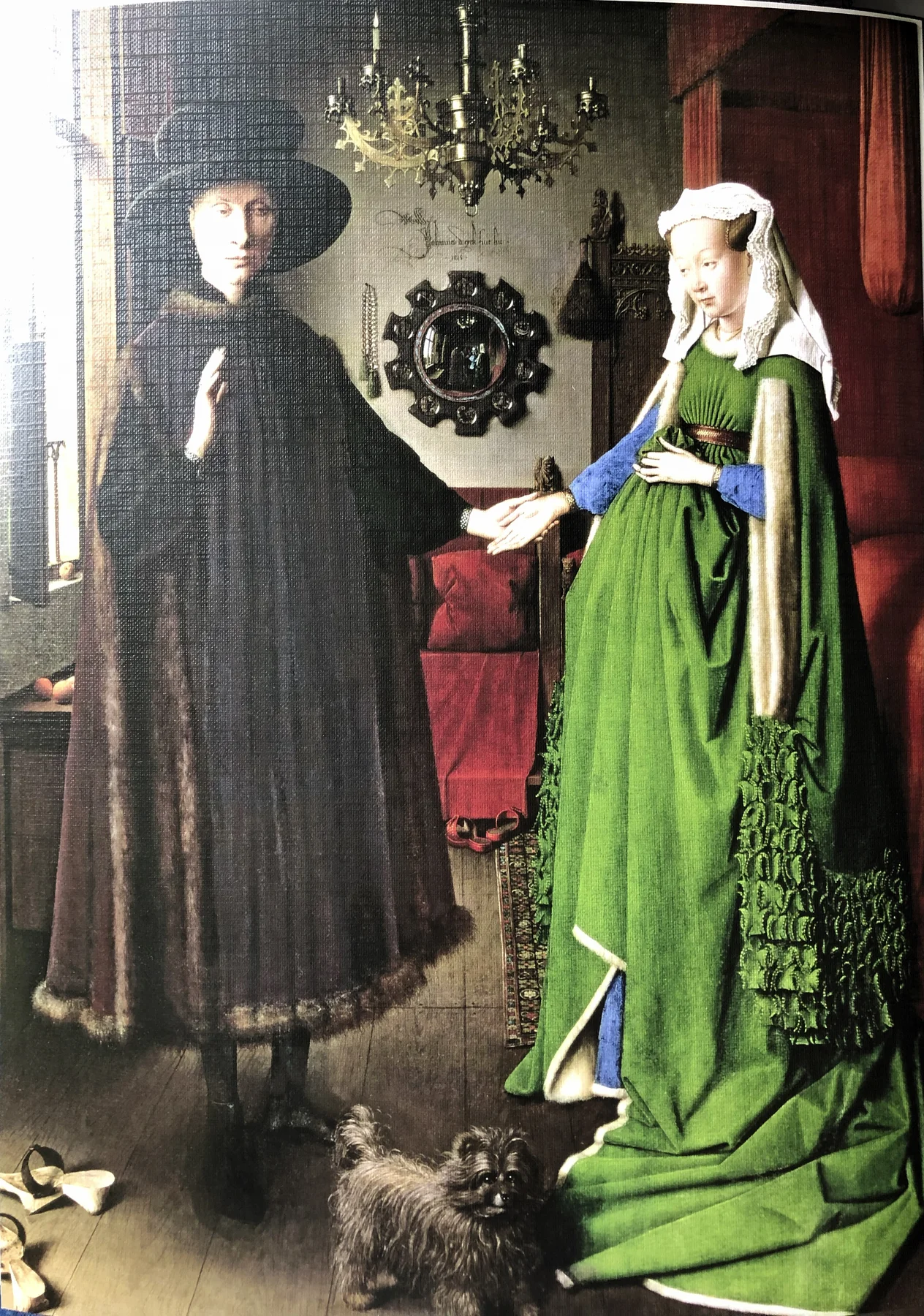
THE ARNOLFINI PORTRAIT
Jan van Eyck
- Artist
- Jan van Eyck (c. 1395–1441)
- Date
- 1434
- Dimensions
- 82 x 59.5 cm
- Medium
- Oil on panel
- Location
- National Gallery, London
The Arnolfini Portrait by the 15th-century Flemish master Jan van Eyck is one of the most interesting and enigmatic works of art of all time, shrouded in obscurity in almost every respect. Who are the people in the picture, and why are they standing there? Does it depict a wedding scene, does it commemorate a marriage, or does it perhaps evoke death? The painting caused a great stir even in its own time, though for other reasons. Painted with unprecedented realism and richness of detail, and showing a contemporary couple in a period domestic setting, it is in its way the first “modern” portrait.
A Methodical Painter
Van Eyck used oil paint so masterfully that he is often credited with inventing it. Oil paint — a mixture of powdered pigment and linseed oil — had in fact been used sporadically since the 10th century, but among artists it was Van Eyck who best exploited its potential. Before oil became widespread, painters used egg-based paint, tempera, which, although extremely durable, dried very quickly. This did not suit Van Eyck’s careful working method; he was among the first to switch to oil paint and enjoy its advantages. Using the slower-drying paint, he could shape his pictures at will, building up layers of translucent, glossy glazes, and thus depict details with unprecedented realism. For this reason The Arnolfini Portrait must have made a stunning impression in its time; viewers may almost have been tempted to reach out and touch the rough skin of the oranges, the gleaming brass arms of the chandelier and the soft fabric of the couple’s clothes. Centuries before photography, Van Eyck created a startlingly lifelike realism that captivated the public almost immediately.
Curious Mysteries
The Arnolfini Portrait is an intimate portrait of a couple performing some kind of ceremony in their home. Despite the summer season, indicated by the cherries on the trees in the courtyard, they are thoroughly dressed in their most expensive and splendid clothes, lending special emphasis to their appearance. Who they are remains one of the greatest unsolved mysteries. Until quite recently it was thought that the picture depicted the Italian merchant Giovanni Arnolfini and his wife, Giovanna Cenami. Arnolfini was a cloth merchant who, like Van Eyck, lived and worked in Bruges and was in the service of the Duke of Burgundy. Records from around 1516 first identified him as one of the figures in Van Eyck’s painting, and he was credited with commissioning the picture to commemorate his marriage. It was also assumed that the painting was actually a record of the official ceremony itself, in which Van Eyck played the role of notary and witness — the painter is one of the two figures reflected in the mirror, and his signature below the mirror proclaims: “Jan van Eyck was here.”
Other Theories
There was thus no shortage of speculation, but these theories were called into question by the discovery of documents showing that Arnolfini and Cenami did not marry until 1447, more than a decade after the picture was painted. Since the documents came to light, the couple has been thought to be either Arnolfini and an earlier spouse, or Van Eyck himself and his wife. It is also possible, however, that the man in the picture is Arnolfini’s cousin, Giovanni di Nicolao Arnolfini.
Powerful Symbolism
Understanding the symbolism of the work has become an obsession for those trying to solve the mystery of The Arnolfini Portrait. The variety of objects in the painting, however, has led to confused and often misleading interpretations. The little lapdog in the foreground, for example, can be seen as a symbol of the couple’s fidelity to each other, but also as a display of their wealth and ostentation. Similarly, the fruit placed on the windowsill and the carved figure of St Margaret on the bed may allude to fertility.
Talent on Display
In reality, however, it is hard to believe that the painter was particularly concerned with hidden meanings. Recent X-ray examinations have shown that many of these pictorial motifs, including the dog, did not appear in the underdrawing of the original composition and were added to the painting only later. It is much more likely that Van Eyck wanted to demonstrate his masterly use of oil paint. From the carved furniture and fur-trimmed robe to the subtle light playing on the figures’ skin and the precisely rendered distorted reflection, he wanted to dazzle the viewer with every detail of the painting. Nevertheless, it is above all its enigmatic quality that inspires debate, and it owes its enduring appeal largely to this irresistible mystery.
- Philip Galle (1537–1612): The Discovery of Oil Paint, plate 15 of “Nova Reperta” (New Discoveries), c. 1600 (engraving, later colouring)
- Statue of Jan van Eyck in Bruges
- The Duke of Burgundy