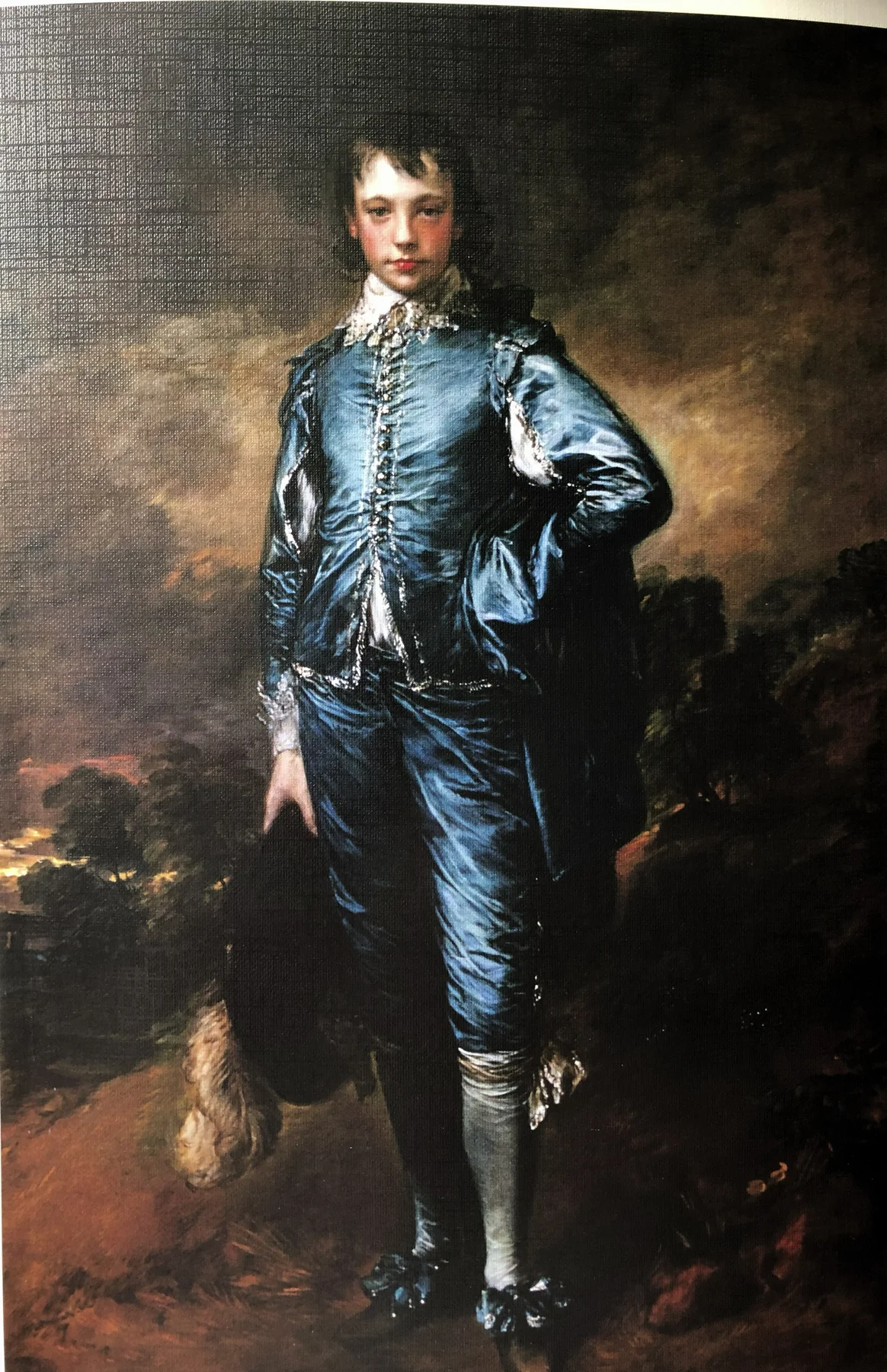
THE BLUE BOY
Thomas Gainsborough
- Artist
- Thomas Gainsborough (1727–1788)
- Date
- c. 1770
- Dimensions
- 180 x 120 cm
- Medium
- Oil on canvas
- Location
- The Huntington, San Marino, California, USA
Gainsborough’s The Blue Boy has been made famous around the world by countless reproductions, prints and products, yet it still exudes an air of mystery. The son of a London ironmonger achieved enormous fame, causing a national outcry in England when the picture was sold for an incredible sum to an American private collector.
The Key to the Mystery
The sitter was Jonathan Buttall (born 1752), son of a wealthy London merchant of Greek Street in Soho. Gainsborough befriended the quiet, cultured young man, with whom he shared a love of music and literature. The fact that he painted the boy’s portrait over an earlier work (as X-ray examinations show) suggests that he did not paint it on commission, which would have required a new canvas, but probably intended it as a gift to a friend and also regarded it as a personal artistic challenge.
In the Style of Van Dyck
The costume did not belong to Buttall but came from the props of the artist’s studio, since it also appears in other works of his. It is a “Cavalier”-style outfit worn at various soirées, masked balls and court events such as tournaments. Such costumes had originally been popularised on canvas by Anthony van Dyck, court painter to Charles I, and came back into fashion in Gainsborough’s time.
The Blue Boy superbly demonstrates Gainsborough’s skill in depicting satin and silk. Although he used a great many shades of blue in the picture, from turquoise and sky blue to cobalt and indigo, the overall effect is a unified and harmonious blue tone.
Clever Methods
Gainsborough’s boldest move was to place his figure, painted in cool colours, against a warm-coloured background. This runs counter to the classical view that warm shades bring a form closer and cool ones push it away. The landscape is a symphony of warm browns and olive greens that in unpractised hands would overwhelm the cool blues. How did the artist overcome this problem?
First, with a shallow depth of field. He places the part of Buttall’s figure nearest to us in good light and shows it more sharply, while depicting the more distant parts more blurred. He also uses chromatic aberration, the optical phenomenon that occurs when a lens refracts light rays of different wavelengths differently. Our eyes cannot focus on the red and green areas of the spectrum at the same time, and Gainsborough exploits this distorting effect to make the blue masses stand out from the warm-toned background.
Against Reynolds’s Rules?
Gainsborough never signed his works and only rarely dated them, so the dates of his works are hard to pin down. At one time it was claimed that he painted The Blue Boy in response to a remark by the President of the Royal Academy, Sir Joshua Reynolds — Gainsborough’s chief rival. In one of his lectures in 1778 Reynolds reiterated the above doctrine that the masses of light in a painting should always be rendered in warm, delicate colour, and cool colours should be used only sparingly, and then only to set off the warm tones. We now know that Gainsborough painted the picture around 1770, eight years before Reynolds’s lecture.
A Popular Boy
Buttall kept The Blue Boy until 1796, when financial ruin forced him to sell the work. The painting passed through the hands of several owners, and in 1809 Robert Grosvenor, 1st Marquess of Westminster, bought it for 100 pounds, and for more than a century the picture enriched his descendants’ art collection.
The Blue Boy became legendary. It appeared on tea trays and tins, countless prints of it were sold, and it even inspired a film. Forgeries were openly put up for auction; one such copy sold for more than 32,000 dollars in 1918, but the Duke of Westminster refused every offer for the original… until Joseph Duveen came on the scene.
Duveen was the shrewdest art dealer of his time, with a keen eye for buying up English masterpieces and selling them on to wealthy American collectors. In 1921 he offered Westminster 200,000 pounds for three paintings: The Blue Boy, Reynolds’s Mrs Siddons as the Tragic Muse (1784) and another Gainsborough picture, The Cottage Door (1780). The duke finally gave in, and Duveen passed the three pictures on to his client, the railway magnate Henry Edward Huntington of San Marino, California.
British Blues
There was a huge outcry in Britain when it became known that the beloved painting was leaving for America. Huntington generously agreed to let the work be exhibited at the National Gallery in London for three weeks in January 1922. More than 90,000 people came to see the picture, and Cole Porter even wrote a song for the occasion called “Blue Boy Blues”.
The director of the National Gallery, Charles Holmes, wrote on the back of the canvas: “Au revoir, C.H.” The canvas was carefully prepared for the voyage: it was placed in a solid wooden case, then in a steel tank, and finally in a waterproof box secured with metal bands. After arriving in New York the painting was placed in a luxury compartment of a train bound for California. The Blue Boy can now be seen as part of the Huntington collection, in the company of Reynolds’s Mrs Siddons.
- Anthony van Dyck
- Joseph Duveen
- Robert Grosvenor
- Reynolds: Mrs Siddons as the Tragic Muse
- Henry Huntington
- The Huntington, San Marino, California