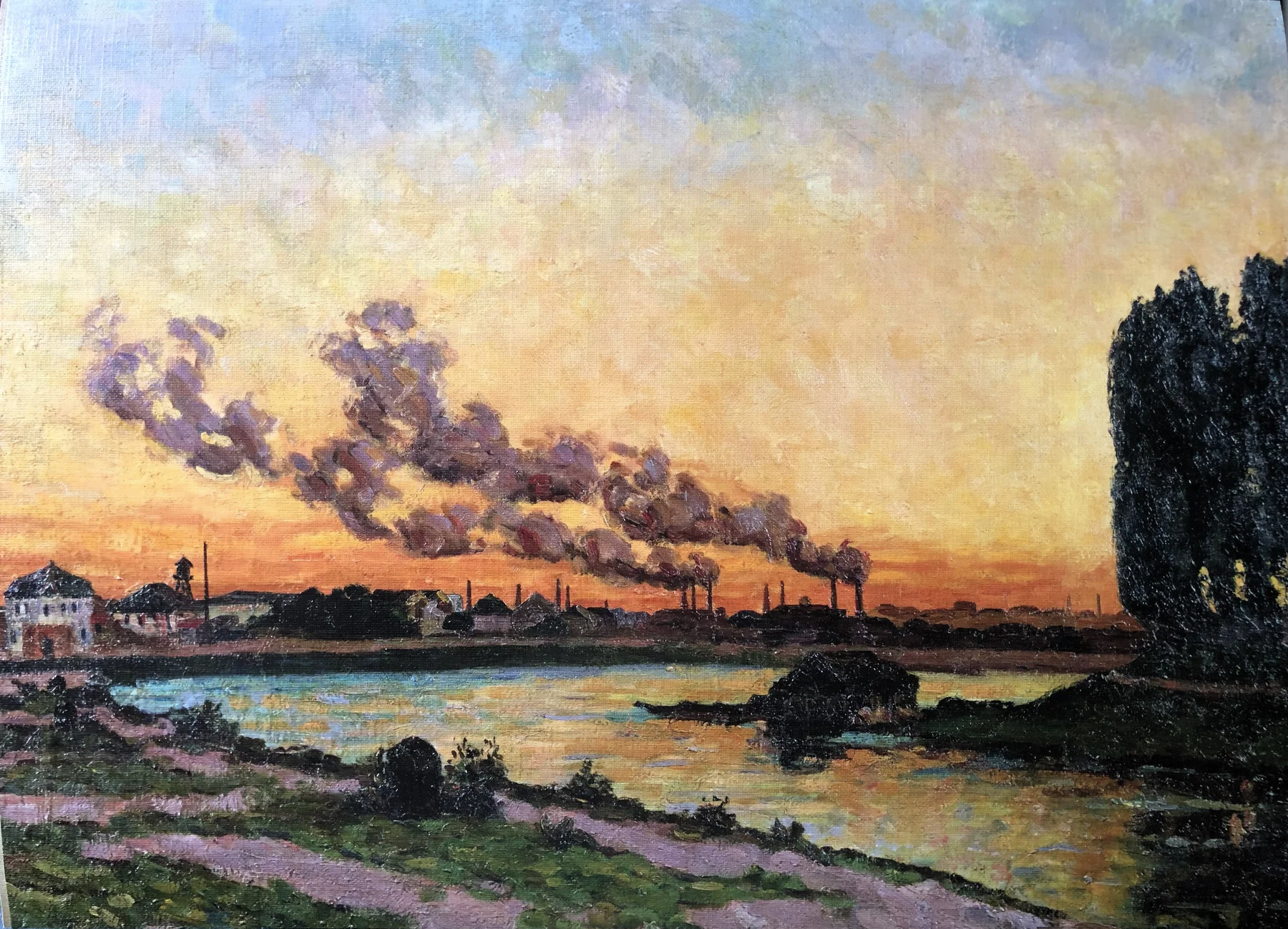
SUNSET AT IVRY
Armand Guillaumin
- Artist
- Armand Guillaumin (1841–1927)
- Date
- 1873
- Dimensions
- 65 x 81 cm
- Medium
- Oil on canvas
- Location
- Musée d’Orsay, Paris, France
Although his fame has long since been eclipsed by that of his former friends Cézanne, Pissarro, Seurat and Signac, Armand Guillaumin was a respected member of the Impressionist movement. He even inspired Vincent van Gogh, who admired his saturated colours and thick brushstrokes. He was among the first to recognise the beauty of the new industrial landscapes along the Seine, in Paris and around it. In this picture, showing the factories of Ivry at a blazing sunset, nature coexists comfortably with industry.
Ivry in the Evening
At the end of the 19th century Paris began to grow rapidly. The Ivry works, covering some 3.4 hectares along the Seine in one of the city’s outer districts, produced rails and rolling stock from scrap iron for the ever faster-growing suburban railway network. These establishments were created by the rapid industrialisation of the Seine region in the second half of the 19th century, which — thanks to newcomers settling in the hope of work — was accompanied by a sharp rise in population. (In 1851, the year the rubber factory was founded, the Seine region had about 1.4 million inhabitants; fifty years later it had 3.7 million.)
Air pollution reached alarming proportions. The rubber factory was fed by a huge steam boiler powered by endless mountains of coal piled up on the riverbank. Barges brought coal every day, and the finished products left on the Paris–Orléans railway line. Several works in Ivry and Charenton produced textile dyes, but the by-products of many other materials also ended up in the river or the air. An 1886 guidebook writes of Ivry: “Its factories produce pigments and varnishes, fertiliser, oil, grease, glue, gelatine, albumin, candles, wax paper, various chemicals and industrial equipment; there is also a coal yard and a glassworks. Some of these give off a suffocating smell…”
Nature versus Industry
In Sunset at Ivry the spreading smoke and nature interact in an exciting way. In the foreground, on the right bank of the river, the grassy stretch of shore and the row of poplars form a peaceful contrast with the buildings; neither dominates the other. Guillaumin evidently finds the same decorative effect in the drifting clouds of smoke as in the silhouettes of the trees.
Artistic Connection
Industrial scenes were surprisingly popular among the Impressionists. In 1873 Pissarro made a series of oils and watercolours of the riverside factory near his home in Pontoise (some of them, no doubt, during Guillaumin’s visits). With its neat red roof tiles and the large grassy area in front of it, the picturesque buildings of Factory near Pontoise blend harmoniously into nature; the chimneys mirror the nearby poplars, and even the smoke melts obediently into the woolly clouds. Much darker in mood is Monet’s The Coal-Heavers (1875, pictured), showing the grimy but dignified workers loading coal onto barges, with the road bridge at Asnières and smoke-belching chimneys outlined against the distant sky in the background.
A View of the Modern World
What was Guillaumin’s intention with Sunset at Ivry? Was he raising his voice against air pollution, proclaiming the greatness of industry, making a study of radiant light, or simply recording the world around him with an outsider’s eye? Probably there is a little truth in each. In the winter of 1873 he painted at least three scenes of the Ivry factories, and in later years he returned to the site for further pictures. Taken together, these paintings show that the artist liked dawn and dusk landscapes, when the dim light and the sunlight filtered through smog created vivid colour effects.
The artist also enjoyed recording the industrial life of the river. The river was only a few steps from his home on the Quai d’Anjou on the Île Saint-Louis, where he painted again and again the bridges under construction, the barges, cranes, dredgers and docks.
- The ironworks of Ivry, illustration from Julien Turgan’s “Les Grandes Usines”
- Guillaumin: The Confluence of the Seine and the Marne at Ivry
- Guillaumin: Bridge at Ivry