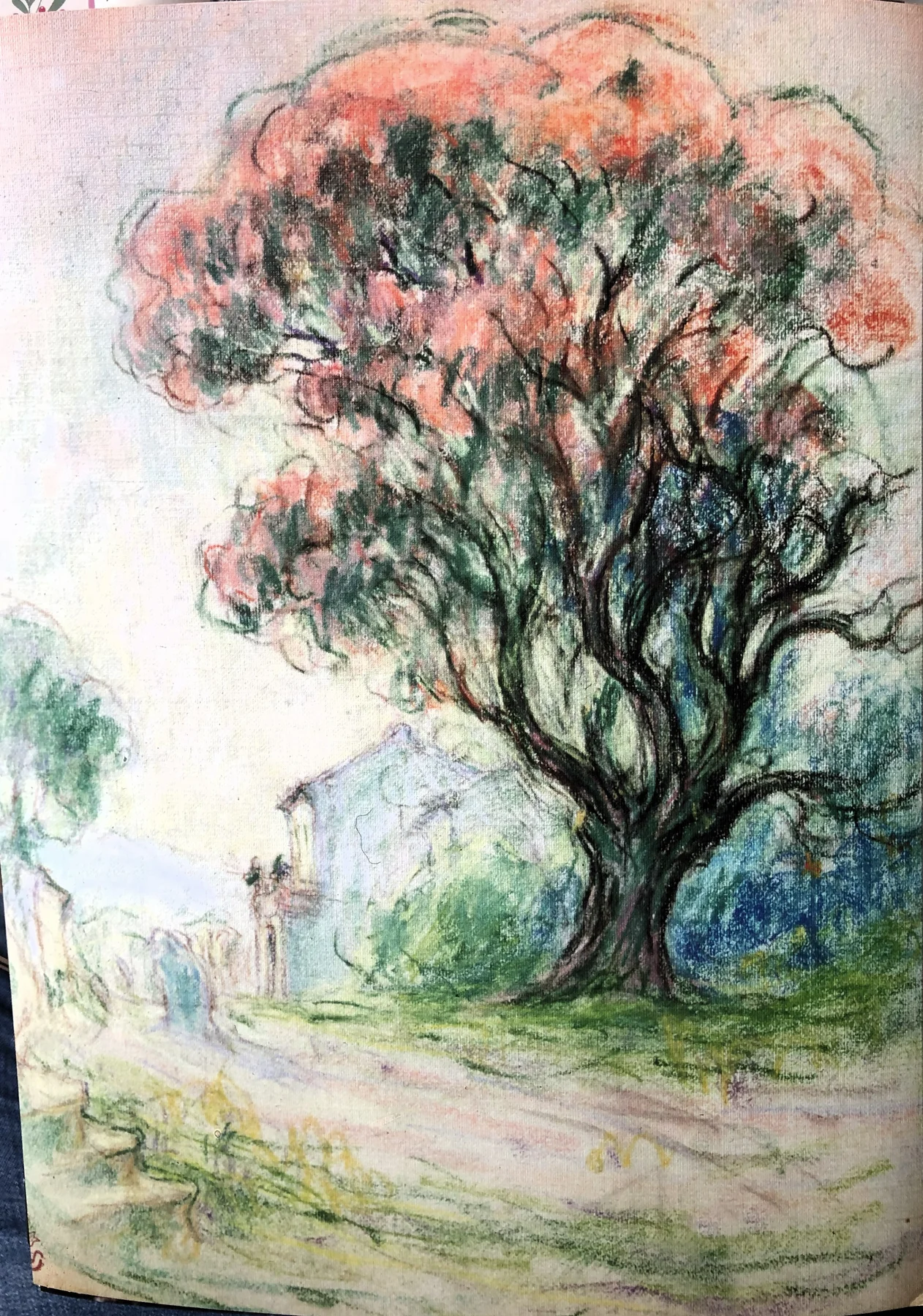
PINK TREE
Claude-Emile Schuffenecker
- Artist
- Claude-Emile Schuffenecker (1851–1934)
- Date
- Between 1894 and 1895
- Dimensions
- Unknown
- Medium
- Pastel on paper
- Location
- Private collection
The painter, teacher and collector Emile Schuffenecker is remembered today above all as the man who launched Paul Gauguin’s artistic career. He created charming works, although Gauguin’s paintings outshone his own. Pink Tree, sketched in a shady suburb of Paris, is clear evidence of the way he fused the methods of the Impressionist, Post-Impressionist and Symbolist styles, with a touch of spiritualism mixed in.
An Independent Artist
At heart Schuffenecker was a follower of the Impressionists; as an art student he made friends with Camille Pissarro and Armand Guillaumin, among others. Like Pissarro, after a while he too turned towards Post-Impressionism. After the Salon rejected his works in 1882–83, he joined the Society of Independent Artists, founded in 1884 by Albert Dubois-Pillet, Georges Seurat, Paul Signac and Odilon Redon. Over the following years Schuffenecker’s style was shaped by the new theories of light of Seurat and Signac. He was also deeply impressed by the dreamlike paintings of his close friend Odilon Redon, who liked to say that his pictures lifted the viewer into the “mysterious realm of uncertainty”.
A Spiritual Bent
Like many artists of his time, Schuffenecker was captivated by the mysticism and occultism that swept anew across Europe at the end of the 19th century. In March 1893 he joined the Theosophical Society, founded in 1875 to study spiritualism and comparative religion. From then on his works took on Symbolist overtones, to which his excellent draughtsmanship, delicate dotted brushwork and bright colours lent an ethereal mood.
The Pink Tree of the title casts its shadow on the road to Meudon; the painter often visited this pleasant little town near Paris to sketch landscapes and see relatives. The densely grown crooked branches and the faintly outlined crown give the picture a constant vibration, further heightened by the vivid contrast of salmon pink and ultramarine. The radiance of the sky suggests that the pink hue is produced by the morning sunlight as it sweeps across the tree’s crown.
While Pink Tree — in the words of a contemporary French poet — resembles a quick sketch by a “decorative Impressionist”, Schuffenecker’s other works bear witness to his leaning towards the “mysterious realm” of Symbolism. In his landscapes he often included a ghostly female figure (here the blue figure), and the path she walks can be understood as a symbol of the way to nirvana or Paradise.
Artistic Connection
Schuffenecker and Gauguin worked at the stockbroking firm of Bertin in the early 1870s and became good friends. On their days off Schuffenecker, initially the better painter, gave Gauguin drawing lessons, taught him how to mix paints and introduced him to Pissarro. The roles were soon reversed, however, and Gauguin’s lightning progress filled Schuffenecker with amazement. After the stock-market crash of 1882 both left Bertin, after which Gauguin became a full-time painter and Schuffenecker accepted a teaching post, but their close friendship continued, and their regular correspondence tells us a lot about Gauguin’s life. When Gauguin fled Van Gogh’s house after a violent quarrel in which Van Gogh lost part of his ear, he found a home for three months with “good old Schuff”, even though Schuffenecker received only belittlement and disparagement from him (Gauguin had a low opinion of Schuffenecker’s work). Gauguin probably had an affair with Louise Schuffenecker, or at least tried to seduce her, but she rejected him. This may explain the not exactly flattering arrangement of his painting The Schuffenecker Family (1889, pictured): the composition is dominated by the grim-looking Louise, pushing her modestly retiring husband into the background.
- Paul Signac
- Jiddu Krishnamurti (left), spiritual leader, and Madame Helena Blavatsky (right), founder of the Theosophical Society
- Paul Gauguin