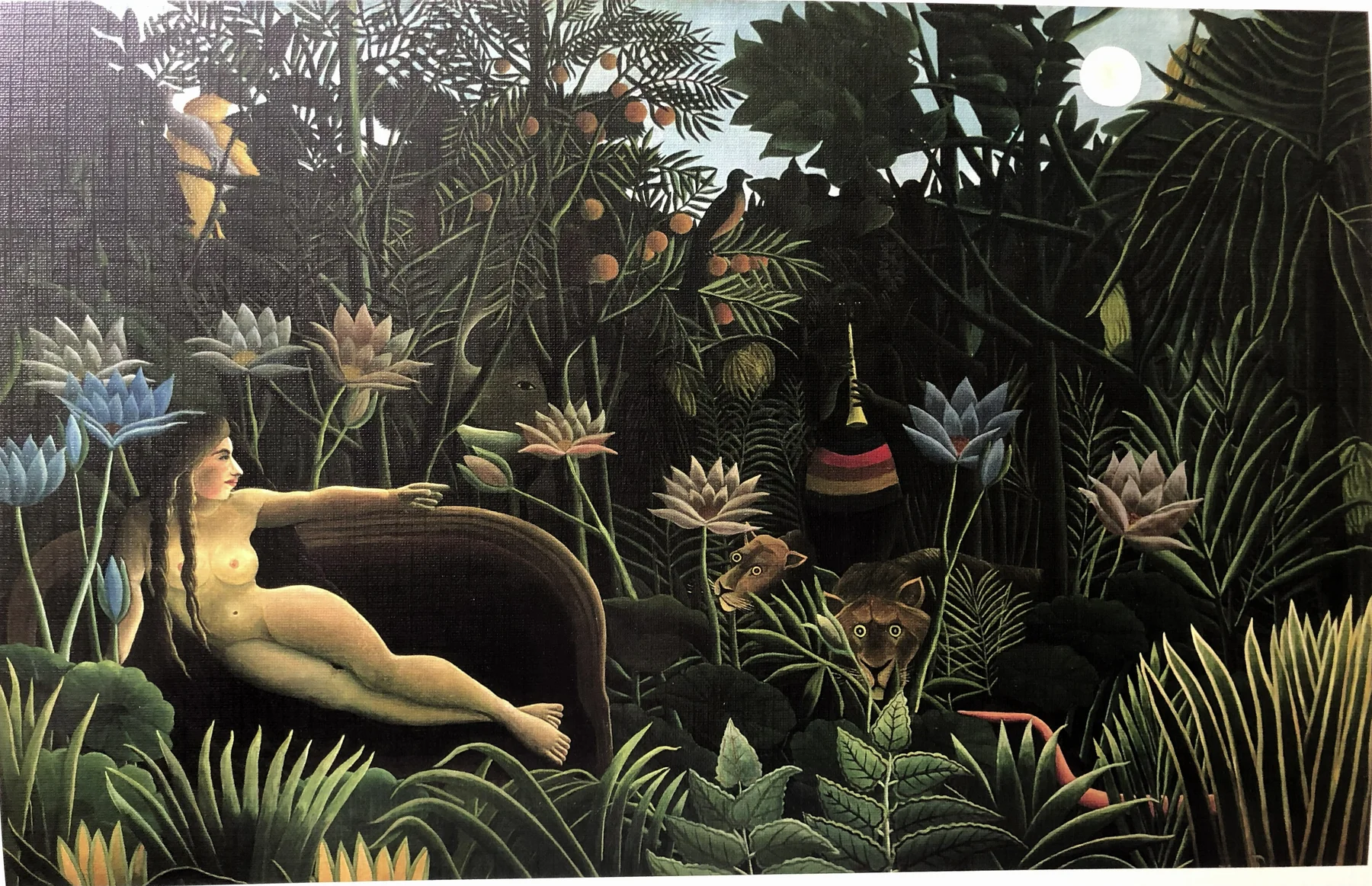
THE DREAM
Henri Rousseau
- Artist
- Henri Rousseau (1844–1910)
- Date
- 1910
- Dimensions
- 204.5 x 298.5 cm
- Medium
- Oil on canvas
- Location
- Museum of Modern Art, New York, USA
For most of his career as a painter, Henri Rousseau, who started late and was entirely self-taught, produced oddly proportioned portraits and unremarkable suburban landscapes that only drew mockery from the critics. In the last five years of his life, however, he wiped the smiles off their faces when he began to pour out the works that are still highly prized today: imaginative, wonderful tropical jungle scenes copied from popular picture books of the time or inspired by his visits to the city zoo. His last and second-largest painting, The Dream, is perhaps also his most mysterious work, drawing us too into this moonlit dream world.
The World of the Wild
Rousseau once claimed that he had been deeply influenced by the tropical jungle during military service in Mexico. In reality his muse was to be found in Paris.
At the time of the 1889 World’s Fair, a show on the life of the colonies in America, Africa and South-East Asia was held in the capital. The reconstructed villages offered all kinds of attractions: tropical plants, wild animals and natives, including dancers and snake charmers, who were treated hardly better than the host of “savages” recruited to frighten the French public with a taste of the world of dangerous lands. It can be no coincidence, then, that the first of Rousseau’s jungle pictures, Tiger in a Tropical Storm (Surprised!), was painted shortly after the exhibition, in 1891.
A Copyist
Rousseau copied persistently: he used sources such as the book Les Bêtes Sauvages (Wild Animals), famous for its animal illustrations, or the illustrated reports of bloody animal attacks in the daily Le Petit Journal. He often visited the zoo, where lionesses paced up and down in their dirty cages; he also went to the botanical garden, whose hothouses displayed exotic plants and whose glass cases showed stuffed animals to the public. A further source for his art were the so-called Orientalist paintings that came to life under the brushes of Western painters such as Jean-Léon Gérôme or Eugène Delacroix.
Using these various sources effectively produced collages, and Rousseau combined plant and animal species with such light-hearted carelessness (or negligence) that it often led to improbable depictions. Take, for example, his Tropical Landscape: An American Indian Struggling with a Gorilla (1910), whose very title carries an obvious contradiction. Even botanists could hardly identify his garishly coloured plants.
His painting style was also much mocked. Today we would call him a “naïve” artist, but at the time the label did not yet exist, and the critics showed no mercy: “Henri Rousseau creates monstrosities at which people can only smile,” declared one of them.
The Music of Enchantment
The jungle of The Dream is typically Rousseau: the exotic plants line up as on a stage, there is no perspective, and the shadows are not realistic either. The shapes of the leaves and flowers, the stylised motifs and other decorative elements, however, unfold before us in rich variety and rhythm. Rousseau populates the scene with figures familiar from his earlier paintings: monkeys, lions, fantastic birds, snakes — and a snake charmer. With the nude reclining on a velvet sofa he also smuggles a dissonant note into the composition: the female figure is an obvious reference to Manet’s famous Olympia (1863). Rousseau accompanied The Dream at the Salon des Indépendants with a poem as an explanatory text:
Yadwigha, peacefully asleep,
in her dream hears the gentle sound of a pipe, played by a kindly charmer, while the moon looks down on the flowers and the green trees, and the snakes listen, enchanted, to the merry tune.
Our eye is held by the pale, sharply outlined figure of Yadwigha. Yadwigha was a former girlfriend of Rousseau, whom he probably still loved, and the painter perhaps imagined himself in the role of the snake charmer, who bewitches his beloved as the magician does the animals. His gaze directed at us suggests that he will soon have us in his power too.
It is not surprising that The Dream received a mixed reception. The Italian painter and critic Ardengo Soffici criticised the “horrible flowers”, but was impressed by the fifty shades of green in the foliage. Rousseau’s loyal friend Guillaume Apollinaire expressed sincere praise: “This painting radiates beauty… I believe that this time no one will dare to laugh… ask the painters.”
Artistic Connection
One of Rousseau’s most devoted admirers was the writer and painter Robert Delaunay, who met the artist in 1906 and the following year persuaded his mother, Berthe, to commission a picture from him entitled The Snake Charmer. In 1911, after Rousseau’s death, Delaunay organised a retrospective exhibition of his works in Paris. He later described Rousseau as “the godfather of the artistic revolution taking place in modern painting”.
- Wolves attack a wedding procession in Hungary, 1894, from Le Petit Journal’s series on animal attacks
- Rousseau