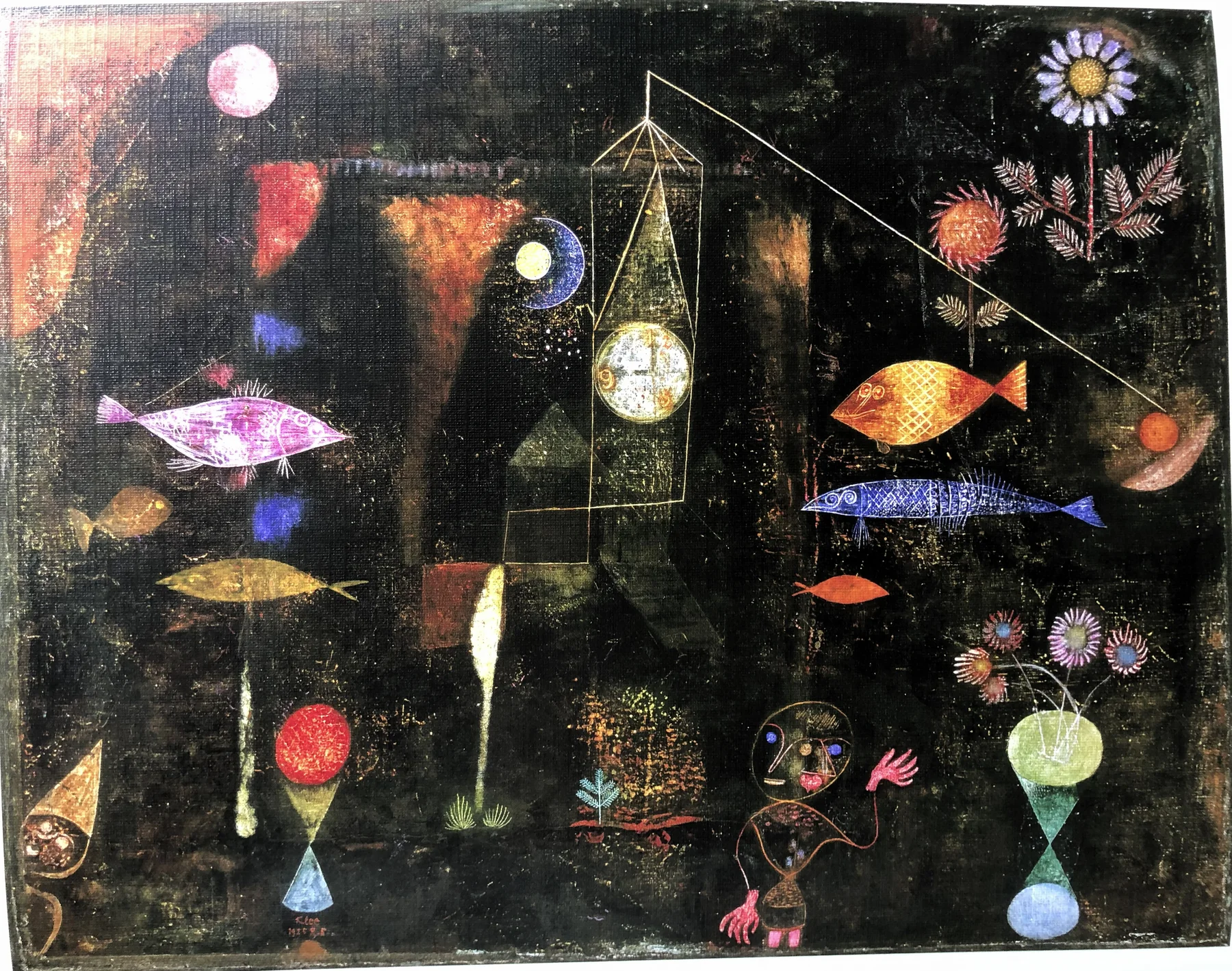
FISH MAGIC
Paul Klee
- Artist
- Paul Klee (1879–1940)
- Date
- 1925
- Dimensions
- 77 x 98.4 cm
- Medium
- Oil and watercolour on panel, muslin and canvas
- Location
- Philadelphia Museum of Art, USA
The Swiss-born painter Paul Klee was, in the words of Jean-Paul Sartre, “an angel who re-created the wonders of the world.” This statement is a fitting tribute to the artist and musician whose deceptively simple-looking works conceal a kind of complexity that resists superficial interpretation. Thanks to his refined use of forms, lines and colours, his paintings can only be enjoyed on an aesthetic and emotional level.
From Line to Colour
Klee had an innate gift for the skilful rendering of lines and forms, but in the early phase of his career he was still far from his main goal, the masterly handling of colour — something he had not been taught as an art student.
The breakthrough came with a trip to Tunisia in 1914. He visited the North African country with two friends, August Macke and Louis Moilliet, and the vivid colours and special light made such an impression on him that he triumphantly declared in a diary entry: “Colour has taken possession of me. I no longer have to pursue it; it has me for ever… colour and I are one. I am a painter.”
After this Klee explored the effect of colour on line. His paintings were often characterised by an irregular grid of brilliant colours. His musical inclination led him to see colours as musical elements and to juxtapose dissonant and harmonious shades as if he were composing.
Fish out of Water
Simple fish motifs, often resembling children’s drawings, appeared in more than a dozen of Klee’s works from the mid-1920s, such as Fish in a Circle and Around the Fish (both 1926), and The Goldfish (1925). They may have been inspired by the artist’s visit to a marine aquarium in Naples in 1902 or by his favourite weekend fishing trips in summer, but they evidently had a deeper significance for him.
In this painting he depicts the fish together with various surrealistic pictorial elements that seem to have surfaced from his subconscious. The curtain at the top left suggests a stage; Klee played puppet theatre for years with his son Felix, and the curtain motif appears in several other works, including Villa R (1919). The work also includes a clown, a few planets, an hourglass or egg cup, a sapling, a two-faced figure, a few daisies and a church tower attached to a pulley.
The composition is dominated by a rectangular piece of muslin glued onto the canvas. Klee may have wanted to cover a damaged area with it, and although the fish swim freely across it, he deliberately emphasised its edges rather than trying to blend it into the picture. It could be a mirror-like device that splits the figures of the hourglass/egg cup and the Janus-faced figure in two. It might be a kind of projection screen which, when raised by the pulley, reveals the painting’s dark secret, but the attachment of the string to the church tower allows other interpretations too.
Swiss Clock
The central placement of the church tower draws our eye to the clock face. Although all the numbers are on it, four digits are highlighted in gold: 1, 2, 9, 5. Rearranged, they give the year the painting was completed. The repeated circular motifs link the clock with the planets floating above it. Was Klee reflecting on the nature of time, which is strictly finite for the human world but infinite in the cosmos? Is the pulley in fact a balancing mechanism between the church tower and the small golden planet? This explanation is at any rate consistent with his 1927 painting Heavenly and Earthly Time, which repeats the motif of the church tower and planet held by strings, and clearly expresses its message in its title. Klee’s well-known aversion to over-explanation ultimately gives us a free hand: Fish Magic is whatever we think it is.
Artistic Connection
One of Klee’s lifelong friends was the Russian-born pioneer of abstract painting, Wassily Kandinsky (pictured). They were colleagues in Munich and at the Bauhaus, and — together with Lyonel Feininger and Alexej Jawlensky — members of the artists’ group Die Blaue Vier (The Blue Four), who not only exchanged works with one another but in 1924 also set off together on a lecture and promotional tour of the United States. After the Bauhaus closed in 1933, Kandinsky moved to France. Klee wrote of him: “I felt deep trust in him. He is no ordinary artist, but an exceptionally wonderful and brilliant mind.”
- Jean-Paul Sartre
- Tunisia today
- The hall of the Philadelphia Museum of Art, the painting’s present home