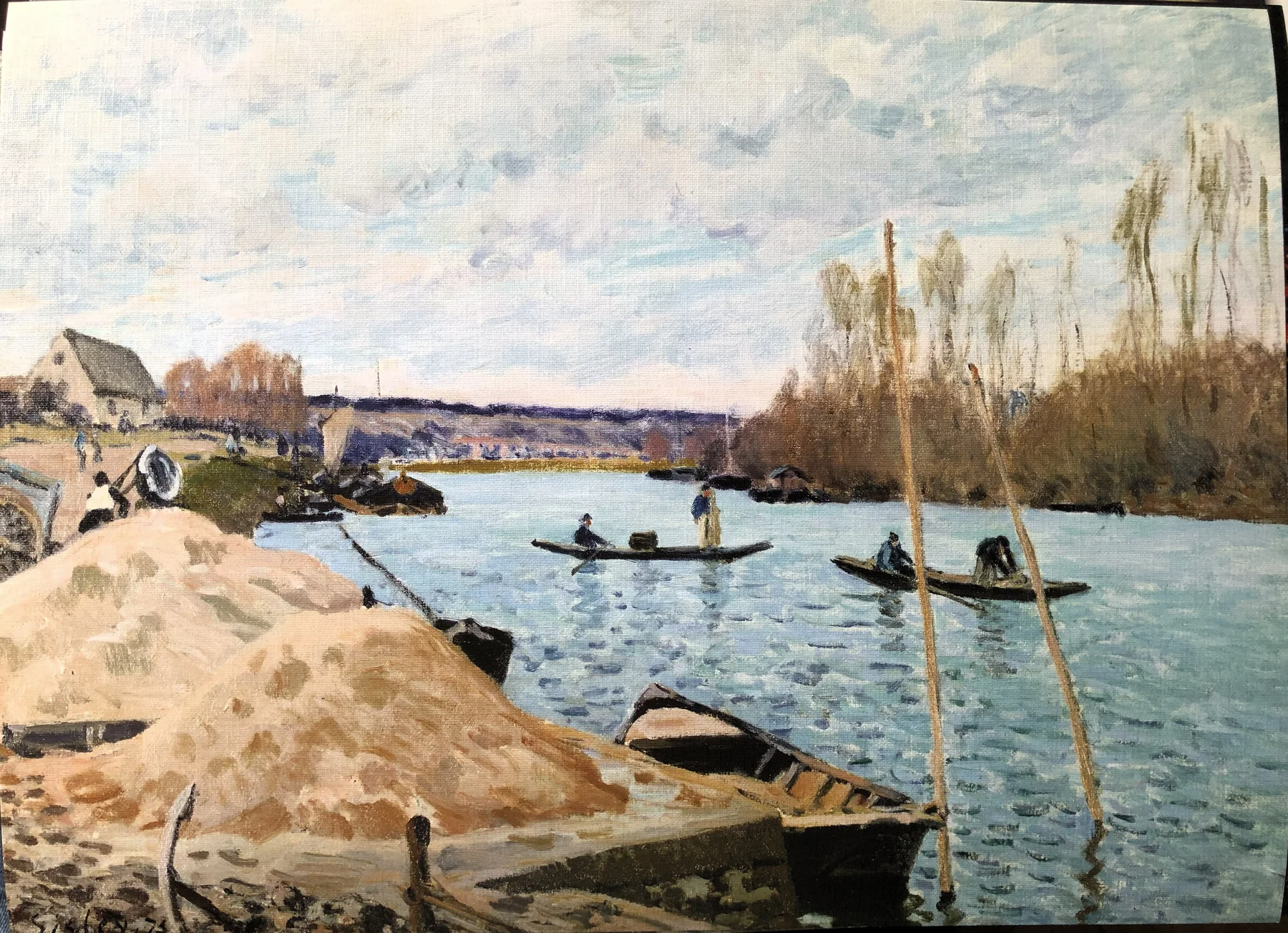
SAND HEAPS
Alfred Sisley
- Artist
- Alfred Sisley (1839–1899)
- Date
- 1875
- Dimensions
- 54.5 x 73.7 cm
- Medium
- Oil on canvas
- Location
- Art Institute of Chicago, Chicago, Illinois, USA
During his lifetime Alfred Sisley was the least known of the five founding members of the Impressionist movement; he was overshadowed especially by his two more energetic friends, Monet and Renoir. Since his death in 1899, however, his works have emerged from the shadow of his fellow artists and won new recognition. His riverside landscapes, such as Sand Heaps, are now among his most popular paintings.
Restrained Splendour
Sisley’s interest in the rivers of the countryside sprang from the Impressionist approach to light and atmosphere. He was fascinated to see how different weather conditions changed the surface of the sky and water, and he masterfully captured these often dazzling atmospheric phenomena on his canvases. Although Sisley is considered the least adventurous Impressionist — he never strayed from pure landscape painting — what he did, he did as well as any of his fellow artists. His delicately shimmering water surfaces and towering clouds radiate a unique, restrained splendour that falls short of none of his contemporaries’ works.
Focus on the River
The full title of Sisley’s picture, usually referred to simply as Sand Heaps, is The Seine at Port-Marly, Sand Heaps, and this more descriptive title gives a clearer idea of the subject of the painting, which is none other than the Seine. Sisley was crazy about the river and spent a significant part of his career capturing the shimmering surface of the Seine in the picturesque suburbs of Paris, Bougival and Argenteuil. Sand Heaps was also painted in such a village-like settlement, Port-Marly, which lies beside a bend of the river west of the French capital. Sisley was then living in nearby Marly-le-Roi, where he had recently moved after a trip to England — the land of his ancestors — in 1874. Although he lived in Marly for only two years, from 1875 to 1877, this short period proved to be a highly productive creative phase. Many of his excellent works date from this time, including his famous Flood at Port-Marly. This picture of the great flood that struck the town in 1876 sold for a huge sum, 43,000 francs, in the year after his death and contributed greatly to establishing his artistic reputation.
Simple Beauty
Sand Heaps was painted a year before Flood at Port-Marly, shortly after Sisley arrived in the town. Its more common title refers to the two artificial heaps of sand on the breakwater visible on the left of the picture. Unlike Impressionist river scenes, the people on the water are not tourists boating but local workers. Sisley captured them at work dredging sand from the bed of the Seine to keep the way clear for the cargo barges that regularly travelled between the port of Le Havre and the capital. The sand was collected in buckets and, as seen here, piled up on the riverbank to be sold for building work. Sisley always depicted the landscape in its simple beauty and rarely made it the playground of pleasure-seeking Parisians, as Monet and Renoir often did. In his picture the figures are connected with their surroundings but do not dominate them.
New Motivation
In Marly-le-Roi Sisley produced more and more pictures, one reason being that his once wealthy family had gone bankrupt in the Franco-Prussian War of 1870–71. Since his paintings were his only source of income — they sold for a mere fifty francs apiece — he had no choice but to work on his canvases day and night to support his wife and children. His creative productivity can also be attributed, however, to the fact that his style was becoming ever more accomplished and mature, finally rising to the level of his more celebrated fellow artists. Sand Heaps was painted not quite a year before the first Impressionist exhibition held in Paris in 1874. Although the show ended in failure — bringing neither critical esteem nor financial gain — it nevertheless had an electrifying effect on Sisley. His newfound self-confidence is already evident in Sand Heaps, especially in the use of harmonious colours and confident brushwork, with which he brings the water, sky and trees to life while paying less attention to details. Sisley’s sense of composition also became more developed: the two mooring posts in the right foreground skilfully stabilise the scene, while with the bend of the river the artist ingeniously creates a sense of depth.
A Delicate Balance
While his Impressionist companions moved towards portraiture and townscapes, Sisley remained a landscape painter, always preferring peaceful places where man is part of his surroundings rather than their master. In the age of industrialisation such places were increasingly hard to find, and as we can see in Sisley’s work, even sleepy Port-Marly did not remain untouched: its once quietly flowing river had become a busy waterway for freight. Nevertheless, Sisley’s unique appeal lies partly in his depiction of the delicate balance between people and their environment, and nowhere did he achieve this more vividly than in Sand Heaps.
- Sisley: The Footbridge at Argenteuil, 1872
- Sisley: Flood at Port-Marly, 1876
- Franco-Prussian War — field dressing station