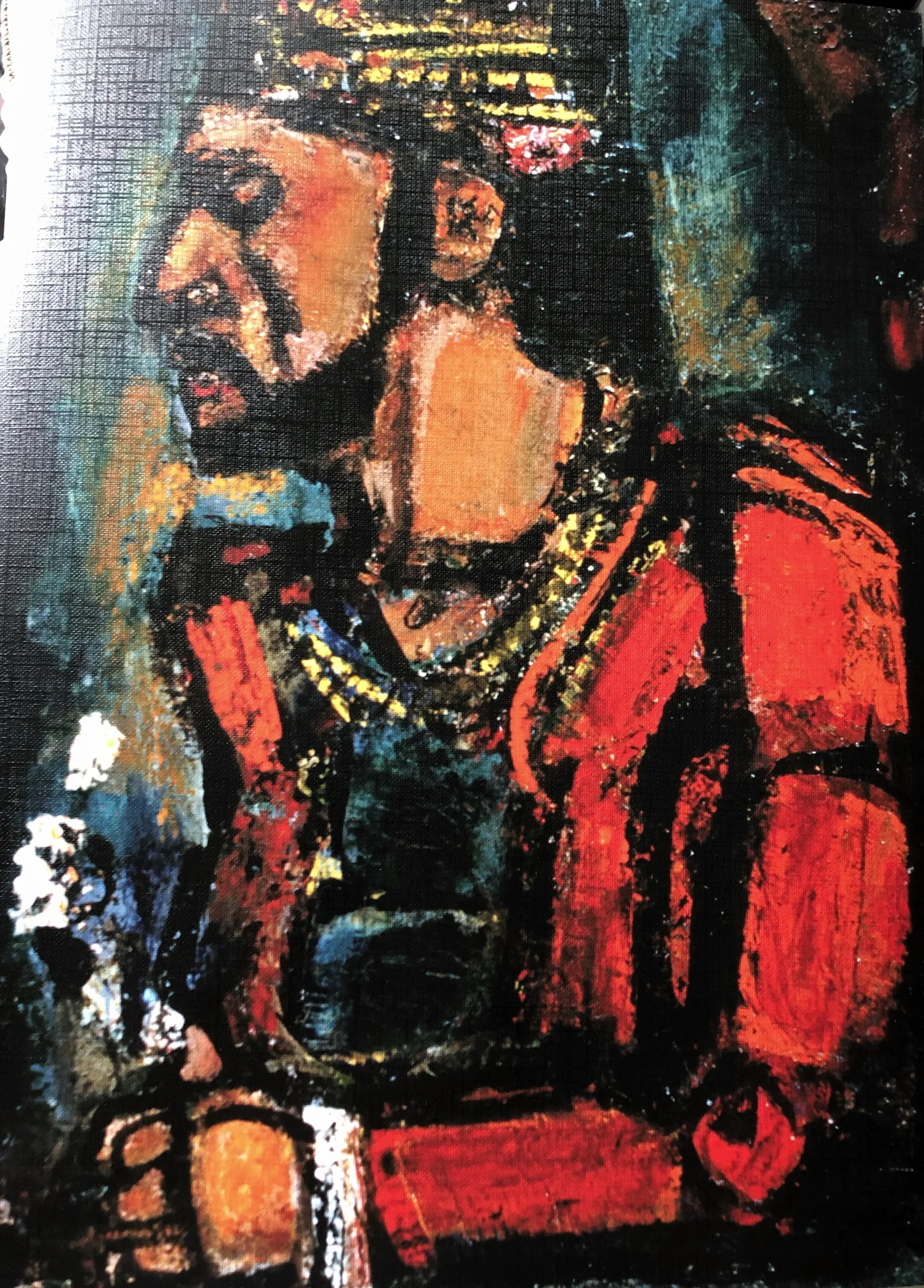
THE OLD KING
Georges Rouault
- Artist
- Georges Rouault (1871–1958)
- Date
- Between 1916 and 1937
- Dimensions
- 77 x 54 cm
- Medium
- Oil on canvas
- Location
- Carnegie Institute Museum of Art, Pittsburgh, Pennsylvania, USA
The Old King, painted over more than two decades, is the masterpiece of the French modernist painter Georges Rouault. Created in the period between the turmoil and horrors of the two world wars, this half-length portrait depicts an imaginary king whose powerful but pessimistic symbolism is belied by the artist’s strikingly bold use of colour. The deeply religious Rouault expressed through his painting his spiritual unease and concern about the morals of modern society. The bold, open emotionalism of pictures like The Old King had a great influence on the German Expressionist painters who followed him.
Early Influences
Georges Rouault’s creative years spanned more than half a century, from the late 1800s to the mid-20th century, and coincided with one of the most exciting periods in the history of art: the spectacular arrival of modern art brought to life by the Impressionists of the 1870s. Although in his own way he represented the radical tendency, Rouault was a painter of highly individual vision; throughout his career he mostly followed untrodden paths, and from 1913 he developed the colourful Expressionist style that became his trademark. Rouault’s career actually began as early as 1885, when at just 14 years old he was apprenticed to a stained-glass painter and restorer. Although he later left this path for his university studies — in 1891 he enrolled at the French Academy — this youthful experience had a lasting and significant influence on his art. His characteristic paintings, such as The Old King, recall the coloured stained-glass windows of medieval churches, in which the intense colours are separated by thick black outlines resembling lead cames.
A Cautious Fauve
One striking feature of The Old King — and of most of Rouault’s paintings — is the veritable flood of sumptuous colours, which the artist applied thickly to the canvas, forming a crust-like coating. The use of many colours began at the French Academy, where he studied alongside painters such as Henri Matisse and Albert Marquet. With them Rouault developed a mode of artistic expression in which bright, often unnatural colours played the decisive role. Although Matisse and his companions, starting from their attraction to wild and explosive colours, later formed the core of the group called the “Fauves”, or “Wild Beasts”, the driving force of Rouault’s art was determined much more by his Catholic faith than by aesthetic considerations. In 1905 he exhibited with the Fauves at the breakthrough Salon d’Automne in Paris, but soon afterwards began to go his own way. He held his first solo exhibition five years later at the Galerie Druet in Paris. This attracted the interest of the German painters Ernst Ludwig Kirchner and Emil Nolde, whose newly founded Expressionist artists’ group Die Brücke (“The Bridge”) was greatly influenced by his works.
The Compassionate Painter
Today Rouault is regarded as one of the greatest religious painters of the 20th century, who created such famous pictures as Christ on the Cross (1937) and Ecce Homo (1952). Besides his many depictions of Christ he also treated secular subjects, but these too carry a moral or religious message: “All my works are religious for those who know how to look at them.” Rouault occasionally condemns his figures, as in The Three Judges (1913), which alludes to corrupt worldly justice, but this is rare in his oeuvre. In many paintings he depicted prostitutes and other outcasts, with whom he illustrated humanity’s ugliness and moral decline, but he also felt pity for these victims of society, as can be felt in his moving Prostitute at Her Mirror (1906). Similarly, The Old King has its own message, which Rouault tells through symbolism. In this picture he depicts the king with his jewel-encrusted crown on his head, but instead of a sword or sceptre he holds a branch with white flowers in his hand, traditionally a symbol of death. With this simple motif Rouault deprives the hollow-eyed king of immortality, and at the same time contrasts his worldly, raw and transient power with the compassionate and eternal kingdom of Christ.
A New Direction
Although Rouault began painting The Old King in 1916, he did not finish the picture until 21 years later. One reason for this was the war that broke out in 1914. The making of the painting also coincided with other important changes in Rouault’s circumstances. In the year he began the work he signed a lucrative contract with the influential art dealer Ambroise Vollard, who promised a regular salary in exchange for the rights to his pictures. Although this agreement brought Rouault financial security, it also had a significant effect on his work. It was largely Vollard who dictated what Rouault should paint, and the dealer’s keen interest in illustration steered the artist in that direction. One of the high points of this period was his acclaimed collection of etchings Miserere et Guerre (1916–1927), and this series alone occupied the artist for a decade. Rouault finally completed The Old King in 1937. Touched by the horrors of the First World War and the looming spectre of the Second, the painter’s work is a sad indictment of humanity’s futile and ultimately self-destructive lust for power.
Artistic Connection
Rouault’s teacher at the French Academy was the French Symbolist painter Gustave Moreau, under whose influence he began to use symbols in his works. After Moreau’s death in 1898, Rouault, formerly Moreau’s favourite pupil, was appointed chief curator of the Gustave Moreau National Museum in Paris (pictured).
- Albert Marquet
- Ambroise Vollard