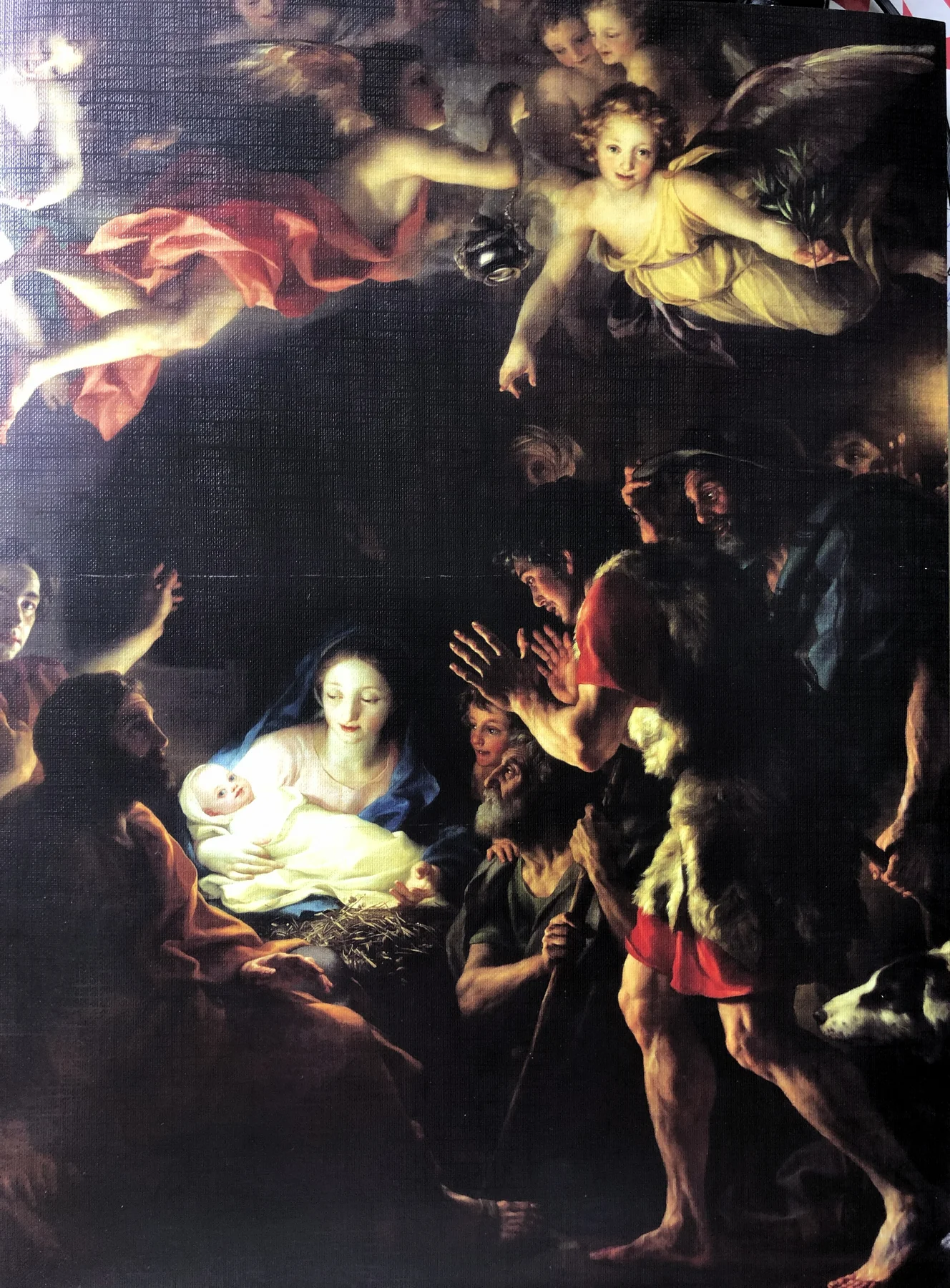
ADORATION OF THE SHEPHERDS
Anton Raphael Mengs
- Artist
- Anton Raphael Mengs (1728–1779)
- Date
- 1770
- Dimensions
- 256 x 190 cm
- Medium
- Oil on panel
- Location
- Prado, Madrid, Spain
Success followed the 18th-century German artist Anton Raphael Mengs from the very beginning; at the height of his career he was considered the greatest living painter in Europe. The son of the court painter to the King of Saxony, he was regarded as a child prodigy whose talent was nurtured from an early age, and he soon surpassed his father. He was only 12 when he was taken to Italy to become acquainted with the Renaissance classicism of Raphael and Correggio, whose paintings he copied with religious devotion. These two artists made a significant and lasting impression on the young German, who later followed in their footsteps, rejecting the dominant styles of his time, the frivolous Rococo and the emotional Baroque, in order to revive the “noble simplicity and quiet grandeur” of classical art. He did this with extraordinary originality; he was perhaps the first true Neoclassical painter of his age, and in the 1760s his fame as a portrait and history painter spread throughout Europe.
A Master of Portraiture
Mengs painted the Adoration of the Shepherds in Rome in 1770, after returning from Madrid, where he had worked for almost a decade as court painter to King Charles III of Spain. At this stage of his life he regarded Rome as his home; he had settled in the city in 1752 after marrying one of his former models, an Italian girl. It was here that Mengs established his reputation as a portrait painter by painting wealthy English tourists who visited the city on their Grand Tour. Unlike other portraitists, Mengs worked mostly in pastel, and this was the key to his success. With pastel he could achieve the saturated colours and glossy finish typical of oil and complete a likeness within two hours, which was impossible with slow-drying oil paint. In this way Mengs enjoyed a decided advantage over his rivals; he was also able to express his outstanding talent, and by the end of the decade he had become the most sought-after portrait painter in Rome.
“The New Raphael”
Despite his excellent portraits, Mengs regarded himself primarily as a history painter, and in this respect too he proved no less successful. He established his fame with his huge ceiling fresco Parnassus, painted in 1761 for the villa of the great Roman patron of the arts, Cardinal Albani. The sensational work raised not only the prestige of the artist, who was soon summoned to the royal court in Madrid, but that of Neoclassical painting in general. The picture shows that Mengs was still strongly under the influence of Raphael and owed much to the Renaissance master’s compositions and figures — so much so that he began to be called “the new Raphael”.
Intensity of Mood
The Adoration of the Shepherds, painted almost a decade later, was inspired by a work of Mengs’s other great model, Antonio da Correggio. Correggio’s altarpiece, made in 1530 for a private commission, treats the story of the birth of Jesus. The painting depicts the scene in which the shepherds visit the newborn Child in the stable. The picture is widely regarded as Correggio’s masterpiece because of its extraordinary, revolutionary handling of colour, but Mengs’s work is similarly evocative. Like Correggio, Mengs was a master of chiaroscuro — the bold contrast of light and shade — and here he uses this technique to create an atmosphere of hushed devotion. At the centre of the painting is, of course, the newborn Jesus, whose figure is bathed in a special bright light that seems to radiate from him, illuminating the face of the Virgin Mary while also throwing back the shadow cast by the circle of worshippers. Mengs’s masterly handling of light lends the picture an almost tangible spirituality and also gives depth to the composition.
Self-portraits
While most of the figures in the Adoration of the Shepherds gaze rapt at the scene before them, the presence of two figures seems to divert the viewer’s attention. One, the angel in a yellow cloak floating on high, almost invites us to step out of the shadows and join the worshippers. The other, at the left edge of the picture, is Mengs himself, who points towards the scene in the role of narrator. This kind of depiction was rare for the artist, who usually painted himself only in self-portraits. Interestingly, several such self-portraits date from the period of the Adoration of the Shepherds, offering a special insight into the life of an artist at the height of his creative powers. During the 1770s Mengs received many honours and tributes and headed the art academies of both Rome and Madrid. Despite his eminent status, he curiously often depicted himself as a weary, dishevelled artist, with the simple tools of his trade rather than in official dress. This modest self-image is deceptive, however, since he was consumed not by poverty or failure but by the crushing burden of his mounting commissions and the relentless pace of work that his own success brought.
- Mengs: Charles III
- Antonio da Correggio