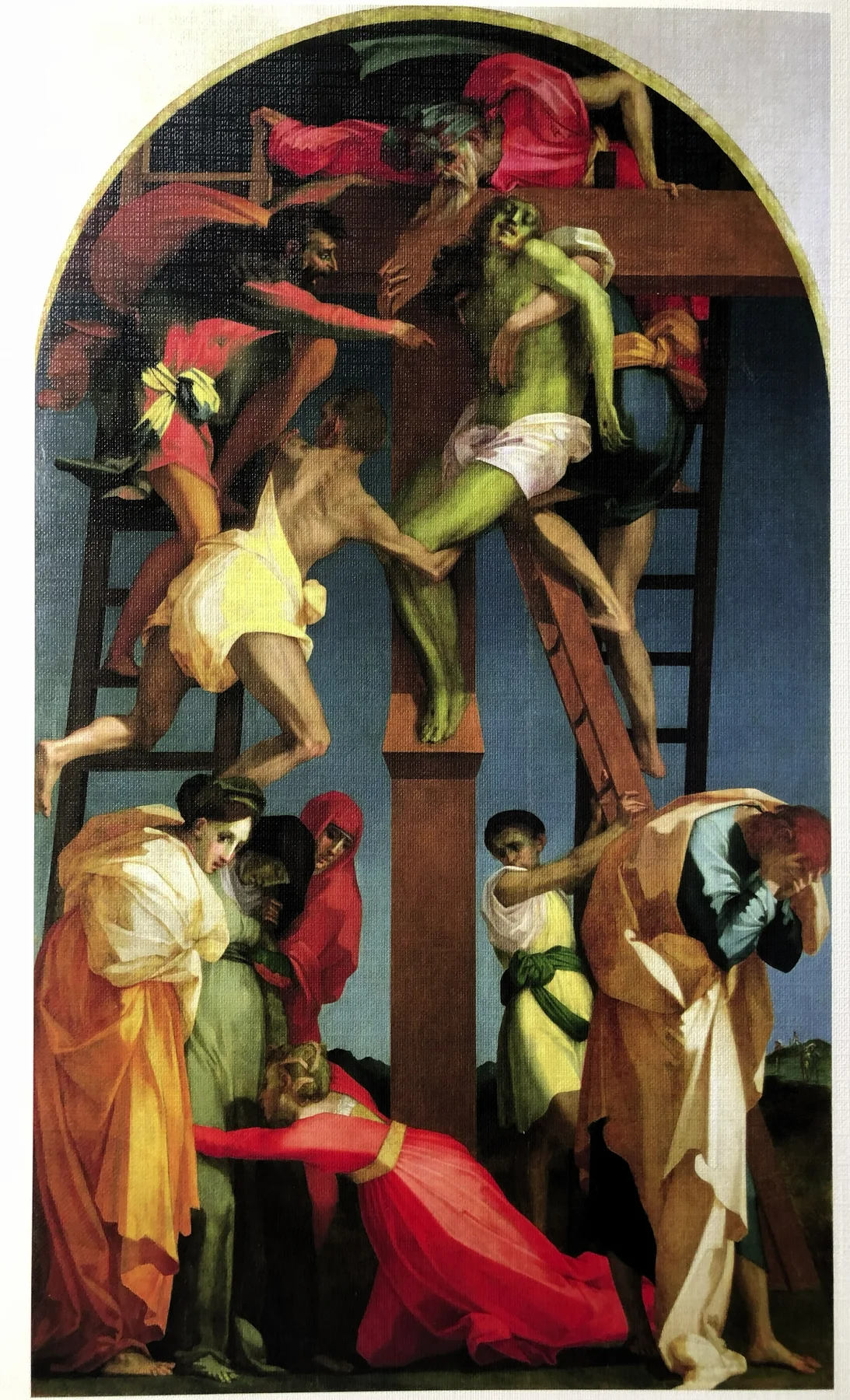
DEPOSITION FROM THE CROSS (detail)
Rosso Fiorentino
- Artist
- Rosso Fiorentino (1494–1540)
- Date
- 1521
- Dimensions
- 335.3 x 198 cm
- Medium
- Oil on canvas
- Location
- Pinacoteca Comunale, Volterra, Italy
The breathtakingly emotional Deposition from the Cross by the 16th-century Florentine artist Rosso Fiorentino resembles none of the pictures ever painted on this subject, and it had an extremely moving effect even in its own time. A sombre painting characterised by desperate figures, vivid colours and uncertain perspective, it is an unreal-seeming yet imposing altarpiece whose particular appeal can be attributed to its creator’s exceptionally individual artistic vision. The young Florentine artist, working in the last years of the Italian Renaissance, competed for recognition with such highly esteemed celebrities as Raphael and Michelangelo, and the race was fierce. For an unknown artist yet to prove himself, the only road to success may have been to sidestep the rules and develop a bold, attention-grabbing style of his own. This is how Mannerism was born.
A Stylised Visual Language
The term “Mannerism” comes from the Italian word maniera, meaning “style”, which perfectly expresses Rosso Fiorentino’s stylised and expressive manner of depiction. By the time “the red Florentine” — as he was then called — painted the Deposition from the Cross, he had been working in this trademark style for years. Like his contemporary Pontormo, who studied with him under Andrea del Sarto, he was at the forefront of this Florentine artistic revolution. The spread of Mannerism throughout Italy can be credited to the two of them. Rosso Fiorentino’s cooperation went no further, however. He was a difficult man who easily made enemies and preferred to get by in life on his own. He travelled alone from place to place, snapping up whatever commissions came his way.
A Popular Subject
The Deposition from the Cross was originally commissioned for the cathedral of Volterra, a picturesque small Tuscan town. Rosso Fiorentino painted the picture at the height of his creative powers, and it is regarded as the masterpiece of his mature Mannerist style. The “Deposition” — the taking down of Christ’s body from the cross after his death — is one of the most common biblical subjects in painting. The story tells how Joseph of Arimathea and Nicodemus lower Christ’s limp body from the cross under the watchful gaze of the mourners before laying him in his tomb. The form of the painting — a composition built around the narrow vertical band of the cross — makes the work an ideal altarpiece; its subject was treated by such great figures of art history as Fra Angelico, Caravaggio, Rubens and Rembrandt. Rosso Fiorentino, however, approaches the story with an entirely new vision and offers a deeply human interpretation of the tragic moment.
A Theatrical Spectacle
One of the most striking features of the painting is the unnatural, almost theatrical way the artist lights the events. The picture actually resembles a stage setting more than anything, in which the figures appear against a neutral backdrop with light streaming onto them from every direction. The action itself takes place in two separate pictorial zones. In the upper part of the composition the men busy with Christ balance precariously on their ladders, as if they might fall at any moment. They gesture vigorously as they struggle to hold on to Christ’s body, while a raging wind lashes their faces. Below them the mood of the picture changes completely: the feverish activity gives way to pure, undisguised grief. The figures are buried in their own sorrow, heads in their hands, or stand bowed with sadness. The faces are distorted by pain, and there is no trace in the scene of the charm and order that usually accompany Renaissance art.
Heightened Emotions
The artist’s choice of colours, as unusual as the lighting, also deserves attention. The strange green colour of Christ contrasts with the brilliant pinks, lemon and orange yellows and blues of the mourners’ clothing. The use of vivid colours was Rosso Fiorentino’s trademark, but it was also characteristic of Mannerism as a whole, as can be seen in Pontormo’s 1528 picture of the same subject. The strong colours give the picture a highly stylised appearance and serve to heighten the drama.
The Deposition from the Cross is indeed distinguished by its almost violent expressive power and in many respects resembles one of Rosso Fiorentino’s later works, Moses Defending the Daughters of Jethro (1523). With paintings on such subjects the artist’s intention was to move and shock viewers and draw them into the scene to share the figures’ heightened emotions. When the Deposition from the Cross was installed in Volterra cathedral, the faithful must surely have looked upon the huge work with a mixture of horror and rapture.
- Andrea del Sarto
- Pontormo: Deposition from the Cross
- Rosso Fiorentino: Moses Defending the Daughters of Jethro