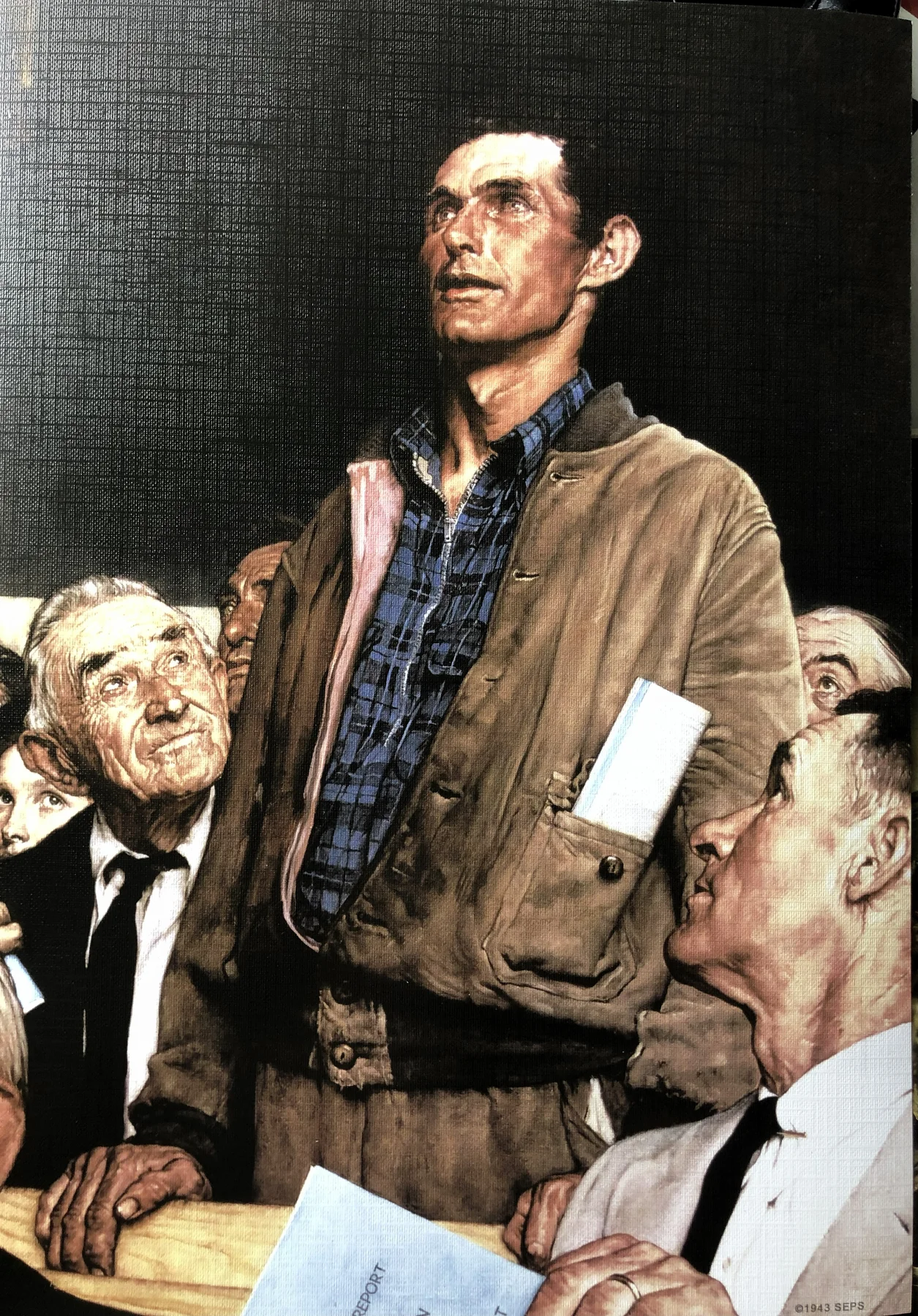
FREEDOM OF SPEECH (from the Four Freedoms series)
Norman Rockwell
- Artist
- Norman Rockwell (1894–1978)
- Date
- 1943
- Dimensions
- 116 x 90 cm
- Medium
- Oil on canvas
- Location
- Norman Rockwell Museum, Stockbridge, Massachusetts, USA
The memorable, much-loved pictures of the outstanding American modern painter and illustrator Norman Rockwell offer a taste of life in the 20th-century United States. During a career spanning more than sixty years, prints of his oil paintings presenting American values appeared on the pages of children’s books, in advertisements and on calendars, and also on the covers of the leading magazine of his time, still in circulation today, The Saturday Evening Post. Freedom of Speech, one of Rockwell’s most famous pictures, was painted in 1943; with it the artist contributed to his country’s war effort during the Second World War.
Moving Words
Inspired by Franklin Delano Roosevelt’s 1941 State of the Union address to Congress, Norman Rockwell began a series of four paintings, one of which was Freedom of Speech. Roosevelt’s stirring wartime speech affirmed basic human freedoms: “In the future days, which we seek to make secure, we look forward to a world founded upon four essential human freedoms. The first is freedom of speech and expression — everywhere in the world… The second is freedom of every person to worship God in his own way… The third is freedom from want… The fourth is freedom from fear… — anywhere in the world.”
The Saturday Evening Post, Rockwell’s employer for 47 years, officially asked the artist to paint the Four Freedoms for the magazine. Rockwell later described the creative process, which lasted six months in all, as a struggle. Freedom of Speech appeared in the Post’s issue of 20 February 1943 as an illustration to an article on freedom of speech by Booth Tarkington. The other three pictures in the series were published in the magazine’s following issues. The four original paintings were among the works that attracted the most attention at a travelling American exhibition jointly funded by the Post and the Treasury Department. Through bond sales the touring show contributed more than 132 million dollars to war expenditure.
Working Method
The outstanding artist Norman Rockwell, who paid meticulous attention to detail, developed a successful working method. He applied the same steps to each commission: first he formulated his idea, made sketches, drawings and oil studies, and finally painted the picture. He chose models, gathered props, sketched out drafts in charcoal, solved the “problems of drawing, composition and shading — practically everything except colour”, and even took photographs of his models and sets for reference. When he had finished the charcoal sketch, he made a colour study exactly the same size as the canvas, working out the colour schemes and values before touching the picture with his brush. Rockwell first drew the picture and made a monochrome paint sketch on the canvas, then primed and varnished the surface, and only then applied the colours.
The Finished Work
Norman Rockwell’s pictorial treatment of the wartime motto of freedom of speech depicts a New England town meeting at which a citizen freely expresses his views without any interruption. Rockwell struggled a great deal with the composition, making three different versions before this superb final oil painting was born. The central figure stands out from the crowd, framed by the black board in the background. The two older men sitting close on either side of the speaker look up at him respectfully, and the gaze of the other participants is also turned upwards, mirroring the gaze of the inspired speaker.
Norman Rockwell is sometimes criticised for his sentimental paintings, but there is no doubt that he was an excellent storyteller who recorded the chronicle of American life in pictures and touched the soul of the nation with his powerful depictions. In this painting Rockwell skilfully uses didactic means to capture the message of Roosevelt’s speech on universal freedoms in difficult wartime.
Artistic Connection
In 1908, at the age of 14, Norman Rockwell decided to become an illustrator and enrolled at the New York School of Art. The greatest influence on him was the children’s book illustrator Howard Pyle (1853–1911), whom Rockwell simply called “a historian with a brush”, famous for his pirate pictures such as The Revolutionary War (pictured). Rockwell continued his studies at the Art Students League of New York, of which Pyle was a co-founder. Rockwell admired the work of James Abbott McNeill Whistler (1834–1903) and John Singer Sargent (1856–1925), as well as many Dutch and Flemish masters of the 15th to 17th centuries.
- President Roosevelt
- Booth Tarkington
- Rockwell working with models