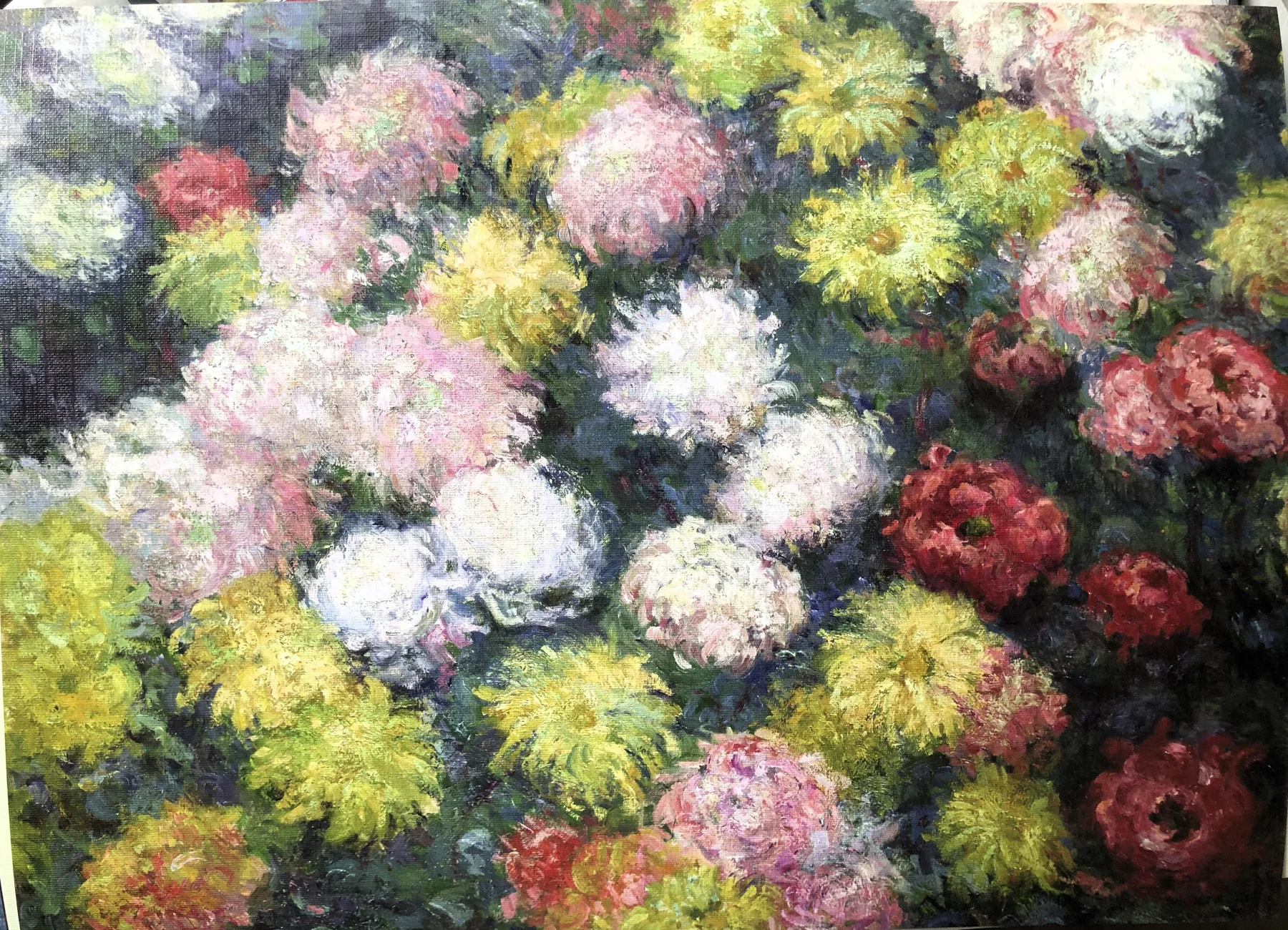
CHRYSANTHEMUMS
Claude Monet
- Artist
- Claude Monet (1840–1926)
- Date
- 1897
- Dimensions
- 80.3 x 120 cm
- Medium
- Oil on canvas
- Location
- Private collection
“I perhaps owe having become a painter to flowers,” Monet once admitted, and indeed his passion for nature, gardening and colourful flowers is a recurring motif throughout his artistic career, which spanned six decades. This flower still life, one of a series of four chrysanthemum pictures painted at his home in Giverny, is proof that although he was approaching the milestone of 60, he was still able to banish convention.
Broken Rules
The four late chrysanthemum paintings from 1897 are among Monet’s most unconventional still lifes. Then as now it was customary to give the objects depicted a support — say, to place them on a tabletop — to create a sense of depth and to set some limits to the depiction. Examples include a still life Monet painted in 1878, in which flowers peep out of a wicker basket standing on a table in front of blue patterned wallpaper, or the pink-budding sprigs in a blue vase on the gleaming surface of a table in his Chrysanthemums of 1882 (Metropolitan Museum of Art).
In this painting, however, the flowers fill the entire canvas to such an extent that they practically float out of the composition at its edges. Moreover, the artist sets the flowers on a bed of leaves, which not only makes any background or support invisible but also dramatically reduces the sense of space. The emphasis is on decorative effect rather than formal or structural elements; the picture is almost like a wallpaper pattern.
The painting owes its outstanding artistic effect largely to its subtle colour harmony. Each flower relates to its neighbour and to the background: the whites to the cool blues and warm pinks. The yellows clash with the mauves, the reds vibrate together with the greens, and the oranges emerge from the blue-green foliage. All this the painter puts on the canvas with energetic brushstrokes which, together with the finely scattered colours, lead the eye through the composition.
The Consolation of Flowers
Monet returned again and again to flower still lifes throughout his painting career, not only for his own pleasure but also because they sold well. He painted several such pictures during the 1870s, and their success largely laid the foundation of his lucrative relationship with the art dealer Paul Durand-Ruel. With the spread of seed catalogues in France in the 1880s, Monet was able to obtain a wide range of plants and use them in his works. But why did he begin working on these four pictures in November 1896?
One reason was the autumn season, which Monet found “unbearable”, when endless rain forced him to postpone his planned early-morning work. Deprived of the chance to paint outdoors, he had no choice but to sit at his easel in his heated greenhouse or bring cut flowers into his studio. But there was probably a more personal motive too.
Also a Gardener
In 1894 Monet’s close friend and fellow Impressionist Gustave Caillebotte died at only 46. His death was a great blow to Monet. The two artists admired each other’s work, and Monet often sought gardening advice from Caillebotte, who spent most of the last decade of his life in his garden at Petit-Gennevilliers near Argenteuil.
Shortly before his death Caillebotte gave Monet his still life White and Yellow Chrysanthemums in the Garden at Petit-Gennevilliers (1893). The painting undoubtedly inspired Monet’s chrysanthemum series of 1896–97; its subdued sense of depth and general decorative character are echoed in Monet’s pictures. Caillebotte also depicted the flowers with similarly energetic brushstrokes.
A Floral Tribute
Caillebotte was an enthusiastic collector of Impressionist paintings: he owned seven pastels by Degas, four canvases by Manet, five by Cézanne, eight by Renoir, nine by Sisley, eighteen by Pissarro and sixteen by Monet, including Red Chrysanthemums (1880), as well as a good number of works by Millet. In his will Caillebotte left the 67 Impressionist pictures to the state, of which 27 (including eight Monets, among them Red Chrysanthemums) were rejected, causing a great public outcry. From the publication of the will in 1894 a fierce debate broke out over the fate of the bequest, until finally in 1897 the accepted works were exhibited in the new wing of the Musée du Luxembourg in Paris. Many academic painters spoke disparagingly of the collection, and Monet, offended by the wrangling, probably painted the chrysanthemums as a mark of respect for his old friend.
A Quiet Revolution
The chrysanthemum paintings heralded significant changes in Monet’s style. Before the turn of the century the “all-over” composition filling the entire canvas and space without a sense of depth gave way to a new subject, the water lilies, which played a decisive role in his remaining years.
- Monet: Chrysanthemums, 1897
- Monet: Chrysanthemums, 1878
- Caillebotte: White and Yellow Chrysanthemums in the Garden at Petit-Gennevilliers
- Gustave Caillebotte, Self-portrait, 1879