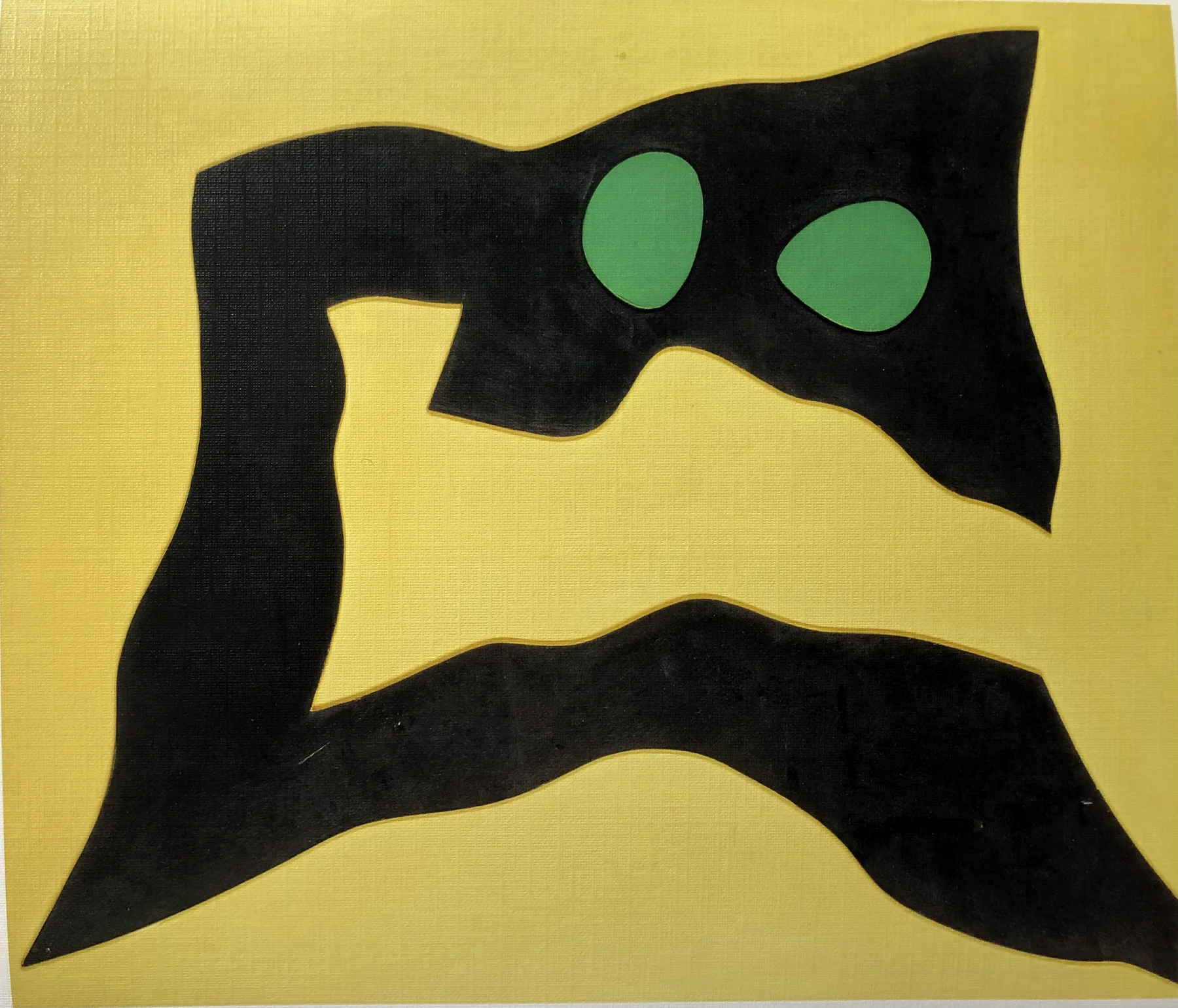
CONFIGURATION
Jean Arp
- Artist
- Jean Arp (1887–1966)
- Date
- 1957
- Dimensions
- 62 x 55 cm
- Medium
- Oil, cardboard relief
- Location
- Private collection
Jean Arp, also known as Hans Arp, the French-German painter, poet, graphic artist and sculptor, was one of the first leading figures of early 20th-century modern art. He played an active part in many of the artistic innovations of his time, and his work is most closely linked with Expressionism, Dada and Surrealism. Unlike many of his contemporaries, however, Arp broke completely with realistic representation and strove instead for pure abstraction, creating an entirely new visual language, “biomorphism”. With his abstract yet strangely familiar shapes, strongly reminiscent of biological forms, Arp’s works radiate a spontaneous, almost involuntary beauty that had a great influence on contemporary artists from Joan Miró to Henry Moore.
Abstract Works
Configuration is a general title covering many of the abstract works Arp produced over the years. This relief, made in oil on cardboard, dates from around 1957, the last decade of the artist’s life. The bold composition is dominated by a heavy black abstract form that seems to float like a sail against a neutral background. The two green pebble-like shapes resembling water drops set into the vertical band on the right bring colour and excitement to the work.
Arp made many similar reliefs in the 1920s, but Configuration is particularly notable because it was made at a time when Arp was active primarily as a sculptor. By the early 1930s he was working almost exclusively in this branch of art, producing such wonderful bronze works as the enchanting Sculpture Lost in the Forest (1932) and the mystical Pagoda Fruit (1949). Although these late works are what most people remember, his sculptures and Configuration itself are the result of an artistic development that began decades earlier, nourished by Arp’s persistent fascination with chance, contingency and the spontaneous nature of life.
Traditional Beginnings
Although Arp stood out among the personalities of the French, German and Swiss avant-garde, he began his career as a tradition-respecting painter; his early works include expressive nudes, self-portraits and Impressionist landscapes. His career took a dramatic turn, however, when in 1912 in Munich he met the Expressionist painters Wassily Kandinsky and Franz Marc. In the same year he showed some of his new semi-abstract works with them at the Blue Rider exhibition, and in 1913 at the first Berlin Autumn Salon. Although this group of experimental artists broke up with the outbreak of the First World War, the die was cast, and from then on Arp became one of the main figures in the changes taking place in the art world.
Irrational Art
Perhaps the greatest mark on Arp’s artistic development was left by Dada, and he can be regarded as one of the founders of this anarchic movement. The movement was launched in Zurich in 1916 in direct response to the horrors of war sweeping across Europe: “While the guns rumbled in the distance, we sang, painted, made collages and wrote poems with all our might.” Dada tried to confront the world with its own madness through abstract and irrational art that offended “good taste”. By then Arp had already begun experimenting with chance in his collages — such as Before My Birth (1914) — and in his Dada period he continued to explore the possibilities of the theme with works including Squares Arranged According to the Laws of Chance (1916). These works challenged traditional methods of artistic creation: Arp scattered pieces of paper at random onto a support and then glued them down.
Organic Forms
It was in the early period of Dada that Arp also began his biomorphic wooden reliefs, which can be regarded as forerunners of works like Configuration. These works developed partly out of his earlier experiments with Cubism. Arp was introduced to Cubism by Picasso, who had a great influence on him, but he later developed his own individual style. He left behind the carefully constructed geometric structures of Cubism in favour of meandering, undulating forms which, even in their abstraction, are strongly reminiscent of organic, living shapes. The kidney-shaped Tears of Enak, for example, resembles a human organ, while the enigmatic elements it contains allude to the principle Arp called the “irrational order” of Nature.
Commercial Success
Configuration was made 40 years after Tears of Enak, when Arp was already enjoying the commercial success that came with his fame, winning major commissions such as large reliefs for UNESCO and Harvard University. Although Configuration is now in a private collection, the artist originally created it for reproduction in his art album Voilier dans la Forêt (Sailing Boat in the Forest), containing his pictures and poems. The album, including prints of seven of the artist’s reliefs and many of his poems, was published by Louis Broder’s fine-art press in just 130 signed copies. Arp also collaborated with Broder on a sequel; Le Soleil Recerclé appeared in 1966, the year of his death.
- Franz Marc: The Little Blue Horse
- Franz Marc