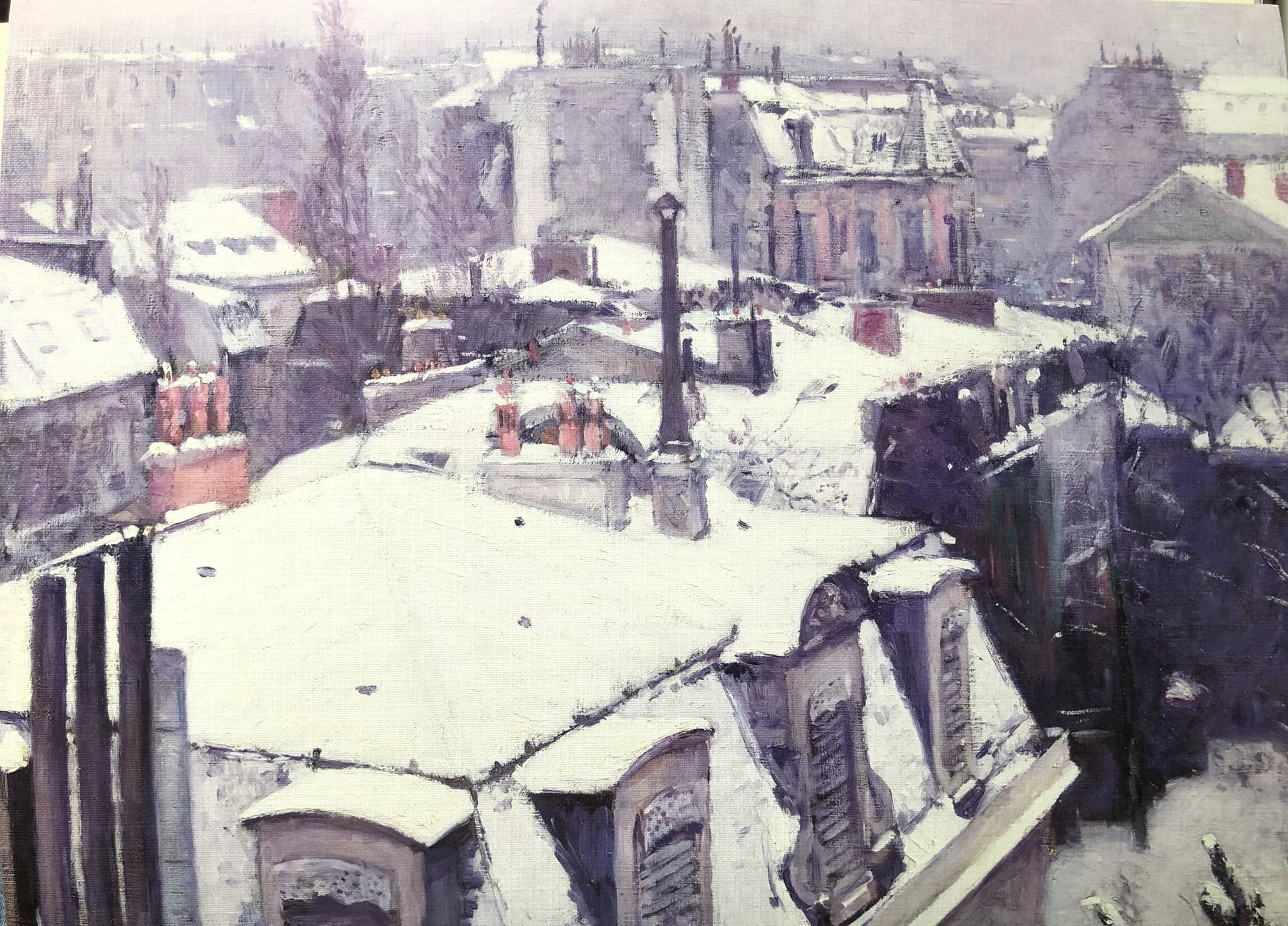
SNOW-COVERED ROOFTOPS
Gustave Caillebotte
- Artist
- Gustave Caillebotte (1848–1894)
- Date
- 1878
- Dimensions
- 64.5 x 81 cm
- Location
- Musée d'Orsay, Paris, France
This was one of two Parisian rooftop panoramas that Caillebotte showed, alongside a dozen other canvases, at the fourth Impressionist exhibition in 1879. As a member, supporter and promoter of the Impressionist group, he reached the peak of his career that year, before internal disputes began to erode the movement in the early 1880s. The special quality of Snow-Covered Rooftops lies in its ordinariness. It is a true anti-subject: in the Paris of the 1870s, who would have thought of pushing aside shady parks, magnificent boulevards and elegant strolling bourgeois in favour of a tangled jumble of gap-toothed tiled roofs and chimneys under a grey winter sky?
A Landscape Like Any Other
After the 1879 exhibition the writer Arsène Houssaye described Snow-Covered Rooftops and its companion piece as a floating landscape, or even a seascape: “Two rooftop pictures by the same painter, depicted in a simple but effective way: roofs, gables, tiles, gutters, mansards, weathervanes and chimneys undulate all the way to the distant horizon.”
Looking back at Caillebotte’s paintings of the mid-1870s, we mostly find Parisian townscapes and street scenes, with the occasional quiet boating scene among them. Despite the unusual choice of subject, this painting can in every respect be called a landscape, and Caillebotte can rightly be called an urban Impressionist. He depicts the light and atmospheric conditions with great care, in this case the thin, damp mist that dims the weak winter sunlight and mutes the colours. An interesting fact about the work is that after Caillebotte’s death in 1894 the painter’s brother, Martial, donated the picture to the state under the title Landscape Study.
A Window on the World
Although Snow-Covered Rooftops drew few other comments from the critics, the painting was nevertheless an important addition to those works by Caillebotte that documented city life from the height of an attic window.
Caillebotte’s first such painting was Young Man at His Window of 1876, in which we see from behind a man standing with his legs wide apart and his hands in his pockets, looking down through the open window at the streets below. The window frames the composition and at the same time forms a psychological barrier between the individual’s inner world and outer reality. The contemplating figure, however, connects the two worlds by leading our gaze from near to far. Caillebotte returned to this theme repeatedly during his career. In Interior, Woman at the Window (1880) a woman looks out through the closed window while her husband sits reading a newspaper in an armchair. The scene is a psychologically convincing portrayal of marital estrangement. In the same year he painted two more relaxed subjects — both titled Man on a Balcony — in which he places the protagonist in open space, leaning on the railing and watching the bustling life of the street: a snapshot of modern man in the modern city.
In Snow-Covered Rooftops the view unfolds before us through Caillebotte’s eyes. The painter has cut the window out of the picture entirely, so that the rooftop panorama unfolds dizzyingly across the whole surface of the canvas. Because the window is missing — as in his similarly vertiginous Rue Halévy, View from the Sixth Floor (1878) and A Traffic Island, Boulevard Haussmann (1880) — we feel as if we were leaning out into the air to look at the streets running far below.
Many of Caillebotte’s contemporaries also captured modern Paris from above. From the same year, 1878, come, for example, Monet’s flag-decked Rue Montorgueil and Manet’s The Road-Menders in the Rue Mosnier.
The Photographer’s Eye
Before this revolutionary painting, rooftops had appeared only in photographs. One of the pioneers of photography, the Frenchman Hippolyte Bayard (1807–1887), made townscapes with rooftop panoramas taken from unusual angles.
There is a suspicion that Caillebotte used photographs as compositional aids for complex works such as Le Pont de l’Europe (1876). There is no evidence that he used them for this picture, but the unconventional depiction of space and the general sense of stillness express his high regard for photography.
- Arsène Houssaye
- Snow-covered rooftops, the companion piece
- The two versions of Man on a Balcony
- Rue Halévy, View from the Sixth Floor
- The Road-Menders in the Rue Mosnier