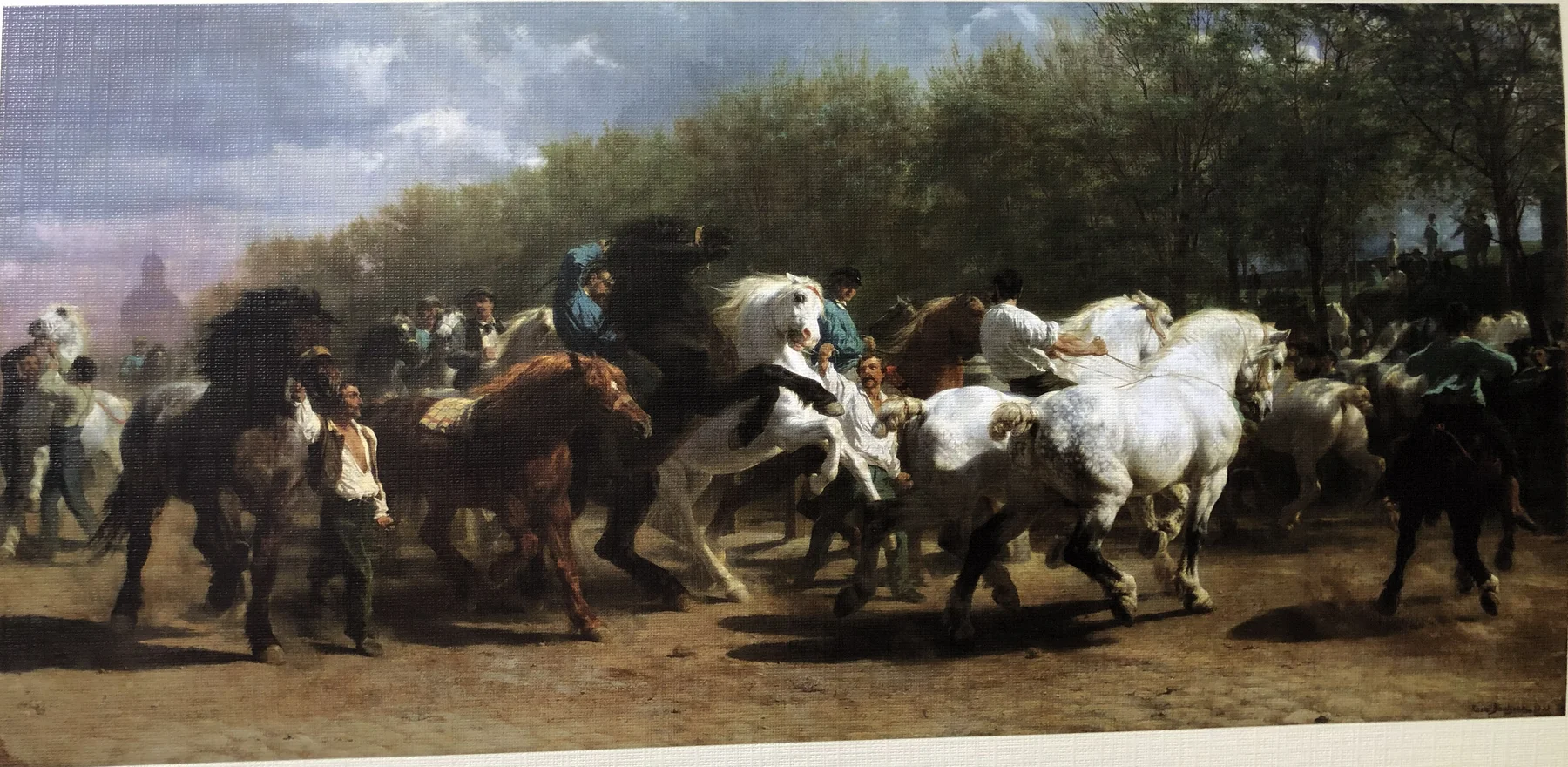
THE HORSE FAIR
Rosa Bonheur
- Artist
- Rosa Bonheur (1822–1899)
- Date
- Between 1853 and 1855
- Dimensions
- 244.5 x 506.7 cm
- Medium
- Oil on canvas
- Location
- Metropolitan Museum of Art, New York, USA
International success came in the blink of an eye for the French animal painter Rosa Bonheur when, at the age of 31, she submitted this large canvas of the Paris horse market to the Salon exhibition of 1853. The artist set off on a promotional tour of England with her picture — demonstrating the importance of personal charm in effective publicity — and the work was later shown in several American collections. Although she went on painting her beloved animals for another 46 years, she never surpassed this masterpiece in size or impact.
Horsepower
The painting, more than five metres wide and at two-thirds life size, is a huge study of the horse fairs held on the Boulevard de l’Hôpital in the 13th arrondissement of Paris (in the south-east of the city). It took 18 months to complete. Bonheur, the persistent animal painter, was inspired by the equestrian studies of Théodore Géricault (1791–1824) and the horse sculptures of the Parthenon frieze. From 1849 Bonheur attended the horse fairs, also made sketches of the horses of the Paris Omnibus Company, and recorded the tree-lined avenue in studies. In the background of the picture appears the dome of the chapel of the nearby hospital, the Pitié-Salpêtrière. (The background originally existed in rather sketchy form, so the artist reworked it in 1855.)
Bonheur’s strength is the breathtakingly realistic depiction of animals; she is able to convey the thrilling moment when men strain every muscle to rein in the powerful workhorses, which wildly toss their tangled manes, stir up the dust with violently stamping hooves, roll their eyes fiercely, their flanks gleaming with sweat. The arrangement of the figures in an arc leads our eye around the bustling group, while the onlookers on the right of the picture act as a repoussoir (leading our gaze back into the composition). Sunlight coming from the right brings out the horses’ forms like a sculptural relief against the background of soft treetops.
A Masterpiece on the Art Market
Although she had won a gold medal at the 1848 Salon with her study of an ox team, Ploughing in the Nivernais, at the time The Horse Fair was exhibited Bonheur’s name was still unknown beyond the borders of France.
The painter first offered the work to her native city, Bordeaux, for 12,000 francs, but was turned down on the grounds that the price was too high for the work of a woman artist. In Bonheur’s time only male painters were taken seriously.
Then the London-based Belgian art dealer Ernest Gambart appeared on the scene, a promoter of French art abroad, who paid 40,000 francs for the work, intending it as the centrepiece of his exhibition in England the following year. Bonheur was pleased with the price (negotiated by her companion, Nathalie Micas) and assigned the reproduction rights of the work to Gambart. For this purpose she produced a ¼-scale copy (painted by Micas) and sent it to Thomas Landseer, brother of the famous English animal painter Sir Edwin Landseer, to make an engraving from it.
Gambart’s Coup
Gambart then persuaded Bonheur to take part in the picture’s promotional tour of England. The work attracted huge crowds in London — people paid 1 shilling each to see it — and then the painting was taken to Buckingham Palace so that Queen Victoria could view it; she afterwards congratulated the artist.
The laurels, however, were reaped by Bonheur. The painter, only 152 cm tall, captivated the public, who could hardly believe that this colossal picture of stamping and snorting horses was the work of a woman. The Illustrated London News dubbed her the “female Landseer”, and the Daily News called her the greatest French painter of rustic scenes, perhaps the best in the world.
Success Across the Ocean
Despite the publicity, Gambart found no English buyer for the painting. Its fame, however, crossed the ocean, and in 1857 it was bought for 30,000 francs by William P. Wright of New Jersey. The picture was shown by the Stevens and Williams Gallery in New York in October of that year and later went on a nationwide tour.
In 1870 Wright sold the painting to a wealthy merchant named Alexander T. Stewart, who hung it in the private gallery of his Fifth Avenue mansion next to Ernest Meissonier’s Friedland (1807). When Stewart’s collection came up for auction in 1886, the work was acquired for around 53,000 dollars by Cornelius Vanderbilt II, heir of the famous shipping magnate. By then Bonheur had become a cult figure in the United States, where children played with dolls made in her likeness. In a characteristically charitable gesture Vanderbilt donated the painting to the Metropolitan Museum of Art, where it can still be seen today.
- Géricault: Black Horse in Harness
- Bonheur: Ploughing in the Nivernais
- Ernest Gambart
- Alexander T. Stewart