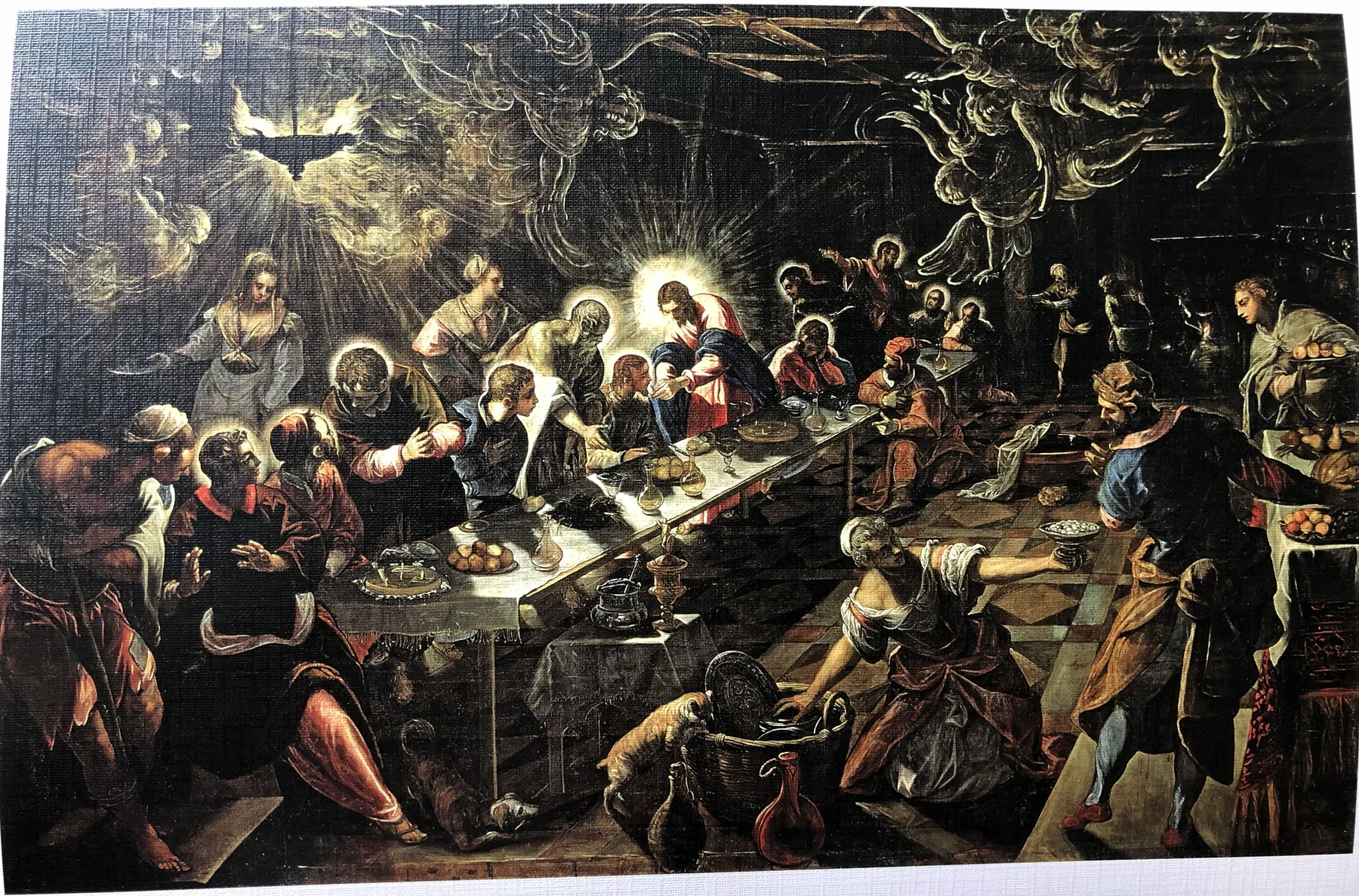
THE LAST SUPPER
Tintoretto (Jacopo Robusti)
- Artist
- Tintoretto (Jacopo Robusti) (1518–1594)
- Date
- c. 1594
- Dimensions
- 365 x 568 cm
- Medium
- Oil on canvas
- Location
- San Giorgio Maggiore, Venice, Italy
The excellent and extraordinarily prolific 16th-century Italian painter Tintoretto was born and died in Venice; apart from a short excursion to Mantua, he spent his whole life in the Serenissima. Unlike Titian, however, he was not a typical Venetian painter: his Mannerist style showed itself in dramatic lighting effects and unusual compositions in many of his religious paintings. Tintoretto painted The Last Supper towards the end of his life, and many regard it as the masterpiece of his career.
The Final Version
Tintoretto’s Last Supper is a late work, probably painted in the last year of the artist’s life, at about the same time as The Gathering of the Manna. Both works were commissioned for 180 ducats by Michele Alabardi, abbot of San Giorgio Maggiore, the Benedictine monastery that was one of the richest in all Venice. Tintoretto painted the subject several times during his life, for example in the San Marcuola version of The Last Supper (1547), which served as the starting point for his later versions and already contained pictorial devices such as the strange concealment of the disciples’ faces. The final version of The Last Supper is Tintoretto’s most original treatment of the sacred theme of the Eucharist.
The San Giorgio Maggiore version of The Last Supper was painted on a huge canvas measuring more than 3.5 x 5.5 metres, and it still adorns the right-hand wall of the chancel, as it did in the artist’s time. The viewpoint of the church congregation may have played a part in the painting’s placement, since the distant pews of the faithful were situated to the right of the picture. The unusual diagonal line of the table in the painting is of great significance for the interior of the church, as the picture appears to be a perspectival extension of the altar, while The Last Supper’s companion piece, The Gathering of the Manna, links the two works. The female figure in The Gathering of the Manna, hanging on the opposite wall, looks out of the picture from the crowd of busily working Israelites, as if she were directly watching the administering of the sacrament in The Last Supper.
Drama and Light
Extremely inventive and blessed with enormous creative energy, Tintoretto did not conform to the prevailing pictorial styles of his time. The contemporary historian Giorgio Vasari described Tintoretto as one who “works according to his own methods, contrary to the established practice of other painters.” Tintoretto admired the way Titian could give drama to his paintings through his handling of light, and although The Last Supper is a relatively dark-toned picture, Tintoretto also made powerful use of lighting effects in his composition. The vibrant yellow halo of the figure of Christ outshines even the double flame of the ceiling lamp. The lights define the forms: some figures are cast into dark shadow, others sharply illuminated.
Christ at the Centre
Tintoretto’s Last Supper concentrates great expressive power in a masterfully constructed composition, in sharp contrast to the detached and symmetrical treatment of Leonardo da Vinci’s Last Supper painted nearly a century earlier. The strikingly oblique line of Tintoretto’s table gives the work a dramatic perspective, further heightened by the unusually strange positioning of the disciples, especially those on the far side of the table.
The main figure, Christ, is seen at the focus of the picture, in the centre, as he offers the host, the gift of the Eucharist, to Peter. The painting refers to Christ’s last act of compassion: “This is my body which is given for you: this do in remembrance of me” (Luke 22:19). Judas is depicted by the painter in a red cloak and turban. This small peripheral figure, far from the focus of the picture, also indicates that Tintoretto places the emphasis on the Last Supper rather than on the betrayal of Christ.
The dynamic figures serving food in the right foreground are products of Tintoretto’s imagination and serve to fill the space created by the diagonal of the disciples’ table. The floating ethereal angel figures in the room, reminiscent of the interior of a Venetian inn, reflect the mystery of the transformation of the bread and wine into the body and blood of Christ.
Artistic Connection
Since we have little information about Tintoretto’s youth, it is difficult to link him to a particular master. Around 1530, at about the age of twelve, he began working as an assistant in a painter’s studio. He claimed that Titian (pictured) was his master, but there is no evidence of this. Tintoretto’s early pictures nevertheless show that the young artist successfully absorbed the styles of Titian and of other leading Venetian painters of the time, such as Bonifazio de’ Pitati and Paris Bordone. An anecdote throws light on the young man’s artistic ambitions: he is said to have fixed the following words above the door of his workshop: “The drawing of Michelangelo and the colour of Titian.”
- Tintoretto’s house
- The Gathering of the Manna
- The Last Supper (1547), San Marcuola version
- Interior of San Giorgio Maggiore
- The Last Supper, 1594 (detail)