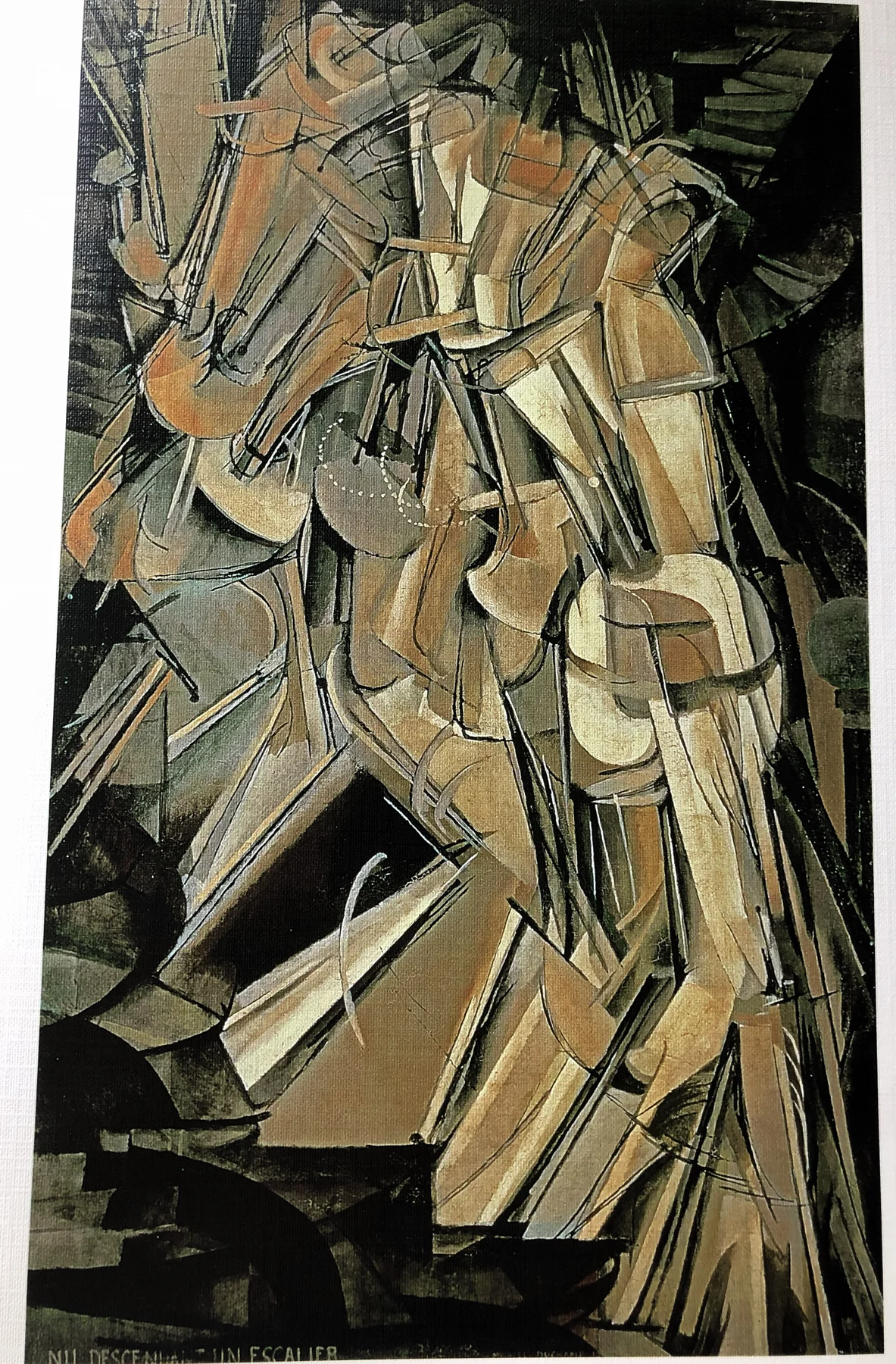
NUDE DESCENDING A STAIRCASE, NO. 2
Marcel Duchamp
- Artist
- Marcel Duchamp (1887–1968)
- Date
- 1912
- Dimensions
- 147 x 89.2 cm
- Medium
- Oil on canvas
- Location
- Philadelphia Museum of Art, Philadelphia, Pennsylvania, USA
Nude Descending a Staircase, No. 2, the ultimate symbol of modernism, condenses into one breathtaking image the most exciting and revolutionary innovations unfolding in art and science at the dawn of the 20th century. Duchamp’s near-abstract painting, which is in fact the portrait of a figure in constant motion, was greeted by the public with astonishment mixed with confusion when it was first shown in 1912, but today it is regarded as one of the iconic pictures of its progressive age.
First and Last
Duchamp’s famous work Nude Descending a Staircase, No. 2 was the artist’s first and at the same time last major painting. His earlier works received little attention, and afterwards he essentially gave up painting and turned to other means of expression. Today Duchamp is best known for his so-called “ready-mades”, those everyday objects, “finished products”, which he did not make but simply came across and exhibited as works of art in their original form. The first of these was Bicycle Wheel (1913), a wheel fixed to a stool for no explicable reason, while the most famous is the ironically titled Fountain (1917), a porcelain urinal signed “R. Mutt”, turned on its side and put on public display, which shocked viewers. Like Nude Descending a Staircase, No. 2, these provocative works were not made to be looked at but to challenge the mind, earning Duchamp fame and notoriety.
Artistic Roots
Duchamp was destined for an artistic career from the start. He was the grandson of the French painter and engraver Emile Nicolle, and the youngest of his siblings, who like the others had a natural talent for drawing and painting. At first he worked in a Monet-inspired Impressionist style, painting landscapes such as The Church at Blainville (1902). In 1904–1905 he studied briefly at the Académie Julian in Paris, then began exhibiting at the Salon d’Automne and the Salon des Indépendants with his elder brothers, the painter and graphic artist Jacques and the sculptor Raymond. During this period, however, his works mostly went unnoticed, and only from 1911, when he began experimenting with Cubism, did he develop his unique, highly individual style, which came to fruition in Nude Descending a Staircase, No. 2.
Movement and Rhythm
The excellence of Duchamp’s Nude Descending a Staircase, No. 2 lies in the way it absorbed many of the artistic styles of its time. The painting, which combines Picasso’s multi-faceted Cubism with the Italian Futurists’ world of movement and speed, was influenced by time-lapse photography (images taken over a long period and later played back in a short time) and by the cinema. In a Cubist manner Duchamp breaks down the figure’s movement into at least twenty different poses, thereby carefully mapping its progress through space. The lines are static, almost engineered, but by overlapping one another they give rhythm to the composition, leading the eye from left to right, following the figure’s progress. The illusion of movement is further heightened by the fact that the figure appears more transparent in its earlier positions than in the later ones, giving the impression of a blurred, gradually fading walk.
In the Crossfire of Criticism
Nude Descending a Staircase, No. 2 was undoubtedly a pioneering work, but to Duchamp’s surprise it provoked controversy even among his own Cubist contemporaries. He originally wanted to show it at the 1912 Salon des Indépendants, but it was rejected there. Duchamp heard the news from his brothers, who were members of the selection committee. The reason for the painting’s rejection was supposedly its title, which appears in large letters in the corner of the picture. The jury argued: “A nude never descends a staircase — a nude reclines.” Duchamp’s crime was the one he “committed” repeatedly throughout his career: he turned conventions upside down, in this case by depicting the most sacred and sensual subject of art — the nude — as sexless, featureless and torn from its context. Duchamp said nothing about it to his brothers, but he never forgave them.
Exhibition and Sale
Duchamp showed his painting at a minor Paris exhibition in 1912, but the following year he found a wider forum. In February 1913 Nude Descending a Staircase, No. 2 went to the International Exhibition of Modern Art in New York. As in Paris, the picture caused a great uproar and scandal. The American public saw the painting merely as an avant-garde trick, and one critic described it as “an explosion in a shingle factory.” Others, however, recognised the merits of the work, including a San Francisco art dealer who snapped up the picture for 300 dollars ahead of Duchamp’s patrons, Louise and Walter Arensberg. In 1916 Duchamp made a copy for the Arensbergs, but by then he had largely left his painting career behind him, and in the mid-1920s he even turned away from art for the sake of chess. This practically marked the end of a career which, despite its relative brevity, challenged the artistic conventions of its time and even the very definition of art.
- Duchamp’s brother, Jacques Villon
- A game of chess with Man Ray, 1957