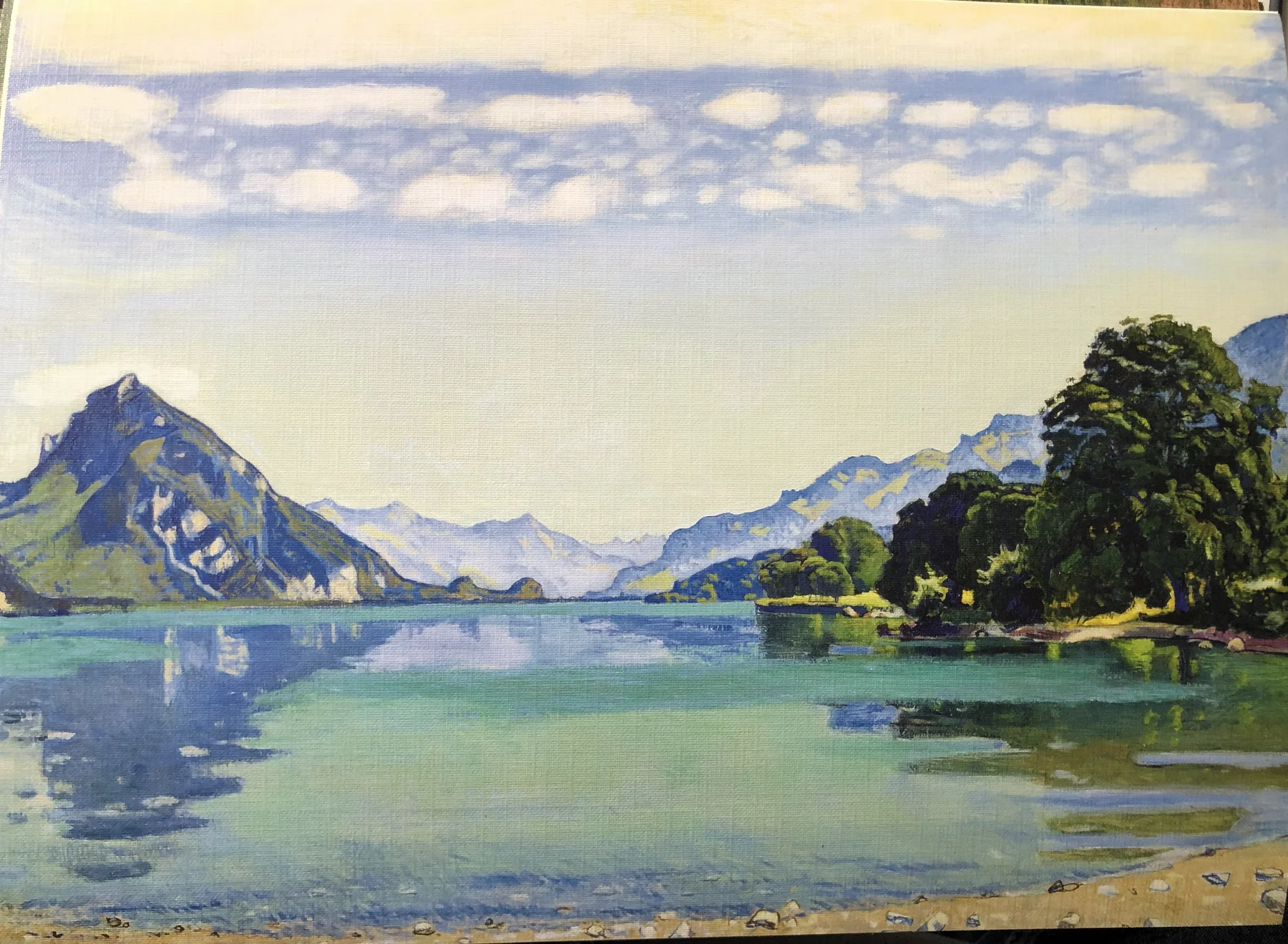
LAKE THUN NEAR LEISSIGEN
Ferdinand Hodler
- Artist
- Ferdinand Hodler (1853–1918)
- Date
- 1904
- Dimensions
- 80 x 100 cm
- Medium
- Oil on canvas
- Location
- Bern Art Museum, Bern, Switzerland
The landscape painting of the Swiss painter Ferdinand Hodler some 100 years ago was characterised by parallelism. On the basis of his scientific observations he discovered graphic patterns in nature, which he regarded as evidence of a fundamental harmony existing in creation. Hodler developed his theory in several stages; this particular view of Lake Thun shows precisely the turning point at which he moved from naturalism towards a more symbolic world view.
A View Between the Lakes
Long, narrow Lake Thun lies in the canton of Bern, in the heart of the Swiss Alps. In the summer of 1904 Hodler stayed in the village of Leissigen, on the south shore of the lake, and painted the view to the south-east. The painting shows only a small part of the lake east of Leissigen; its shore narrows into an isthmus separating Lake Thun from its eastern neighbour, Lake Brienz. The isthmus, a green strip of low-lying land, can be seen in the centre of the composition. The town of Interlaken (the name literally means “between the lakes”) occupies the isthmus and is today a popular resort.
Behind the isthmus are the low foothills of the Schynige Platte plateau. Judging from Hodler’s later pictures of this view, he was preoccupied with painting the horizon sinking into the water, created by the slope of the Harder (the cone-shaped peak on the left) and the Därliggrat (the ridge on the right), partly shaded by the wooded foothills.
Working in Parallel
In this picture examples of parallelism are the three planes formed by the shore, the horizon of the lake and the band of clouds, but they do not appear particularly natural. Hodler shaped the composition according to his own way of seeing. He deliberately sets the shore in parallel, even if its weak ochre can hardly compete with the rich, full greens in the distance. His band of clouds, with its neatly rounded ends and meringue-like jagged edges, is more an Art Nouveau stylisation than a realistic depiction, and the artist, searching for symbolic forms, was beginning to leave realism behind.
The mountains reflected in the lake are further, even more refined examples of Hodler’s parallelism: they create symmetry along the axis of the lake’s horizon. The triangular flank of the Harder likewise forms a symmetry around its own axis.
The artist reveals this symmetry even more clearly in later works, such as Lake Thun, Symmetrical Reflection Before Sunrise, painted from further east. In it he has cut out the wooded foothills, the reflections are more clearly outlined, and the palette is limited to blues and greens. The shore, deepened this time and rich in detail, is at last a strong, balanced element of the composition. In this second painting Hodler, demonstrating his craftsmanship, concealed the stylised effects and thus preserved a sense of realism. In all his Lake Thun paintings the mirror-smooth surface of the water provides a calm horizon that forms a natural contrast with the jagged mountain range towering in the background.
A Unified View
“Nothing inspires me more,” Hodler wrote, “than regular forms.” He saw examples of parallelism wherever he turned — for instance in a row of trees along an avenue, where “the main element that creates the impression of unity is the parallelism of the tree trunks”. In a speech given in Vienna in 1904 he explained how he had turned from realism towards a form of symbolism: “Slowly… thanks to years of study and observation, I arrived at my present direction: pure form, simple depiction, repeated motifs.” Parallelism also had a strongly humanist element, namely that it focused on similarities rather than differences. “What unites us is stronger than what divides us,” he explained. In his later years, however, Hodler turned to a more mystical painting style, and in his pictures simplified mountain ranges, their bases shrouded in mist, merge with fantastically shaped crowns of cloud billowing above their peaks.
Artistic Connection
After a visit to Vienna in 1903 Hodler formed a close friendship with the Austrian Symbolist Klimt (pictured), who until 1908 was the leader of the Vienna Secession, a group of artists who had broken away from the conservative style of the Association of Austrian Artists. Klimt chose Hodler as the featured artist of the 1904 Vienna Secession Exhibition (the year this lake scene was painted), with a major retrospective of his works. Klimt earned a reputation as the fin-de-siècle Viennese “bad boy” for his scanty dress and for entertaining an endless string of lovers. His highly erotic paintings, often decorated with gold leaf, are extremely sought after today. When the Portrait of Adele Bloch-Bauer sold for 135 million dollars in New York in 2006, it set a record as the most expensive painting ever sold at auction.
- Lake Thun today
- Lake Thun, Symmetrical Reflection Before Sunrise
- Bern Art Museum