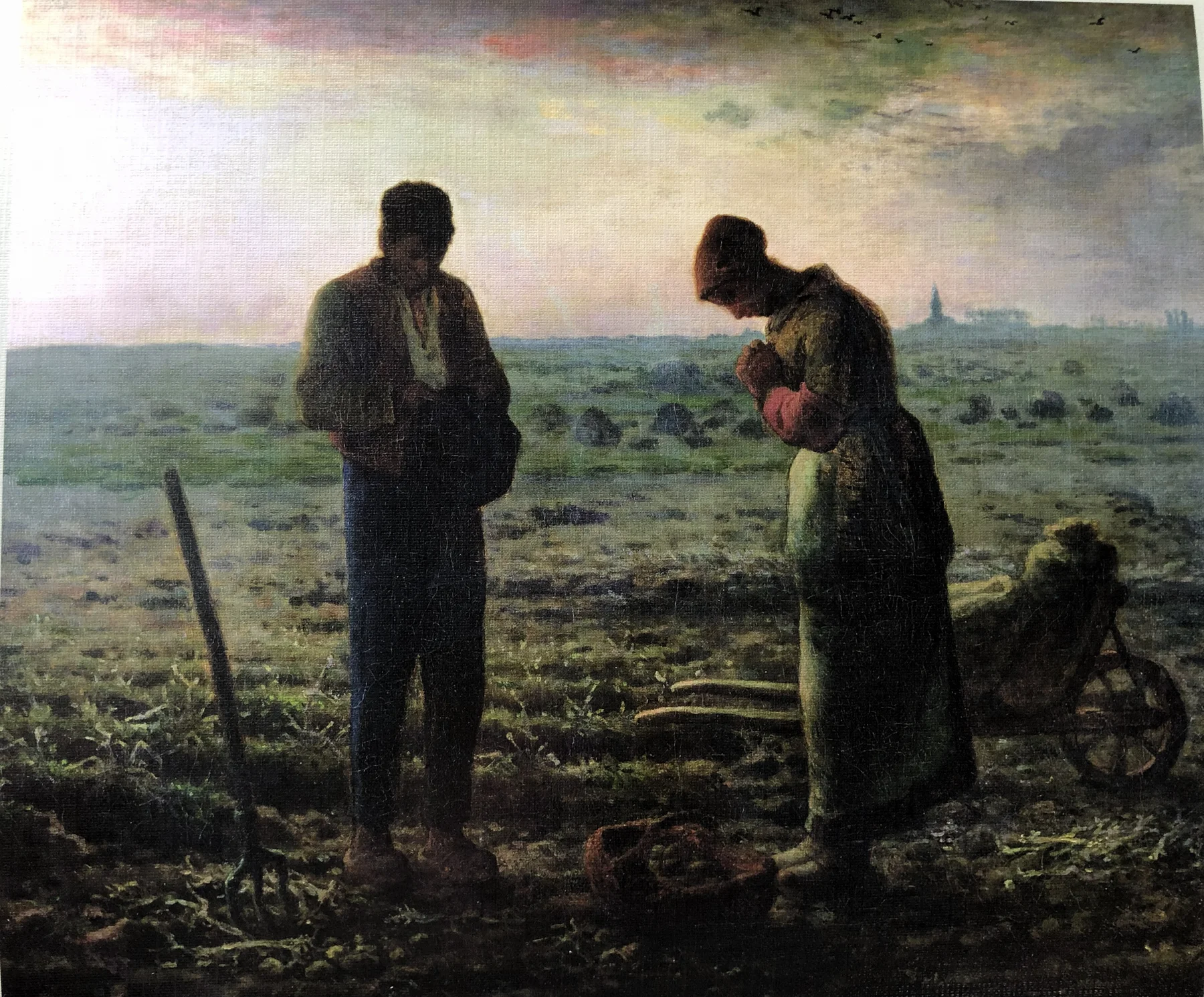
THE ANGELUS
Jean-François Millet
- Artist
- Jean-François Millet (1814–1875)
- Date
- 1857–1859
- Dimensions
- 55.5 x 66 cm
- Medium
- Oil on canvas
- Location
- Musée d'Orsay, Paris, France
Although the reputation of the naturalist painter Jean-François Millet had faded considerably by the early 20th century, it has since rightly regained its former lustre. One of his best-known and most famous paintings, The Angelus, and his other masterpieces, The Sower, Man with a Hoe and The Gleaners, depict monumental peasant figures at exhausting work in the fields, or taking a short rest before continuing their hard labour.
A Change of Title
In 1857 a wealthy Boston patron, Thomas Gold Appleton, commissioned a painting from Jean-François Millet showing two peasants in silent prayer in the fields. When Appleton did not take delivery of the finished work, Millet painted a church tower into the picture and renamed it The Angelus.
The Angelus, from the Latin, is a Christian prayer about the Incarnation. In an 1865 letter Millet explained the personal reasons behind the change of title: “When I painted The Angelus I was thinking of my grandmother, who, when we were working in the fields, always made us stop work at the sound of the bells to say the Angelus, as God-fearing people, for our dead, with our hats in our hands.”
Return to France
The Angelus had several owners in the 1860s. The painting was first exhibited in 1865, and in the same year it was bought by one of Millet’s influential patrons, the Parisian architect Emile Gavet. In 1889, a good many years after Millet’s death, the picture sold for more than half a million francs at the sale of the Secrétan collection, although the efforts of French bidders to acquire the work for the Louvre were thwarted. The Angelus nevertheless returned to France in 1909, when the department-store magnate Alfred Chauchard bequeathed the painting in his will to the famous Paris museum, the Musée d'Orsay. Millet’s reputation faded over the years, until in 1932 the picture returned to the spotlight after an unemployed engineer slashed the canvas. The Angelus was restored, and after successful exhibitions in Paris and London in 1975–76 Millet regained his place among the geniuses of painting.
A Freer, Naturalist Style
Vincent van Gogh regarded Millet, whom he simply called “Father Millet”, as the most important mentor of young artists. He once declared: “It is Millet, not Manet, whom I consider the truly modern painter, who opened new horizons for many…” Before the French Impressionists — Manet, Pissarro and Monet — it was the naturalist Millet who was able to render light and the subtleties of natural phenomena in his landscapes. In The Angelus Millet uses lighter colours and freer brushstrokes.
Monumental Figures
Millet places two large figures and their tools in the foreground of the wide open field. He depicts the two farm workers in a state of contemplation, as the pious peasants murmur their prayer with bowed heads, commemorating the archangel Gabriel’s revelation to Mary, the Annunciation. Millet was not a regular churchgoer, yet he presents the couple in a spirit of humility: the man holds his hat, the woman clasps her hands in prayer. The light of the fading sun falls on the woman’s raised arms and belly, the source of human life.
Despite the artist’s explanation recalling his childhood, when work in the fields was halted for prayer, the meaning behind the painting’s original title — Prayer for the Potato Crop — is equally evident in the central placement of the basket of freshly dug potatoes lying at the woman’s feet. For poor peasants a good harvest was a necessity of life, to survive the hard, harsh winter. The glow of the beautiful twilight sky lends the work a meditative, elevated mood, further emphasising the picture’s message.
- Alfred Chauchard