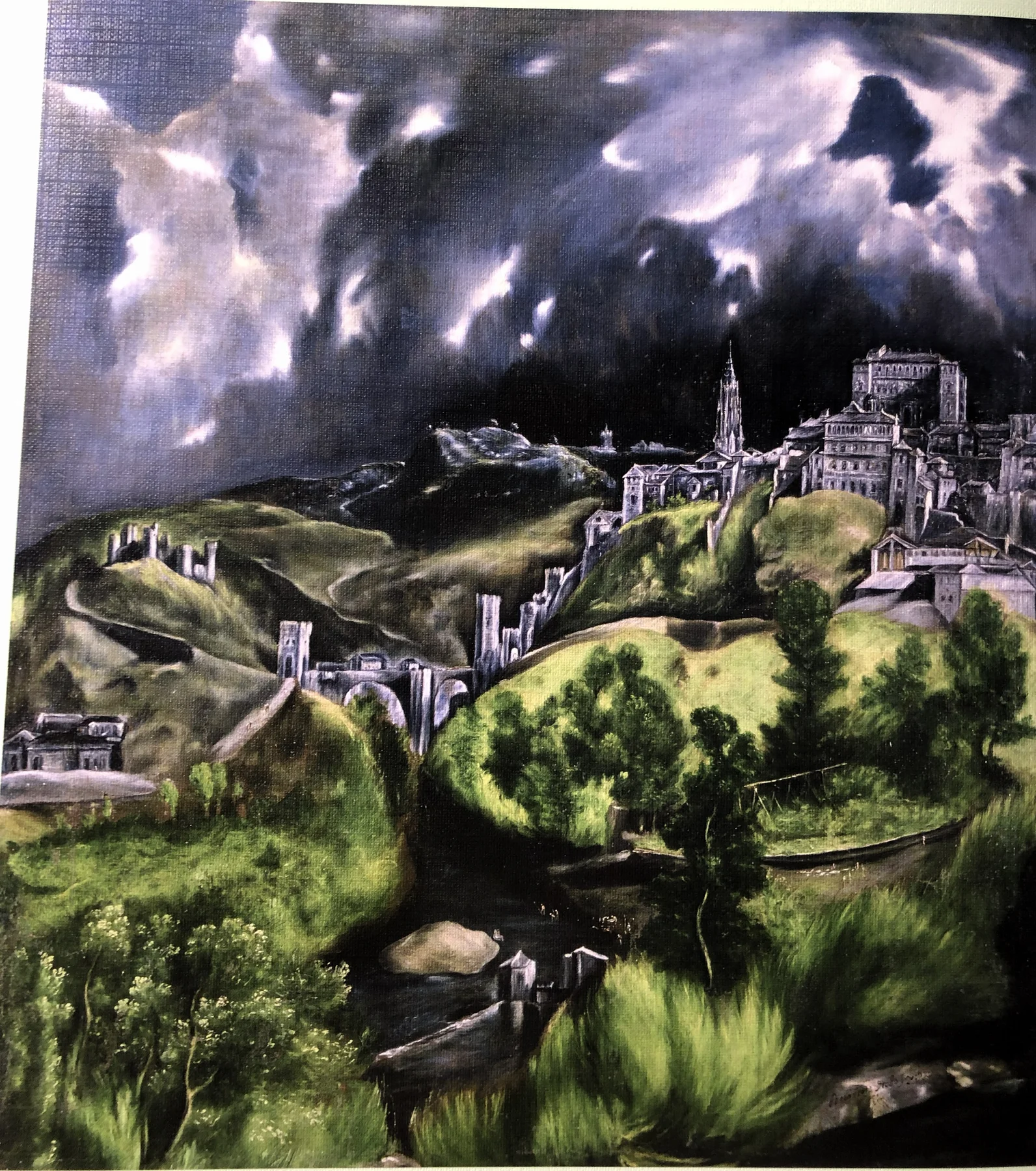
VIEW OF TOLEDO
El Greco
- Artist
- El Greco (1541–1614)
- Date
- 1597–99
- Dimensions
- 121.3 x 108.6 cm
- Medium
- Oil on canvas
- Location
- Metropolitan Museum of Art, New York, United States
Originally from Crete, Greece, El Greco settled in Toledo, Spain, in 1577 at the age of 36 and lived there until his death. It was here that he became one of the most outstanding and original artistic talents. View of Toledo, the masterpiece that immortalised his chosen home, was painted at the very end of the 16th century.
Views of Toledo
El Greco may have painted View of Toledo and his other landscapes for patrons who favoured such depictions of cities. Another version of the hilly view of the city on the banks of the Tagus may have belonged to his friend Pedro Salazar de Mendoza (c. 1550–1629), who believed that Toledo was unsurpassed “in traditions, customs, laws, courtesy, fine manners and refined language”.
An Uncertain Background
The exact provenance of View of Toledo is uncertain, since according to the studio inventory drawn up at his death El Greco painted at least three views of the city. The world-famous version of View of Toledo exhibited in the Metropolitan Museum probably once belonged to Pedro Lasa de la Vega, first Duke of Arcos. The painting later passed to one of his descendants, who first showed it to an American couple, Louisine and Harry Havemeyer, in 1901. Louisine Havemeyer then bought the picture for 70,000 francs in 1909, after her husband’s death. As part of the H. O. Havemeyer Collection, View of Toledo was donated to the Metropolitan Museum in New York in 1929.
An Expressionist Picture
View of Toledo is the portrait of a city and an unusually powerfully depicted landscape. As in his best portraits, El Greco expressed his own feelings in the painting far more than he recorded the view with perfect realism. El Greco’s early landscape, Mount Sinai (1570–72), depicts three huge peaks and the walled Monastery of St Catherine at the foot of the dizzyingly high Mount Horeb. In his later years he made an expressionist picture of the city of Toledo. As the writer Aldous Huxley wrote in an essay in 1950, “El Greco used natural objects as raw material from which, by deliberate distortion, he created his own individual pictorial forms in a pictorial space, under pictorial lighting”. With his picture El Greco expresses his feelings for his home and captures the most important features of the city.
Three Hues
El Greco uses only three main hues in this surprising, atmospheric picture — the green of the hills, the light grey of the buildings and the bluish grey of the storm clouds — plus a little ochre for the tiny matchstick figures in the river. El Greco’s landscape may seem gloomy, but the dark, dramatic tones are vivid and brilliant, conveying the threateningly approaching storm. The artist’s swirling, vibrant green hills wind with the same powerful momentum as the storm clouds in the sky.
A Particular Viewpoint
El Greco presents Toledo from the north; he depicts a row of buildings following the steep ridge down to the Roman Alcántara bridge, on the other bank of the Tagus, and above it he paints the castle of San Servando. The artist paints the hills and the bend of the river larger, but the relative positions of the buildings along the river are quite realistic.
In the easternmost part of Toledo El Greco shows the impressive royal residence, the huge Alcázar fortress rising high on the hilltop above the river, on the right. The artist chose his viewpoint in a particular way, for from this angle the cathedral, on the right, is not visible. El Greco therefore decided to place its tower to the left of the Alcázar in the painting. The cathedral tower rises as high as the Alcázar, thereby emphasising the importance of the Spanish Church.
- Metropolitan Museum of Art
- Aldous Huxley
- View and Plan of Toledo, another painting by El Greco