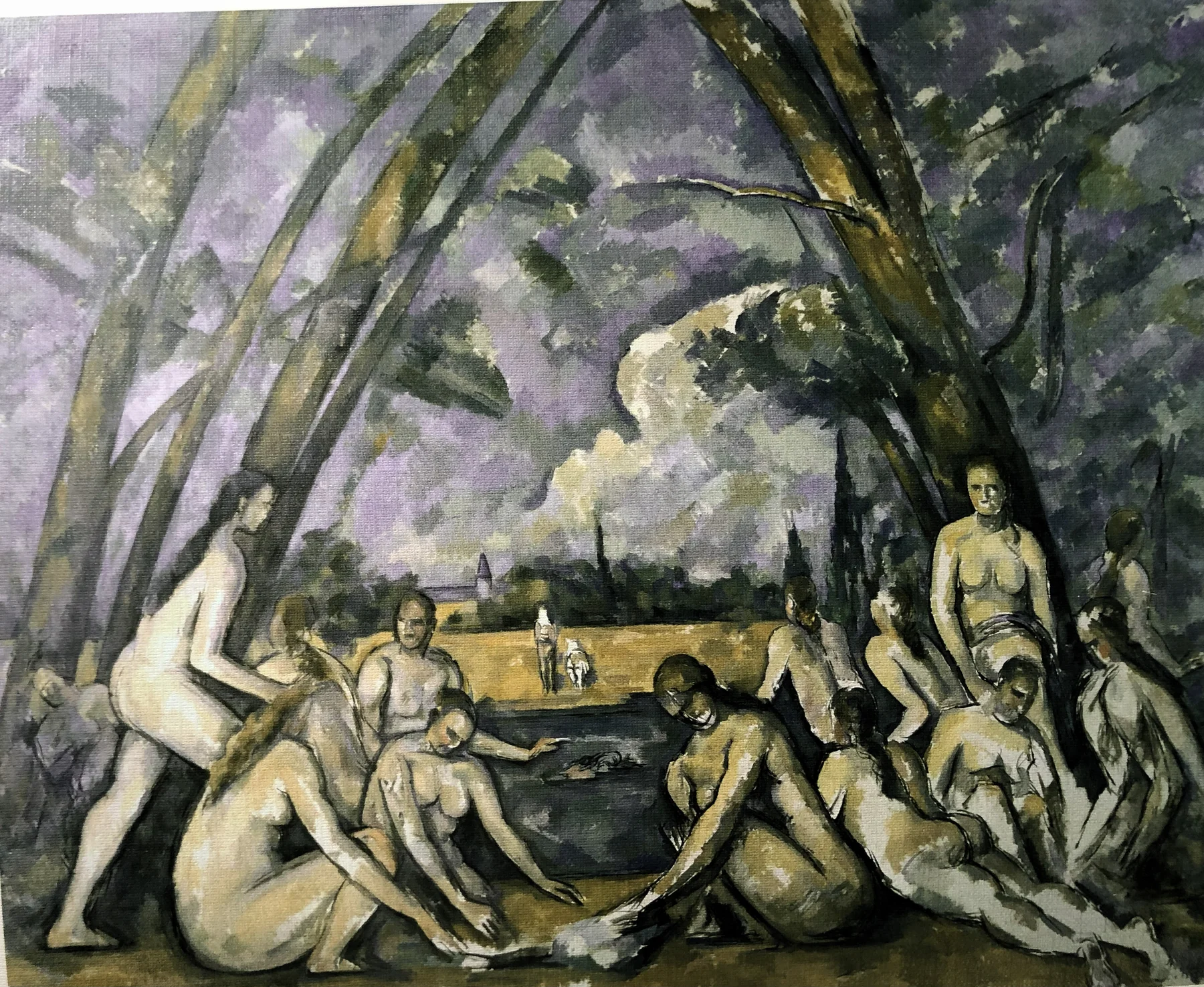
THE LARGE BATHERS
Paul Cézanne
- Artist
- Paul Cézanne (1839–1906)
- Date
- Between 1895 and 1906
- Dimensions
- 210.5 x 250.8 cm
- Medium
- Oil on canvas
- Location
- Philadelphia Museum of Art, Philadelphia, Pennsylvania, United States
Throughout his career there were two great subjects to which Cézanne returned again and again: Mont Sainte-Victoire in Aix-en-Provence, not far from his birthplace, and the theme of bathers. Cézanne began painting bathers as early as 1870, but only at the very end of his life did he create what has perhaps become his most famous picture: the monumental Large Bathers. Now in the Philadelphia Museum of Art, it is Cézanne’s largest treatment of one of his favourite subjects, and compositionally the most dramatic.
Exhibition and Exile
Born a year before Monet and two years before Renoir, Cézanne belonged to the young generation of French painters who in the late 1800s took over the art world at lightning speed with their radically new “Impressionist” style of painting. Although he exhibited with them in 1874 and 1877, Cézanne never fully identified with their vision. While he too sought “truth to nature”, he believed that Impressionism was ultimately a flawed idea, lacking structure and solidity, which he regarded as essential components of art. In the 1870s, after the scornful reception of the group’s work, which deeply hurt Cézanne, he left Paris and returned to Aix-en-Provence in southern France. For almost two decades he remained a solitary, largely unknown figure; only in 1895, encouraged by his close friend Camille Pissarro, did he return to Paris, where his solo exhibition was a huge success.
Cézanne’s Bathers
It was in this period, in 1895, that Cézanne began work on three large paintings known as The Large Bathers. These paintings were the culmination of two decades of research on the subject, and he hoped they would gain him entry to the Salon’s annual exhibition, which had so far rejected his works. He worked on these pictures until his death more than a decade later, in 1906.
During his life Cézanne made some 200 pictures of women and men bathing alone or in groups, and his passion for the subject goes back to his childhood. As a young man he loved playing in the nearby River Arc with his friends Baptistin Baille and the future writer Émile Zola, and he kept happy memories of that period, but these experiences were not his only inspiration. Cézanne was always a great follower of the old masters, especially Titian and Nicolas Poussin, whose paintings typically featured scantily clad nymphs, maidens and sensual goddesses. Cézanne had once admired these works on the walls of the Louvre, and with his bathers he paid tribute to his role models.
A Great Imagination
For an artist who enjoyed painting from nature as much as the Impressionists did, it may seem strange that Cézanne painted his bathers in settings borrowed from his predecessors. But Cézanne simply could not paint them in a real situation. As he later wrote to his friend Émile Bernard, the subject raised many problems, among them that he had no models who would be “willing to undress and hold the pose I imagined”. Instead Cézanne relied on the past and on his great imagination.
In The Large Bathers, 2.5 m wide, we see 14 figures, intertwined shapes in almost abstract form. Divided into two groups, they engage in various activities, mostly turned away from us, fortunately unaware of the viewer’s gaze. Characteristically, Cézanne did not focus only on the figures but rather divided his attention equally between the figures and the landscape, so that neither predominates. He was famous for his instinctive sense of visual harmony, which he achieved here with his palette: the ochres, blues and greens of the landscape are echoed in the figures, uniting the two elements in the picture. As in other works, Cézanne based the composition on the pyramid form favoured by the old masters. To this end he took dramatic artistic liberties, painting the trees at an almost impossible angle, bending them inwards to create the apex of the pyramid. Cézanne was never afraid to distort reality, and he did so in this painting too; he emphasised the grandeur of the pictorial arrangement and, with enormous ingenuity, heightened the unity of man and nature.
An Unfinished Masterpiece
Of the three Large Bathers pictures, the version owned by the Philadelphia Museum of Art was the last to be begun, and it remained unfinished at Cézanne’s death. There is, however, something very characteristic about this fact. Throughout his career Cézanne painted bathers obsessively, not only because the subject fascinated him but also because he regarded practice as an important learning process. Cézanne was a perfectionist who all his life tried to combine the Impressionists’ truth to nature with the compositional principles of the old masters. In many respects The Large Bathers is an overwhelming example of Cézanne’s unyielding, lifelong striving to achieve artistic perfection.
- Cézanne’s painting, Mont Sainte-Victoire
- Pissarro
- Poussin’s painting, The Nurture of Jupiter
- The Bathers, a painting by Cézanne on a similar subject