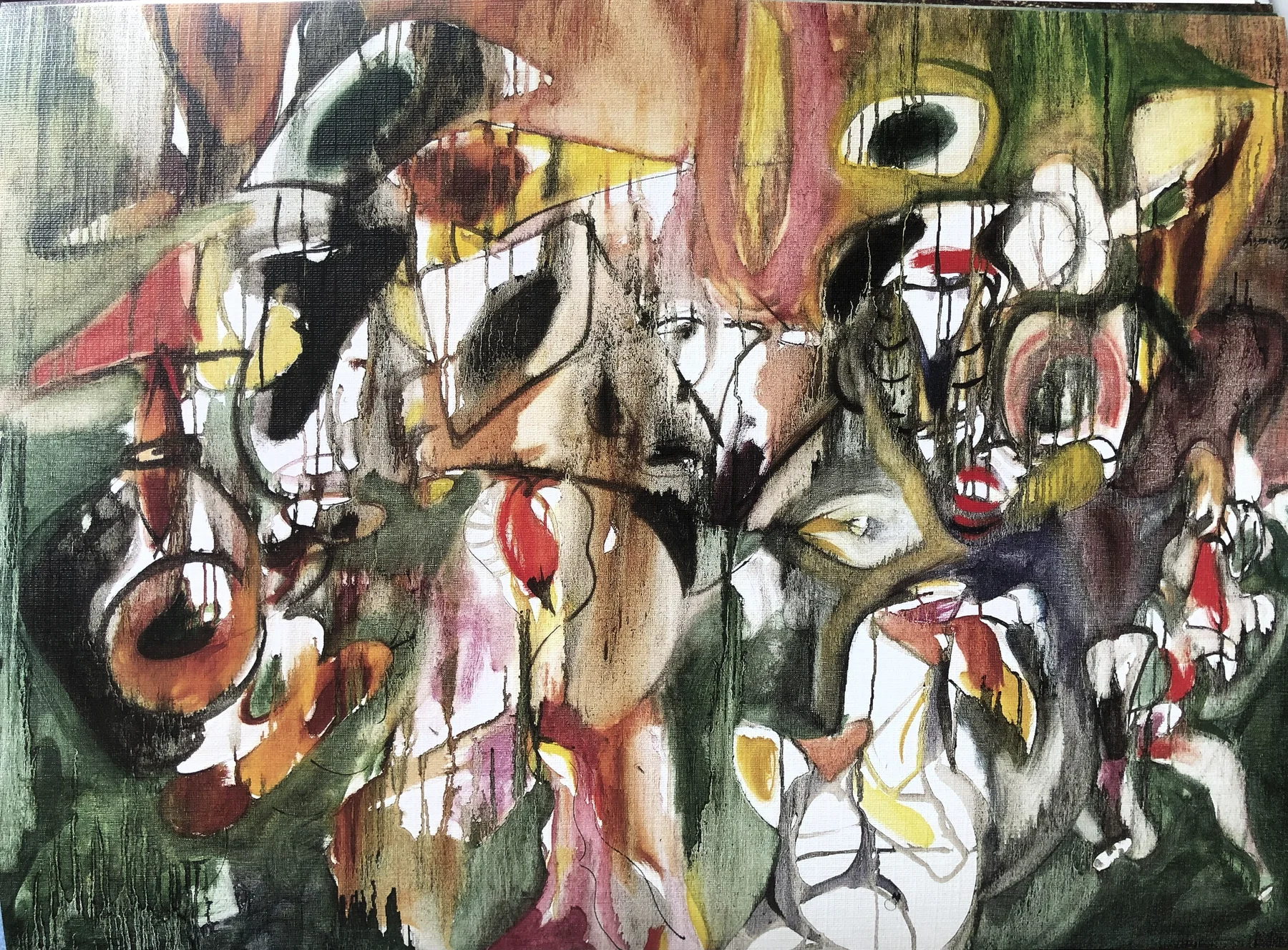
ONE YEAR THE MILKWEED
Arshile Gorky
- Artist
- Arshile Gorky (1904–1948)
- Date
- 1944
- Dimensions
- 94.2 x 119.3 cm
- Medium
- Oil on canvas
- Location
- National Gallery of Art, Washington DC, United States
In 1920 an Armenian émigré, Arshile Gorky, arrived in America, fleeing inhuman Turkish persecution, and within two decades he became one of the leading figures of American art. Regarded as the link between European Surrealism and American Abstract Expressionism, Gorky went through many changes of style before, by the mid-1940s, he developed the highly original abstract vision seen in paintings such as One Year the Milkweed. This period found Gorky at the height of his powers, but tragically it ended before it could really begin. After a series of misfortunes Gorky took his own life in 1948, leaving behind a unique body of work that helped shape the future of modern art.
A Meteoric Rise
Between the time he first set foot on American soil, aged barely 16, and the time he painted One Year the Milkweed, he rose like a comet from refugee to respected American artist. He first settled in Massachusetts and studied at the New School of Design in Boston from 1922 to 1924. He then exchanged green New England for the bright lights of New York, which at that time was overtaking Paris as the art capital of the world. Before the Second World War the influx of European painters turned the city into a centre of artistic creativity, and Gorky found himself right in the middle of it. Although he never achieved the commercial success of some of his peers, by the 1930s he was regarded as a key figure of the avant-garde, and his works were shown at the Museum of Modern Art.
Changing Influences
Despite some art training, Gorky was a self-taught painter. He constantly reinvented himself in his art, and only at the end of his career did he find the style associated with his name. He was first influenced by the Post-Impressionist Paul Cézanne; he was also a great admirer of Pablo Picasso, whose Cubist style he imitated. In the 1930s he began to move in the circles of abstract painters such as Stuart Davis and Willem de Kooning, and later he befriended the European Surrealists led by André Breton. Gorky’s great breakthrough, however, came in the early 1940s, when he finally began to work together these many and sometimes conflicting influences. The result was his unique, well-known abstract style, characterised by light, free brushwork, organic forms and an emotional intensity that runs counter to Abstract Expressionism.
Memories of Youth
Although Gorky took One Year the Milkweed to the extreme of abstraction, there is something in the earthy tones that suggests a landscape, and this is no coincidence. The painting’s title was given by André Breton, one of Gorky’s friends, and refers to the milkweed growing in rural Virginia, where the picture was painted. In 1941 Gorky married a 19-year-old girl named Agnes Magruder, and the couple often spent their summers at her mother’s farm in the Virginia countryside. The rural retreat brought back happy memories of Gorky’s youth and somewhat eased his insatiable longing for his father’s farm, which lay near Lake Van in Armenia. In Virginia he found temporary peace and painted many abstract works inspired by the rolling natural landscape, including Waterfall, painted in 1943, and One Year the Milkweed, made the following year.
Veils of Colour
The paintings of Gorky’s early and later periods differ in both style and technique. In the earlier period of his career he used very thick layers of paint. He often worked all night, and in the morning his wife sometimes found the painting she had seen the previous evening completely transformed. This constant process of repainting resulted in layers of paint building up on one another and made the canvas so heavy that it was difficult to lift. By the 1940s, however, Gorky’s painting technique had reached the point where he applied thinner layers of paint, known as “veils of colour”. One Year the Milkweed is an example of this style, in which he applied bold colours in layers of varying thickness and combined them with his familiar shifting shapes.
A Tragic End
Gorky’s unique style did not escape criticism. His works combined Surrealism and abstraction, two not entirely compatible tendencies, and as a result he received some criticism that hurt him deeply. Then, only two years after painting One Year the Milkweed, he suffered a whole series of misfortunes that eventually led to his death. In 1946 a fire in his studio in Sherman, Connecticut, destroyed 30 of his most valuable pictures. In the same year he was diagnosed with cancer, and in 1948 he was seriously injured in a car accident and his painting arm was temporarily paralysed. These misfortunes plunged him into deep depression, and as a result his wife left him on 16 July 1948. Five days later Gorky hanged himself. His friend Willem de Kooning summed up Gorky’s artistic achievement in 1949: “When… I first went to Arshile’s studio, I was greeted by such a wonderful atmosphere that it made me dizzy… I can honestly say that some of his paintings will be much better than those of Pablo Picasso, Matisse or El Greco.”
- Boston in the 1920s
- André Breton
- Willem de Kooning
- Milkweed in Virginia today