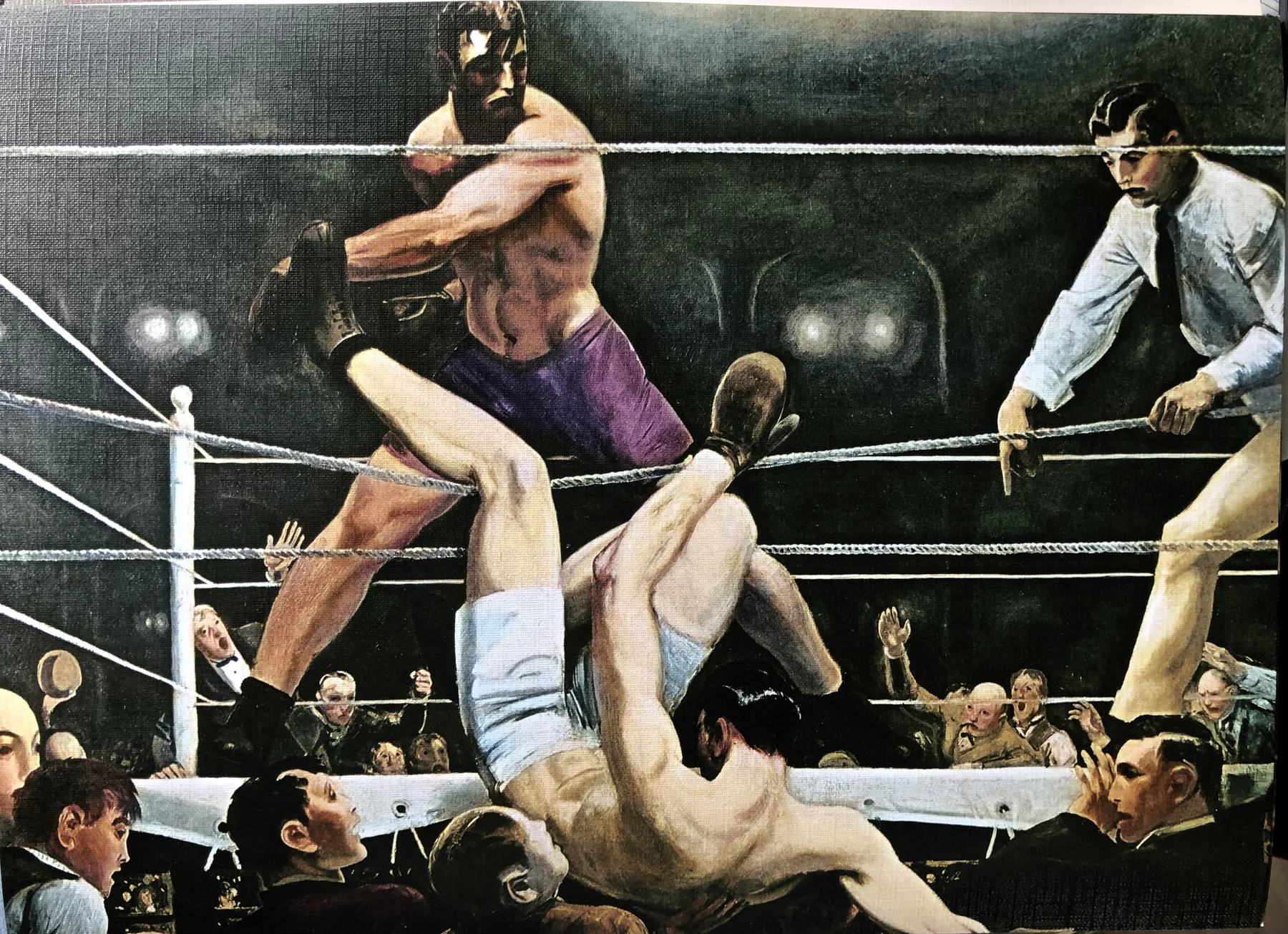
DEMPSEY AND FIRPO
George Bellows
- Artist
- George Bellows (1882–1925)
- Date
- 1924
- Dimensions
- 129.5 x 160.5 cm
- Medium
- Oil on canvas
- Location
- Whitney Museum of American Art, New York City, USA
George Bellows was an American realist painter working in the early 20th century who presented life in New York through his own lens. He depicted crowded tenements, street scenes, snowy townscapes and landscapes, but he also portrayed people and painted portraits. Bellows’ perhaps most memorable works are his paintings and lithographs of boxing matches, which practically explode with raw energy.
The Fallen Champion
In 1923 the New York Saturday Evening Post asked Bellows to make an illustration of the boxing match held at the Polo Grounds on 14 September. The bout was for the world heavyweight title, between the American title-holder Jack Dempsey and his challenger, the excellent Argentinian boxer Luis Firpo. The painting depicting a scene from the match was the last piece in Bellows’ series on boxing. The artist felt a strong urge to capture the primitive brutality and excitement of boxing matches, which took shape in six paintings, 18 lithographs and 22 drawings. In Dempsey and Firpo, dating from 1924, Bellows chose to show the most dramatic moment of the first round, when Dempsey fell out of the ring and landed in the front row of the press seats. The crowd pushed the fallen champion back into the ring; he pulled himself together and in the second round knocked his opponent down with a devastating blow, thereby winning the match.
From the Widow to Whitney
George Bellows’ illustration never appeared in the New York paper, as the issue was cancelled because of a printers’ strike. Bellows made a lithograph of the event and the painting Dempsey and Firpo. Six years after Bellows’ death from peritonitis in 1925, his widow, Emma, sold the picture for 18,500 dollars — then a record price for an American work of art — to Gertrude Vanderbilt Whitney, who bought the work for the Whitney Museum of American Art in New York. The picture became a well-known classic, and reproductions of it were handed out to soldiers in camps and hospitals during the Second World War.
Effortless Strength
George Bellows followed the artistic teachings of his master, Robert Henri, who encouraged his pupils to observe things in their own surroundings and to paint quickly. This direct, realist style of painting characterised Bellows’ early works — The Lone Tenement (1909), New York (1911) and Cliff Dwellers (1913) — which depicted working-class life in notorious New York neighbourhoods such as the Lower East Side.
Bellows also painted the illegal professional boxing matches at Tom Sharkey’s Athletic Club, at a time when public boxing was banned. These works include Club Night (1907), Both Members of This Club and Stag at Sharkey’s (both 1909). With dark tones he vividly depicted the unique atmosphere and bloodthirsty world of the ring, the aggressive, muscle-bound yet effortless-seeming strength of the fighters, and the enthusiastically cheering audience. His later work, Dempsey and Firpo, painted in 1924, shows signs of a change of style with its stronger use of contrast between light and shadow — here we see the boxers, as well as the faces and hands of the spectators, in the spotlight.
A Well-Constructed Composition
George Bellows’ painting captures a dramatic moment in the boxing match fought by Dempsey and Firpo for the world heavyweight title. The artist claimed that he watched the events from the front row and that Dempsey fell right on top of him when he was knocked out of the ring, but critics dispute whether he depicted himself among the people behind the falling champion or as the bald man on the left. Bellows described his dynamic work in memorable but sardonic words, saying that he only wanted to capture the brutality of the sport: “I am just painting two men trying to kill each other.”
Although there are obvious similarities with his earlier boxing studies, Dempsey and Firpo clearly illustrates the more structured, geometric approach of the artist’s later works. Bellows arranges his composition in a clearly legible triangular shape, whose apex is formed by Firpo’s head. This structural element is emphasised by the Argentinian boxer’s stance: his legs are spread wide as he lands a blow on his opponent. The referee, although seen from a different angle from the fighters, also forms a triangle with his arms and legs, mirroring the figure of the dominant boxer. In contrast, the artist depicts Dempsey with tangled limbs, his body all curved lines, as he falls with his full weight into the ranks of the audience.
- Dempsey knocked out of the ring
- Bellows: The Lone Tenement
- Bellows: Both Members of This Club
- Jack Dempsey with the painting in 1965