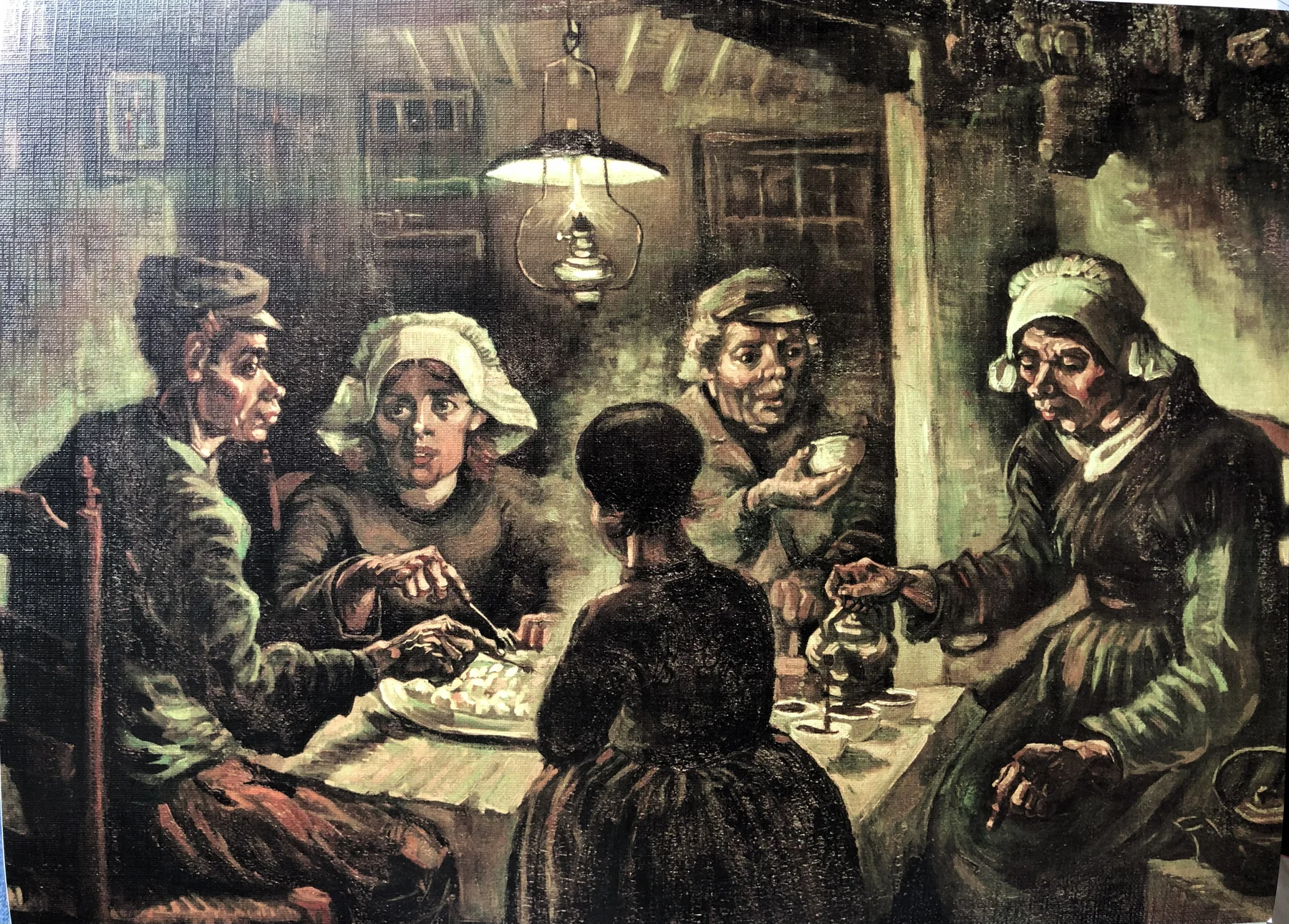
THE POTATO EATERS
Vincent van Gogh
- Artist
- Vincent van Gogh (1853–1890)
- Date
- 1885
- Dimensions
- 95 x 114 cm
- Medium
- Oil on canvas
- Location
- Van Gogh Museum, Amsterdam, Netherlands
The two years Van Gogh spent in Nuenen, 1883–85, sometimes referred to as his gloomy, dark period, proved to be a productive creative phase. Inspired by the famous works of Jean-François Millet, Van Gogh made more than two hundred drawings and some 180 paintings during this time, including Dutch landscapes, scenes of simple rural life and the work of farm labourers, and figure studies. The Potato Eaters, in a style diametrically opposed to the vivid, vibrant colours of the yellow sunflowers and wheatfields, is regarded as one of his early masterpieces.
Painter of Peasants
Van Gogh wanted to paint for the people, to make art accessible to everyone through reproductions, and at the same time he had a strong desire to depict people. When he returned from The Hague in 1883 to his parents’ home in Nuenen in North Brabant, his drawings and paintings mainly showed the life of the local peasants: he depicted the farm labourers of the flat Dutch countryside at work. Like his role model, the Frenchman Millet, Van Gogh regarded himself as a “peasant painter”, recognising the heroism of the simple but hard lot of the farm worker: “I am so absorbed in studying peasant life, watching it all day long, that I can hardly think of anything else.”
Van Gogh spent most of the winter of 1884–85 making sketches, working up drawings or painting studies while preparing a large figure composition, which finally took shape in his oil painting The Potato Eaters. On 9 April 1885 he wrote to his brother Theo: “I am working again on the picture of peasants sitting around a dish of potatoes… I have painted it on a rather large canvas, and I hope that, like the sketch, it has life in it.”
Earth Colours
Van Gogh was famous for his bold use of colour in his later expressive and energetic works, but even the dark and gloomy palette of his early works, such as The Potato Eaters, is charged with emotion. In this picture, made in the family home in Nuenen, Van Gogh creates a sombre mood with shades of brown, grey and green as the peasants eat their modest supper of boiled potatoes. In his later paintings colours have a meaning of their own, but the dark tones of The Potato Eaters are in keeping with the subject depicted. He painted the hands and faces of the peasants eating in the dimly lit room in earthy shades; by his own account he wanted to paint them the colour of “a really dusty potato, unpeeled of course”.
Honest Manual Labour
In a letter to his brother Theo in March 1882 Van Gogh describes Jozef Israëls’ painting Peasant Family at the Table, which depicts a farming couple eating with their small children around a table, and which inspired Van Gogh to create a similar composition. Here too the man and the woman sit at the two ends of the table, as in Israëls’ earlier picture, but Van Gogh compresses the space with the small table and shows all five figures of the family scene close up. His perspective is distorted; he depicts each figure from a different viewpoint, and despite their relative closeness they remain separate from one another. The artist heightens the sense of alienation by showing the child in the central position from behind and by freezing the adults in poses as they are absorbed in their various activities.
The small orange glow of the night lamp casts a weak light on the peasants’ hands and faces and on the dish of boiled potatoes. Van Gogh wanted to express the dignity of the hard manual labour of simple peasant life: “they reach into the dish with the same hands with which they have dug the earth… and they have honestly earned their food.” In The Potato Eaters Van Gogh depicted the life of poor peasants free of any sentimentality, but with deep feeling and empathy.
- Jean-François Millet
- Millet: Peasant Woman
- Van Gogh: Head of a Peasant (study)
- Jozef Israëls
- Israëls: Peasant Family at the Table
- The Van Gogh Museum, the painting’s present home