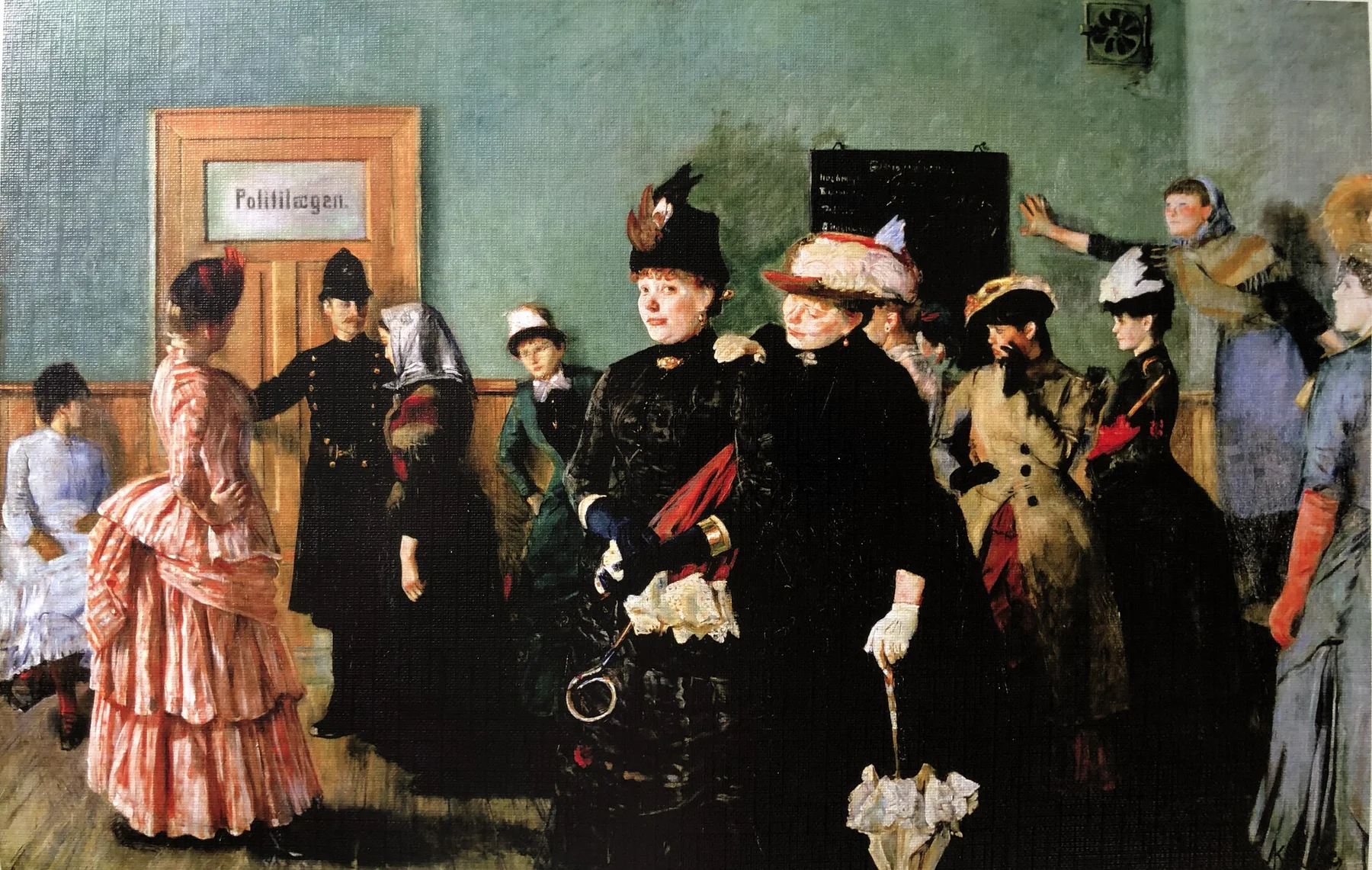
ALBERTINE IN THE POLICE DOCTOR’S WAITING ROOM
Christian Krohg
- Artist
- Christian Krohg (1852–1925)
- Date
- Between 1886 and 1887
- Dimensions
- 211 x 326 cm
- Medium
- Oil on canvas
- Location
- National Gallery, Oslo, Norway
Albertine in the Police Doctor’s Waiting Room, by the outstanding Norwegian painter Christian Krohg, was made at the end of the 19th century. In a significant number of his paintings this highly socially conscious artist presented to the public the situation of the “fallen women” of the Norwegian capital. In doing so he too made a significant contribution to the banning of prostitution in the country in 1887.
A Sensitive Subject
The painter, graphic artist and writer Christian Krohg created Albertine in the Police Doctor’s Waiting Room in 1886–87. Krohg not only strove for an objective, realist mode of depiction in his paintings but also portrayed everyday Norwegian life in his writings. In 1886 he wrote the highly controversial novel Albertine, about a poor seamstress who became a prostitute in the Norwegian capital, Christiania, today’s Oslo.
Krohg was taken to court on charges of obscenity, mainly because of his vivid description of the police medical examination of prostitutes. In late-19th-century Norway prostitutes had to undergo humiliating regular medical examinations, a practice introduced to protect the health of the male clients rather than the women. At the trial on 10 March 1887 Krohg lost the case, was fined, and his book was banned. Krohg nevertheless painted the same subject in Albertine in the Police Doctor’s Waiting Room. Since he could not show in his novel what went on in the doctor’s surgery, he made the picture; he depicted the group of prostitutes on the other side of the police doctor’s room.
Part of a Series
Before painting Albertine in its final form on a large canvas, Krohg made numerous oil studies of prostitutes, such as Jossa (1884). Through a series of different scenes Krohg presented the fate of Albertine, the poor seamstress who was raped by a police officer and then dragged to the police station for a medical examination. The first painting in the series, Daybreak (1880), shows Albertine asleep, slumped by her sewing machine, unable to continue her work from sheer exhaustion. Albertine in the Police Doctor’s Waiting Room is the last piece in the series.
Social Realism
Krohg’s creed was that a painter must paint “truthfully, penetratingly truthfully, uncomfortably truthfully”. Although Krohg’s social-realist picture is not as graphic as his earlier novel, Albertine in the Police Doctor’s Waiting Room nevertheless caused a great uproar when it was first shown. Known for his energetic and outspoken creative style, Krohg, as one of the leading figures of Norwegian art, played an important part in the transition from Romanticism to Naturalism and in the highly precise depiction of the visible world.
Pushed into the Background
Krohg first planned a group picture of six figures with Albertine and the police officer in the middle of the waiting room, but he repainted his original composition and added several more figures to the scene, while placing the young seamstress in the background. The perspective lines of the floor, however, lead to the figure of Albertine with her head bowed, whom the police officer is about to lead into the doctor’s surgery. Most of the women’s eyes are directed at the unfortunate Albertine, whose simple clothing contrasts with the more colourful and elegant attire of the prostitutes. The two women in black standing defiantly in the middle of the foreground embody Albertine’s future: how the young girl’s character will change under the influence of life on the streets of Christiania.
Artistic Connection
Christian Krohg was a forerunner of Norway’s most famous painter, Edvard Munch (1863–1944, pictured). Munch received little artistic training, but his compatriot Christian Krohg was his teacher at the Royal School of Art in Christiania. Under Krohg’s influence Edvard Munch began painting in a realist style in the 1880s, but he soon abandoned this mode of depiction: “I shall paint living people who breathe, feel, suffer and love,” he declared. In his later imaginative pictures Munch used stripped-down landscapes, simple colouring and abstract lines, as in his unforgettable work The Scream (1893).
- One of Krohg’s pictures, The Warning (1884)
- National Gallery, Oslo, the painting’s present home