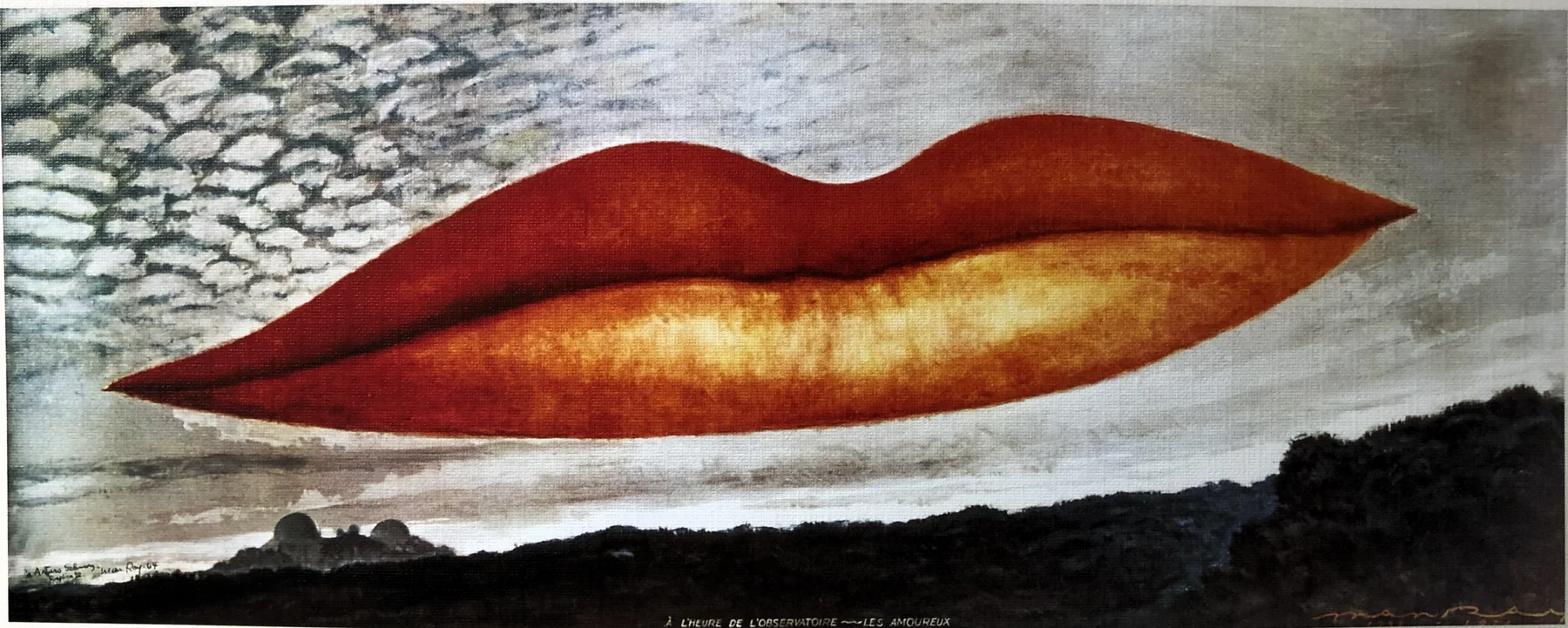
THE LOVERS
Man Ray
- Artist
- Man Ray (1890–1976)
- Date
- 1934
- Dimensions
- 100 x 250.4 cm
- Medium
- Oil on canvas
- Location
- Private collection
Man Ray was one of the most inventive and technically gifted photographers of the 20th century, and his mastery of this art form overshadows even his remarkable talent as a painter. The most famous picture by this excellent and highly original painter is The Lovers, made in 1934 in Paris, then the centre of the art world. Man Ray moved from New York to Paris in 1921 and soon rose to become one of the leading Surrealist artists. His monumental painting, a passionate ode to a lost lover, immediately became an iconic work of the movement.
Dramatic Changes
The Lovers is the high point of Man Ray’s painting career in Paris and at the same time a shining example of how much his style had changed since his American debut. His early works, such as a self-portrait from 1909, are much more conventional, and only in 1913 did he experience the kind of creative enlightenment that prompted a dramatic change of direction. This turning point came with the famous — and notorious — Armory Show of modern art, held in New York in October of that year. At this exhibition Man Ray discovered Cubism and, more importantly, Dada, the “anti-art” movement that challenged traditional aesthetics. One of the key figures of the movement was the Frenchman Marcel Duchamp, whose absurd exhibits — so-called ready-mades — such as a bottle rack or a urinal perfectly summed up the essence of the movement and baffled the critics of the time again and again. Man Ray met Duchamp at the New York exhibition; they became close friends and in time the leaders of American Dada. While Duchamp’s career was approaching its early end, Man Ray’s was only just beginning. In 1921 he moved to Paris, where he remained connected with Dada and then began to collaborate with the masters of depicting subconscious processes, the Surrealists.
The Lost Lover
The Lovers, Man Ray’s Surrealist masterpiece, is known for its strange dreamlike quality and open sensuality. Undoubtedly the most distinctive feature of the painting is the huge ruby-red mouth, almost two metres wide, which seems to float like an airship above the green, billowing landscape. Despite the improbable combination of pictorial elements, the lips and the landscape are surprisingly realistic. The setting of the picture is the Luxembourg Gardens, a large public park in the centre of Paris, and the lips belong to Lee Miller, Man Ray’s lover, assistant and model at the time.
Although the painting seems to glorify Miller, Man Ray actually painted The Lovers when he was already mourning the end of their relationship. The couple’s stormy three-year affair ended in 1932, after which the depressed artist often disappeared from his Montparnasse studio to clear his head on long walks. His wanderings usually ended in the Luxembourg Gardens, which offered a splendid view of the Paris Observatory, whose twin domes rose like “faintly outlined breasts on the horizon”. In this painting Man Ray captures exactly this view, while the lips of his former lover hover like a ghost above it in the cloud-flecked sky.
A Fruitful Relationship
In the early 1930s Lee Miller meant an enormous amount to Man Ray, both personally and professionally. Born in New York in 1907, Miller had a successful career as a model before she crossed the ocean in 1929 and entered Man Ray’s life. Although their relationship was relatively short and not without stormy scenes, it proved fruitful. During their time together Miller became a skilled photographer herself, assisted at Man Ray’s fashion shoots and finally opened her own studio. On the other hand she inspired many of Man Ray’s famous photographs; her lips, which fascinated the artist, were often given a prominent place in his works, as in the erotically charged The Kiss (1930). Miller also played a significant part in Man Ray’s reputation as an innovator. When she arrived in Paris, Man Ray had already developed his “rayograph”, his cameraless photographic technique, but the later perfection of “solarisation” effects is at least as much due to Miller. This photographic process reversed the light and dark tones in pictures and became a characteristic feature of Man Ray’s work at the time. Miller discovered the technique by accident in 1929 while developing photographs in Man Ray’s studio.
A Practical Dreamer
Although today he is best known as a Surrealist photographer, Man Ray was much more than that. He described himself as a “practical dreamer”, since he was versed in all the arts, from painting through sculpture and film to photography and literature. Although he saw himself primarily as a painter, it was his pioneering photographs that caused a sensation, and it is almost natural that The Lovers also appeared in print. After finishing the painting he hung it on the wall of his studio and in 1936 used it as the backdrop for a series of photographs later published in the magazine Harper’s Bazaar. Although the painting is now in a private collection, Man Ray kept it in his studio for years, a painful reminder of the woman who left an indelible mark on almost every area of his life.
- The 1913 Armory Show
- Marcel Duchamp
- The Luxembourg Gardens today
- Lee Miller