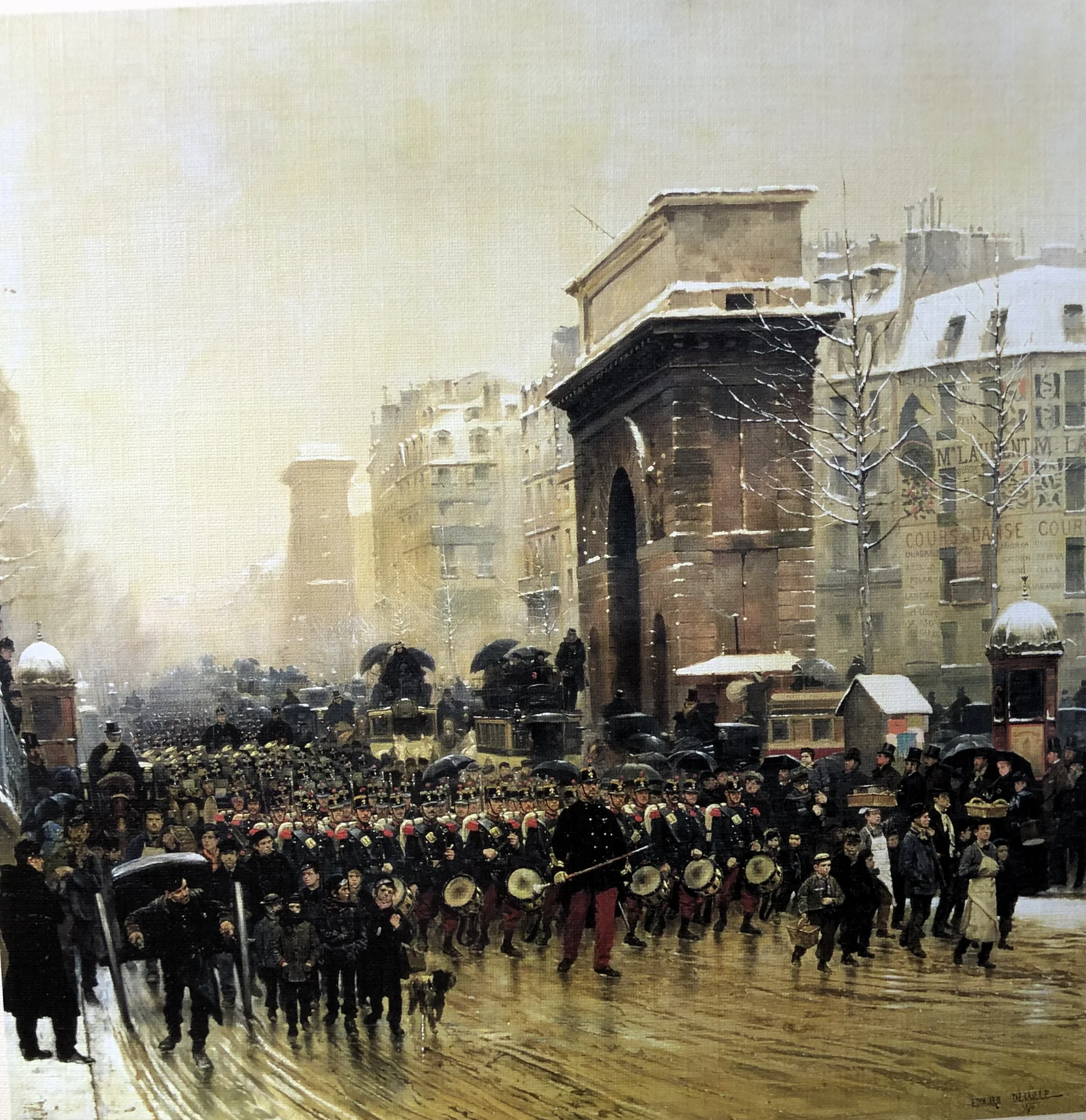
THE REGIMENT PASSING
Édouard Detaille
- Artist
- Édouard Detaille (1848–1912)
- Date
- 1875
- Dimensions
- 127 x 127 cm
- Medium
- Oil on canvas
- Location
- Private collection
At the end of the 19th century, after the Franco-Prussian War of 1870–71, which ended in humiliating French defeat, France cried out for revenge. In the years after the war, battle painters rode the waves of patriotic enthusiasm and could barely keep up with the demands of their buyers. One of the finest representatives of the genre was Édouard Detaille. In The Regiment Passing he captures the proud survivors of the “glorious defeated” as they march past the Parisian monuments erected in honour of earlier French victories.
A December March
On a snowy December day we stand among the gawping onlookers on one of the old, broad boulevards of Paris, the rue Saint-Martin. Along the muddy road a regiment in formation approaches us, led by the military band. The regiment marches past the triple-arched Porte Saint-Martin, while the Porte Saint-Denis looms in the background.
While the townspeople watch the scene respectfully from under their umbrellas, a band of children takes the lead of the procession, along with a few bakers carrying bread baskets; this is truly the people’s army, not the elite corps of a monarch.
The Gates of Glory
The two triumphal arches of the rue Saint-Martin and the Porte Saint-Denis were erected in the 1670s to commemorate the military victories of King Louis XIV. The Porte Saint-Martin bears the following inscription in Latin: “To Louis the Great, for his victories over the German, Spanish and Dutch armies.” Since he painted his picture shortly after the French military collapse, there is no doubt that Detaille deliberately chose to depict these two proud monuments in The Regiment Passing. It may also have played a part in the depiction of the triumphal arches that Napoleon passed under the Porte Saint-Denis after his successful campaign of 1816.
The Company of Three
Several well-known personalities can be seen in the crowd painted by Detaille. On the far right of the picture, dressed in blue, is his former teacher Ernest Meissonier. Next to Meissonier stands Detaille himself, wearing the red ribbon of the Legion of Honour on his brown clothes. On the far left of the composition we can recognise Adolphe de Neuville (1835–1885), Detaille’s close friend and another famous battle painter of the age.
Like Detaille and Meissonier, Neuville was known as an ardent patriot who captured the glory of the French army in pictures such as The Last Cartridges, depicting the desperate resistance to the Prussian attack of 1 September 1870. (Emperor Napoleon III laid down his arms and was taken prisoner the following day.)
The fate of the French was sealed when the Prussians took Paris at the end of January 1871 after a four-month siege. The following month the unified German Empire came into being.
Detaille, to the Letter…
Detaille volunteered for the army and served as a war painter in 1870. He not only painted war scenes but also made topographical maps of the Paris area and the enemy positions. His direct experience of battle gave his works a degree of authenticity matched only by Meissonier and Neuville.
In the years after the war Detaille obsessively collected original military uniforms and equipment, studying even the last boot nail and belt buckle thoroughly, so that by painting his pictures slowly and carefully he could depict his figures with perfect accuracy.
His love of detail did not impress everyone. In 1877 the journalist Henri Houssaye said of the soldiers in Detaille’s paintings: “Their equipment is complete, their armour gleaming, their horses carefully groomed. Not a speck of dust! Their hair is regulation, their packs in order… Even the mud takes care to spatter the boots and trouser legs according to regulations… but the soldiers lack character, verve, life. Although they look as if they had stepped out of an enameller’s kiln, Detaille’s painted soldiers have never fired a gun.”
- The Porte Saint-Denis today
- Porte Saint-Martin, 1890
- The Siege of Paris
- Detaille: The Battle of Villejuif, Siege of Paris (1870)
- Henri Houssaye