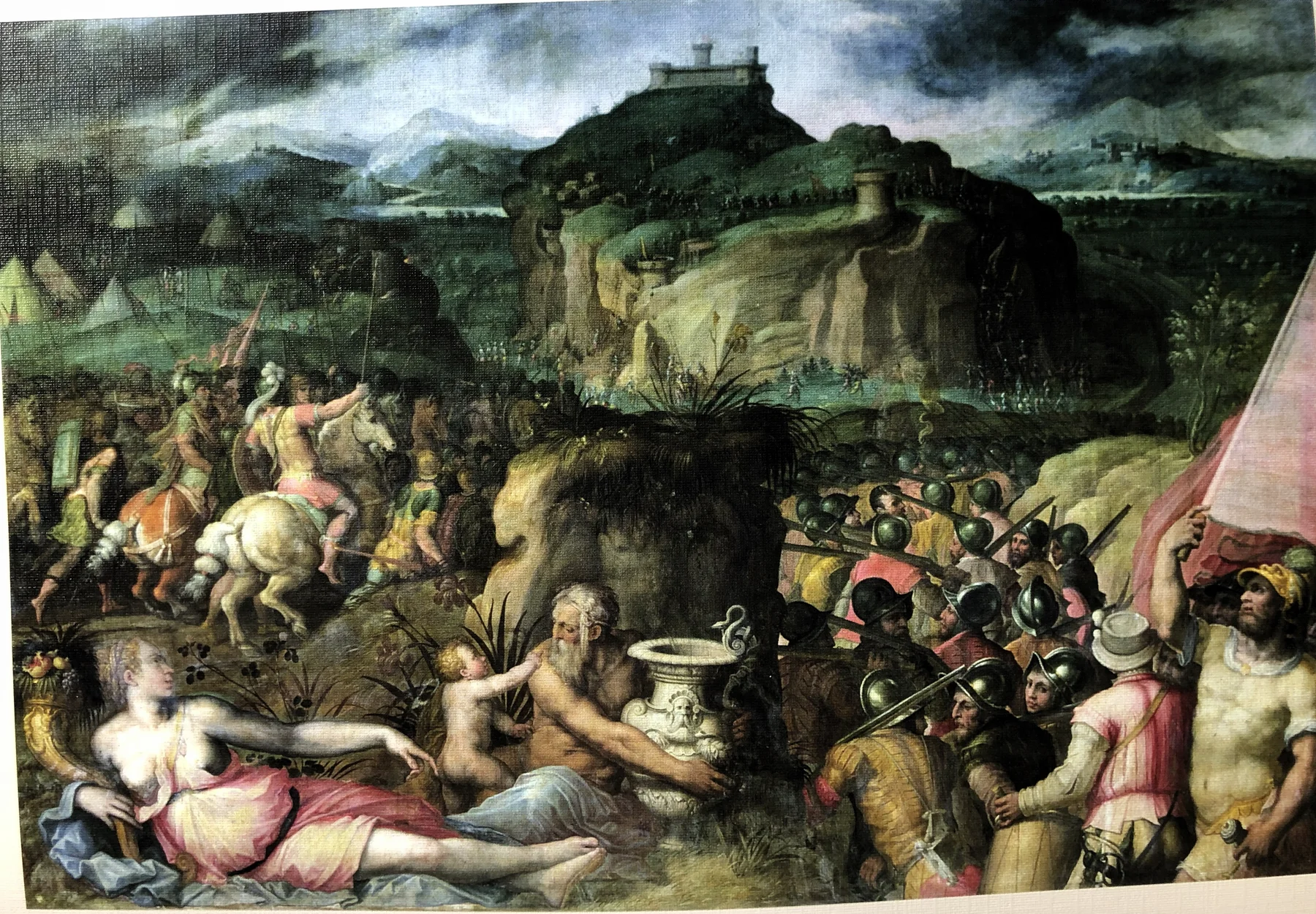
THE SIEGE OF SAN LEO
Giorgio Vasari
- Artist
- Giorgio Vasari (1511–1574)
- Date
- Uncertain (c. 1555–62)
- Dimensions
- Unknown
- Medium
- Fresco
- Location
- Suite of Pope Leo X, Palazzo Vecchio, Florence, Italy
In the mid-16th century Giorgio Vasari was appointed chief architect to the ruler of Florence, Grand Duke Cosimo I de’ Medici. For the next twenty years, until his death in 1574, Vasari exercised a decisive influence on the artistic life of the court. He not only designed important buildings such as the Uffizi but also decorated many walls and ceilings with his frescoes, such as The Siege of San Leo. Vasari was regarded as the unchallengeable authority on artistic taste and criticism, and his book the Lives gave an accurate account of the work of Italy’s finest artists.
Chief Architect and Painter
Cosimo I de’ Medici commissioned Vasari to renovate and enlarge the Palazzo Vecchio in the centre of Florence. Vasari modernised the fortress-like building between 1555 and 1562. He converted the great hall on the ground floor of the Palazzo Vecchio into a suite dedicated to the memory of Pope Leo X, in which huge frescoes presented important scenes from the life of the pontiff. The frescoes were painted by two artists: Giovanni Boscoli and Giorgio Vasari. Large paintings were placed on the three main walls of the richly decorated room: they included Pope Leo X’s Visit to Florence, The Siege of San Leo and Leo X Appoints Cardinals.
The Great Hall
Vasari’s fresco The Siege of San Leo, depicting the assault of the Florentine armies on the fortress of San Leo in Montefeltro, was, like the other pictures, made in honour of Pope Leo X. Born a scion of the eminent Medici family, Giovanni de’ Medici (second son of Lorenzo “il Magnifico”, the most famous ruler of the Florentine Republic) held the papal office from 1513 until his death in 1521. In this period of Florentine history the power of the Medici family rested largely on his election as pope. Four hundred and fifty years after its creation, The Siege of San Leo can still be seen in the Suite of Leo X in the Palazzo Vecchio, but today it serves mainly as a spectacular backdrop to the meetings of the Florence city council. The papal suite is also used as the reception room of the mayor of Florence and is officially closed to the public.
Mannerist Disharmony
If drawing technique is taken as the most important characteristic, Vasari followed the Mannerist style of the Italian painters he held in high esteem, including Andrea del Sarto (1486–1530), Baccio Bandinelli (1493–1560) and Parmigianino (1503–1540). Vasari idolised Raphael (1483–1520) and drew inspiration from the sculptures and paintings of Michelangelo (1475–1564). These artists rejected the lofty Renaissance ideals of unity, balance and harmony, using instead unusual proportions and poses and louder colours and tones in their compositions, which thus radiated a general sense of disharmony. The standard-bearer in the right corner of The Siege of San Leo adopts a characteristic Mannerist pose: his muscular torso is turned towards the viewer in a strangely twisted position, while with his head turned away he looks towards the imposing crag of San Leo.
An Irresistible Force
Vasari’s painting The Siege of San Leo records the assault on the rocky fortress of Montefeltro, in the Marche region of central Italy, which the Medici, financed by Leo X, besieged in the early 16th century during their short campaign against the Duke of Urbino, Francesco Maria I della Rovere. Despite the anachronistic placing of classical figures in the foreground of the battle scene, the centre of gravity and focus of the composition is directed to the picturesque mountain fortress towering in the background. Vasari shows the soldiers’ pincer movement: on the left a flood of cavalry pushes forward with great force, while armed infantry cross a ravine on the right. By depicting heads turned in different directions and awkward poses, Vasari gives the soldiers individual character. The Florentine army in the distance appears far more unified, as the men march like tiny ants, determined and unstoppable, along the rough road leading to victory.
- Vasari: Cosimo I
- Palazzo Vecchio
- The Suite of Pope Leo X in the Palazzo Vecchio, designed by Giorgio Vasari
- Raphael: Portrait of Leo X
- The fortress of San Leo today