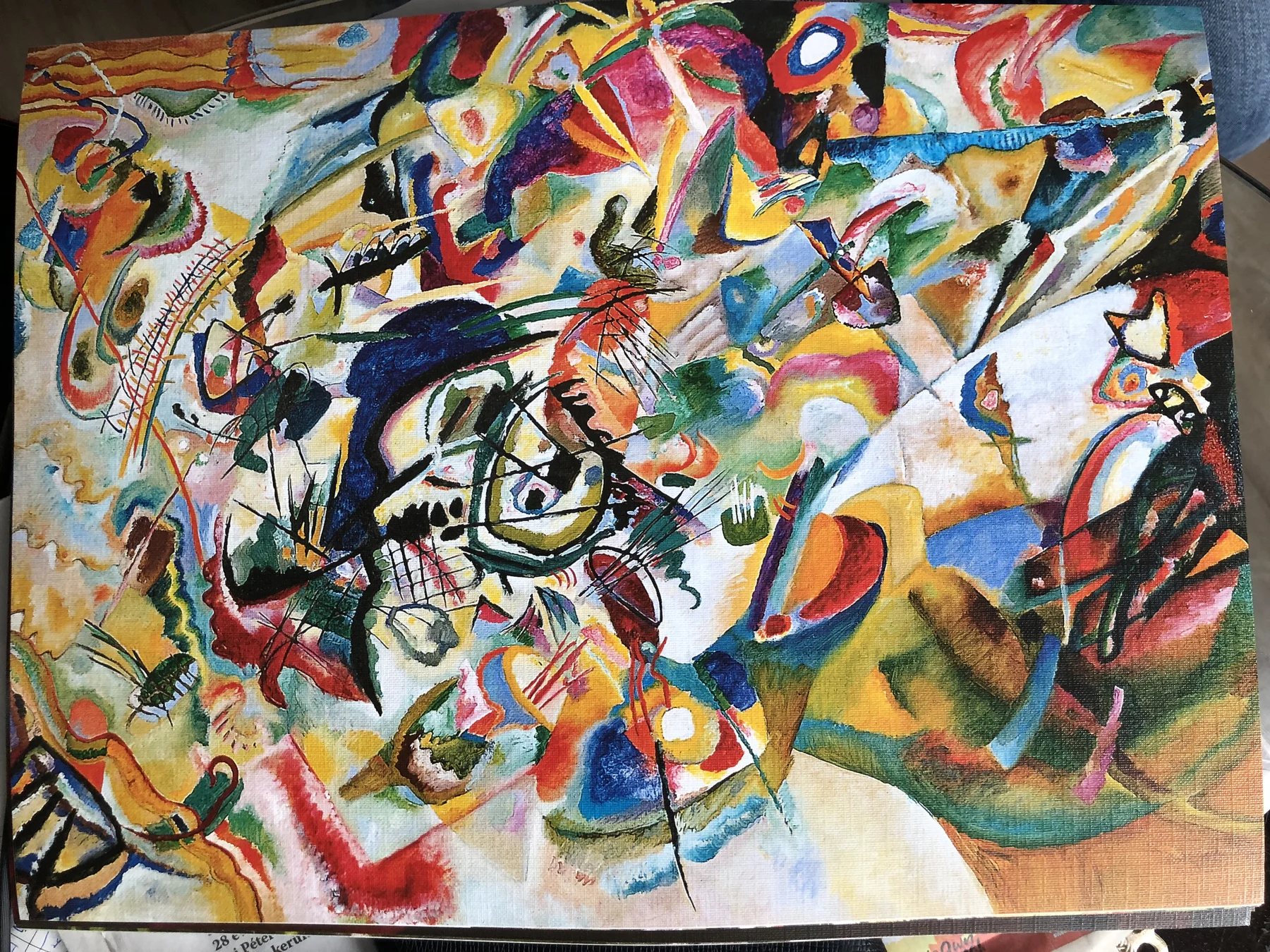
COMPOSITION VII
Wassily Kandinsky
- Artist
- Wassily Kandinsky (1866–1944)
- Date
- 1913
- Dimensions
- 200 x 300 cm
- Medium
- Oil on canvas
- Location
- Tretyakov Gallery, Moscow, Russia
In the late 1940s and the 1950s artists including Jackson Pollock and Willem de Kooning dazzled the art world with a series of monumental paintings presenting vivid expressions of their innermost feelings: they painted, poured, dripped and splattered paint. It is debatable whether these artists sacrificed the depiction of the real world for a new, more abstract art form, and they were not the first to work this way. Long before the period known as Abstract Expressionism, the Russian Wassily Kandinsky was already applying a new, radical artistic approach to convey raw emotional experience beyond the visible object.
Music and Emotion
The most important difference between Kandinsky and the Abstract Expressionists such as Pollock is that while the latter sought to give visual form to their own emotions, Kandinsky wanted to pass on emotional experience to the viewer. The fundamental challenge was the “how”, and in searching for the answer he went beyond the boundaries of conventional art into the realm of music. From childhood Kandinsky was fascinated by the psychological effect of music; he called music the supreme teacher. Through the symphonies of avant-garde composers, including Arnold Schoenberg, he realised that abstraction lies within music, and that its spontaneous language can immediately and dramatically influence the listener’s emotions. Kandinsky believed that colour could do the same: “Colour vibrates the soul. Colour possesses a still unknown but real power that acts on every part of the human body.” From the early 1900s Kandinsky began to explore the relationship between music and emotion in his art, composing his paintings as a composer composes a symphony. Instead of notes and chords Kandinsky used colours and forms to create an entirely new and emotion-filled visual language.
The Discovery of Abstraction
Painted in 1913, Composition VII is part of Kandinsky’s ten-piece Composition series. He chose this title not only because of the musical connection but also because of the emotions it stirred in him: “The word composition moved me spiritually, and painting a composition became my life’s goal.” He made the first picture in the series around 1910 and finished the last almost three decades later, in 1939. The pictures offer a unique opportunity to gain insight into how Kandinsky explored the world of abstraction. The first seven paintings were made before the First World War, and they focus to varying degrees on the themes of violence and the end of the world as they appear in the Bible. The early works are mostly figurative, and in Composition IV, painted in 1911, some of their elements can still be recognised, including three Cossacks holding lances, rearing horses and a walled city spread over a hilltop. After this, however, the pieces in the series become increasingly abstract, and in Composition VI pictorial representation has disappeared.
A Carefully Planned Composition
Kandinsky’s writings and his preliminary studies for the picture suggest that Composition VII, like the earlier pieces in the series, is essentially a collage of biblical stories, from the Flood and the Resurrection to the Last Judgement. Apart from the familiar boat-like object in the lower left corner of the frame, however, the subject cannot be identified visually. Although at first glance the colours and forms in the painting seem chaotic and arbitrarily arranged, Kandinsky in fact thoroughly planned and constructed the picture, making more than thirty sketches, watercolours and oil studies for it. After these meticulous preparations he finished the work in his Munich studio in November 1913 in just four days.
A Swirling Vortex
Kandinsky’s aim was for the viewer “to walk around within the picture…, thus becoming part of it”, and indeed it is easy to get lost in the swirling vortex of Composition VII. The picture is not only the largest but also the most ambitious piece of the Composition series. With undulating lines moving outward from a narrow centre drawn in black calligraphic and meandering lines, Kandinsky presents intense, strong colour contrasts and interpenetrating, colliding forms. We feel that the painting has created a kind of symphony with the composition’s undulating lines and combination of colours, producing rhythm, harmony and dissonance that rise and fall as the eye scans the picture.
Kandinsky once said that “the more frightening the world becomes…, the more abstract art becomes”, and this could not have been put more precisely in the light of the events of the time. Composition VII was completed just as Europe was drifting towards the First World War, a huge catastrophe for humanity. Kandinsky’s pictures are often seen as a premonition of this turbulent period, although the equally present harmony and dissonance can easily be understood as hope, and perhaps as the promise of peace to come.
Artistic Connection
Kandinsky’s aims differed considerably from the spontaneous techniques of the “gestural painters”, including Pollock and De Kooning, and his works bore more resemblance to those who followed the other form of Abstract Expressionism, so-called “colour field painting”. These painters, such as Mark Rothko and Barnett Newman, like Kandinsky, used broad, flat areas of colour in order to communicate with the viewer and elicit emotional responses.
- Arnold Schoenberg
- The Tretyakov Gallery, where the painting can be seen