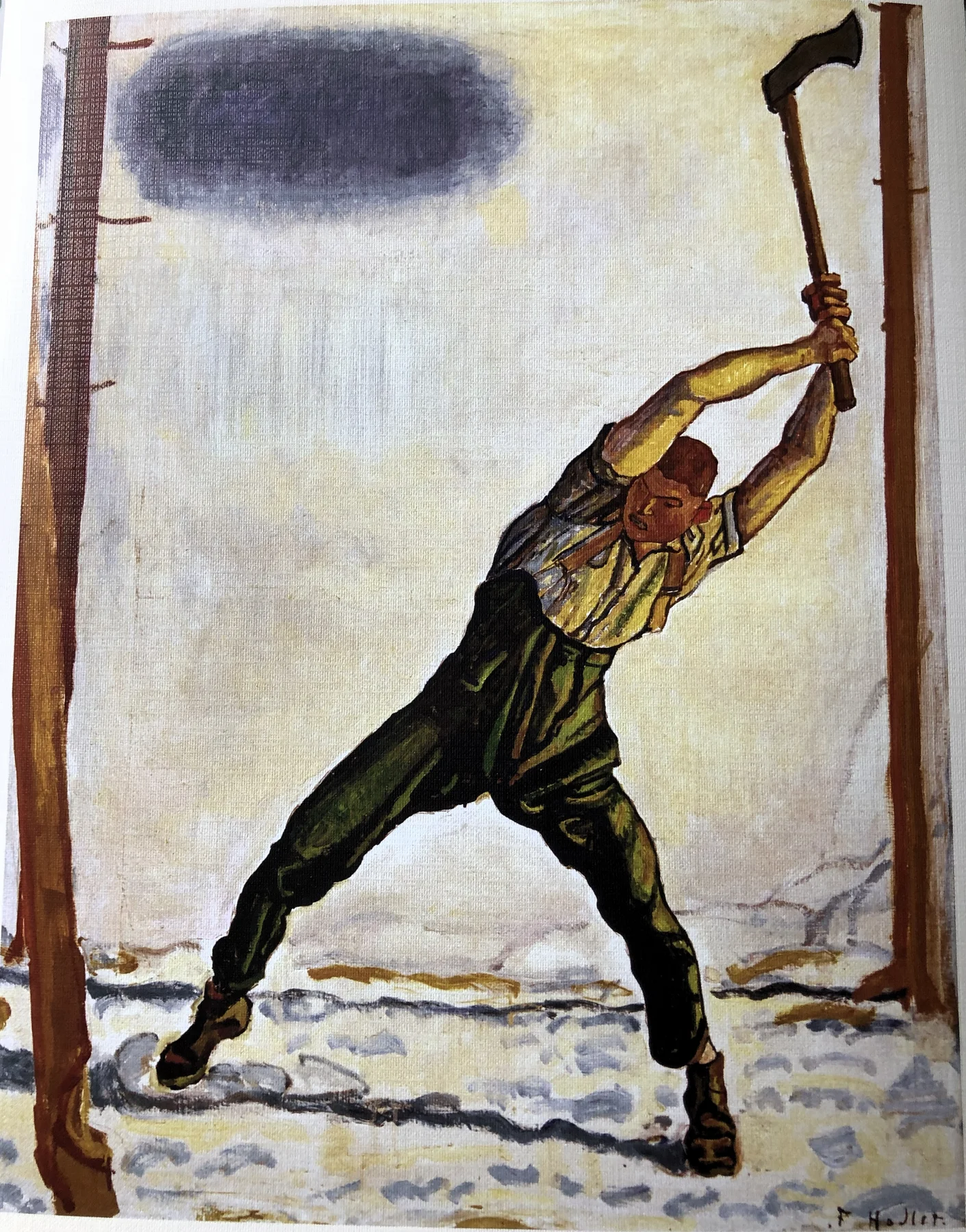
THE WOODCUTTER
Ferdinand Hodler
- Artist
- Ferdinand Hodler (1853–1918)
- Date
- 1910
- Dimensions
- 130 x 101 cm
- Medium
- Oil on canvas
- Location
- Von der Heydt-Museum, Wuppertal, Germany
Roughly a century ago Ferdinand Hodler was, alongside Arnold Böcklin, one of Switzerland’s leading modern painters. Known for his landscapes of mountains and lakes, he also wove elements of the contemporary art styles — Symbolism, Art Nouveau and its German equivalent, Jugendstil — into his deeply spiritual depictions of people. The Woodcutter is one of his most popular works: drawn from traditional rural iconography, it was received as a masterpiece of Symbolism, as it expressed the dynamism and self-confidence characteristic of modern Switzerland.
An Existential Study of Death
Ferdinand Hodler was a prolific painter and graphic artist who slowly but surely rose to become one of Switzerland’s best-known modern artists. In the 1870s he started out from the realist school, following in the footsteps of Corot and Courbet, then gradually moved towards Symbolism, painting historical and mythological scenes whose figures he depicted in expressive, emotional poses. Man’s spiritual response to mortality (which he called the “permanence of absence”) became his main subject. His works either confronted the inevitability of death or embodied surging vitality.
An example of the former is his picture Night (1890): among six naked sleeping figures a man suddenly wakes to find a strange hooded figure crouching over him, a terrifying vision of death. Although the painting was not permitted to be shown in Geneva because of the nudes, elsewhere it received excellent reviews: it won gold medals in Munich in 1897 and at the 1900 Paris World’s Fair.
World Fame at Last
The success of Night established Hodler’s international reputation, which grew further with his large retrospective exhibition in Vienna in 1904. After that he was flooded with so many portrait commissions that he could pick and choose among them.
Hodler also received state commissions. Switzerland underwent profound changes in the second half of the 19th century, developing into a modern federal state, and national sentiment found expression in public art and design. Hodler’s decorative murals include works such as The Retreat from Marignano (1899, Swiss National Museum, Zurich) and The Departure of the Jena Students to the War of Liberation (1909, University of Jena), both historical frescoes commemorating self-sacrifice.
In the Service of the Nation
In October 1908 the Swiss National Bank asked Hodler to design pictures for a new series of banknotes. The theme of the series, Work, covered four main areas: manual labour, agriculture, commerce and industry. Hodler designed The Woodcutter (manual labour) for the back of the fifty-franc note and The Reaper (agriculture) for the hundred-franc note. The designs for the five-hundred and thousand-franc notes were made by the realist painter Eugène Burnand; one shows an iron foundry, the other an embroidery workshop.
Variations on a Theme
Hodler made some 200 studies before submitting the final design for the banknote. His original version was delicately coloured and painterly in execution, but he was bitterly disappointed to find that the small format and the steel-engraving technique distorted the image and wiped out the expressive power of his careful work.
In 1910 the undaunted artist made a new version of The Woodcutter… then another… and another. He is thought to have come up with 13 versions in all, including copies made on special commission for collectors in distant Japan. (Almost unbelievably, a Swiss court charged him with self-plagiarism.)
Whatever he felt about the banknotes, they became popular and remained in circulation for more than half a century, until their withdrawal in 1958.
A Symbol of Vitality
The huge, heroic figure of the woodcutter fills the space between two trees whose slender trunks pale beside the figure’s strong, masculine build. The tree trunks provide a frame for the composition, well counterbalanced by the long line of the diagonal running from left to right. The extremely low viewpoint gives the picture a monumental effect, and the background to most of the diagonal is the snowy, untouched winter landscape. The strange oval cloud contributes to the balance of the composition. (It should be mentioned here that Hodler made different backgrounds for the versions of the painting: on at least two he used the stylised cloud, while on the others he depicted the sky more naturalistically.)
The long diagonal demonstrates Hodler’s draughtsmanship; he created the illusion of space with lines rather than tones. Tension radiates from the outline of the worker’s figure; his raised boot, bulging muscles and fingers clenched around the axe betray restrained violence. The decorative treatment of the axe’s flaring head recalls the artistic idiom of the Art Nouveau style then prevailing.
- Hodler: Night
- Hodler: The Departure of the Jena Students to the War of Liberation
- Fifty-franc banknote from 1911