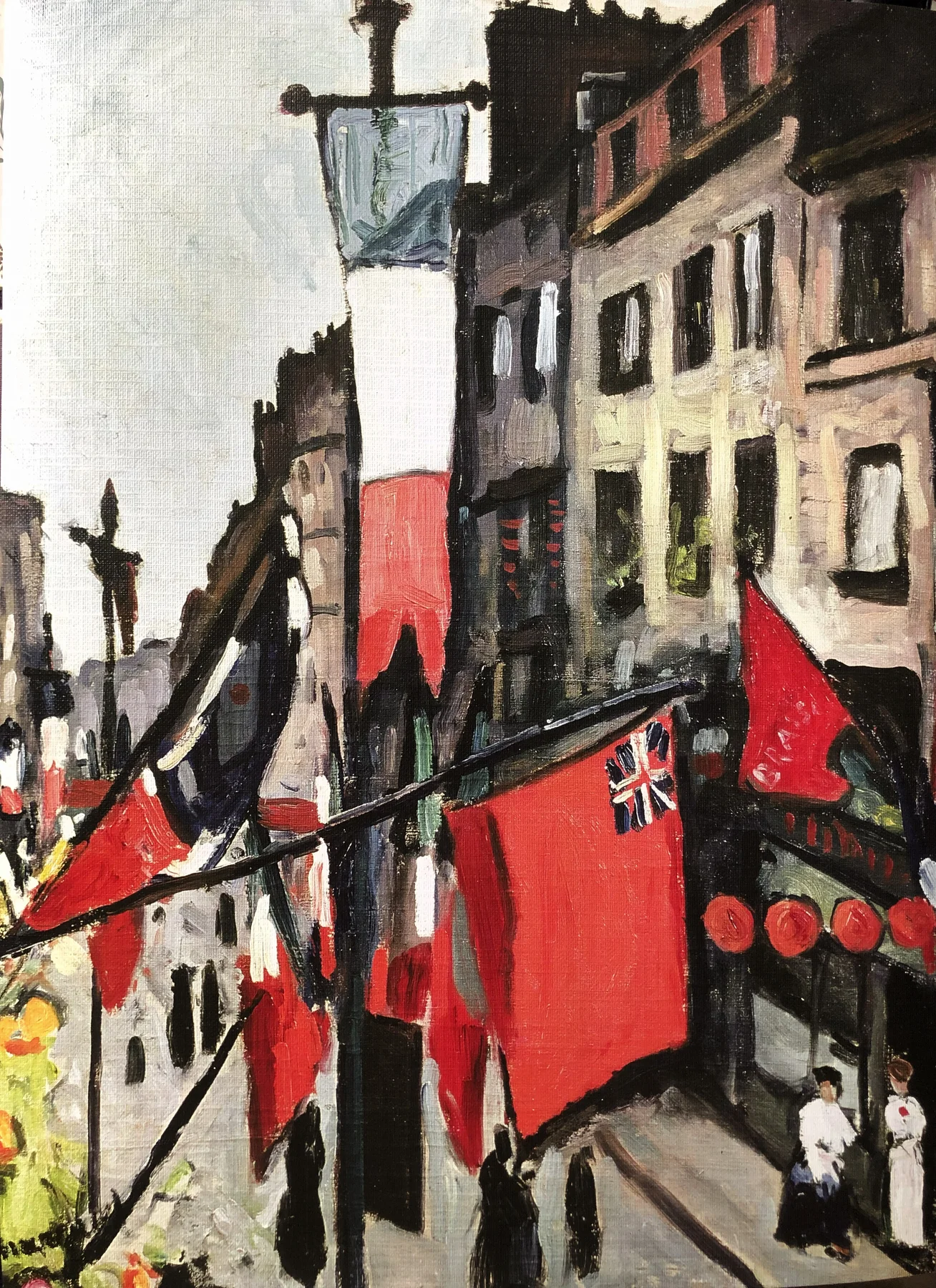
14 JULY IN LE HAVRE
Albert Marquet
- Artist
- Albert Marquet (1875–1947)
- Date
- 1906
- Dimensions
- 81 x 65 cm
- Medium
- Oil on canvas
- Location
- Musée Albert André, Bagnols-sur-Cèze, Provence
From the turn of the 20th century until his death in 1947, Marquet perfected the use of soft, filtered light in his favourite views of bustling docks, rivers and harbours, made on his travels around the world. The finely restrained palette characteristic of his mature style, however, belies the fact that he once belonged to the group of artists known as the “Wild Beasts”, who during their brief golden age, between 1905 and 1907, captured scenes such as this depiction of the French national holiday with colours applied straight from the tube.
One of the Gang
Marquet was linked to Fauvism above all by his lifelong friendship with Henri Matisse, dating back to their student days in Paris. The young artists, joined by Charles Camoin and Henri Manguin, practically lived together, shared ideals, roamed the streets of Paris with their sketchbooks and paintboxes, and when their finances allowed, travelled together to paint the sunny south or the northern light of cool Normandy.
Conquests in Normandy
Generations of French painters had already visited the Normandy coast, from Eugène Boudin and Gustave Courbet to the Impressionists associated with the names of Manet, Monet, Pissarro and Sisley, for whom the new railway network made travel in the region easier. After them came Albert Marquet, Raoul Dufy, Othon Friesz and Georges Braque, who in their Fauvist years visited the towns of the coast from Étretat to Fécamp.
The last three artists grew up in the great port city of Le Havre at the mouth of the Seine, whose busy docks handled the brisk cross-Channel trade and from which huge ocean liners departed for New York. By 1906 the expanding city, with nearly 130,000 inhabitants, had already swallowed up the elegant resort of Sainte-Adresse (where Monet painted in the 1860s) and the venerable port of Harfleur.
A Festive Mood
Marquet and Dufy had already painted together in Fécamp in the summer of 1904; at the end of June 1906, at Camoin’s urging, they also travelled to Le Havre. They took a room at the Blue Riband Hotel on the Place d’Armes in Harfleur and stayed there until the national holiday on 14 July. The umbrellas and grey sky in Dufy’s canvases suggest that the weather was bad in places that day, but this did not stop them from painting a few street scenes.
Unlike André Derain and Maurice de Vlaminck, who delighted in plunging into the anarchic colour world of Fauvism and regularly swapped colours — painting pink trees and orange pavements, for example — Marquet depicted the world more or less as he saw it. He took pleasure in the large graphic shapes of the garishly coloured flags. In this scene the drunkenly lurching flagpoles stand in glaring contrast to the tight framing, but the strong diagonals of the pavements and rooflines give the work a powerful sense of perspective, emphasised by the theatrical juxtaposition of larger and smaller flags. As in other works by Marquet, here too we find earth colours, such as the mouse-grey walls and the ash-coloured pavement.
A Holiday
Flag-decked holidays were always a popular subject for the Impressionists, since they enriched the modern townscape with vivid colours; examples are Monet’s The Rue Mosnier with Flags and The Rue Montorgueil, Paris, Celebration of 30 June 1878 (both 1878). From a practical point of view, these paintings, which reinforced national sentiment, stood a good chance of selling on the art market.
Marquet and Dufy continued their tour of Normandy: during the autumn they painted in Fécamp, Dieppe and Trouville. In the latter town they were delighted to discover that instead of flags the streets were lined with huge colourful posters, most of them advertising the local casinos, and the red-and-white striped changing tents on the beaches did not escape their attention either.
For Marquet Fauvism was never more than an interlude, and his art soon took a new direction. On 22 October Paul Cézanne died, and the following year the Salon d’Automne held a large retrospective of his works, which brought about a decisive change in the Parisian avant-garde: Picasso and Braque adopted Cézanne’s geometric treatment of form, from which Cubism later developed, while Marquet switched to a darker palette, which he kept to for the next four decades.
- Le Havre
- The Rue Mosnier with Flags