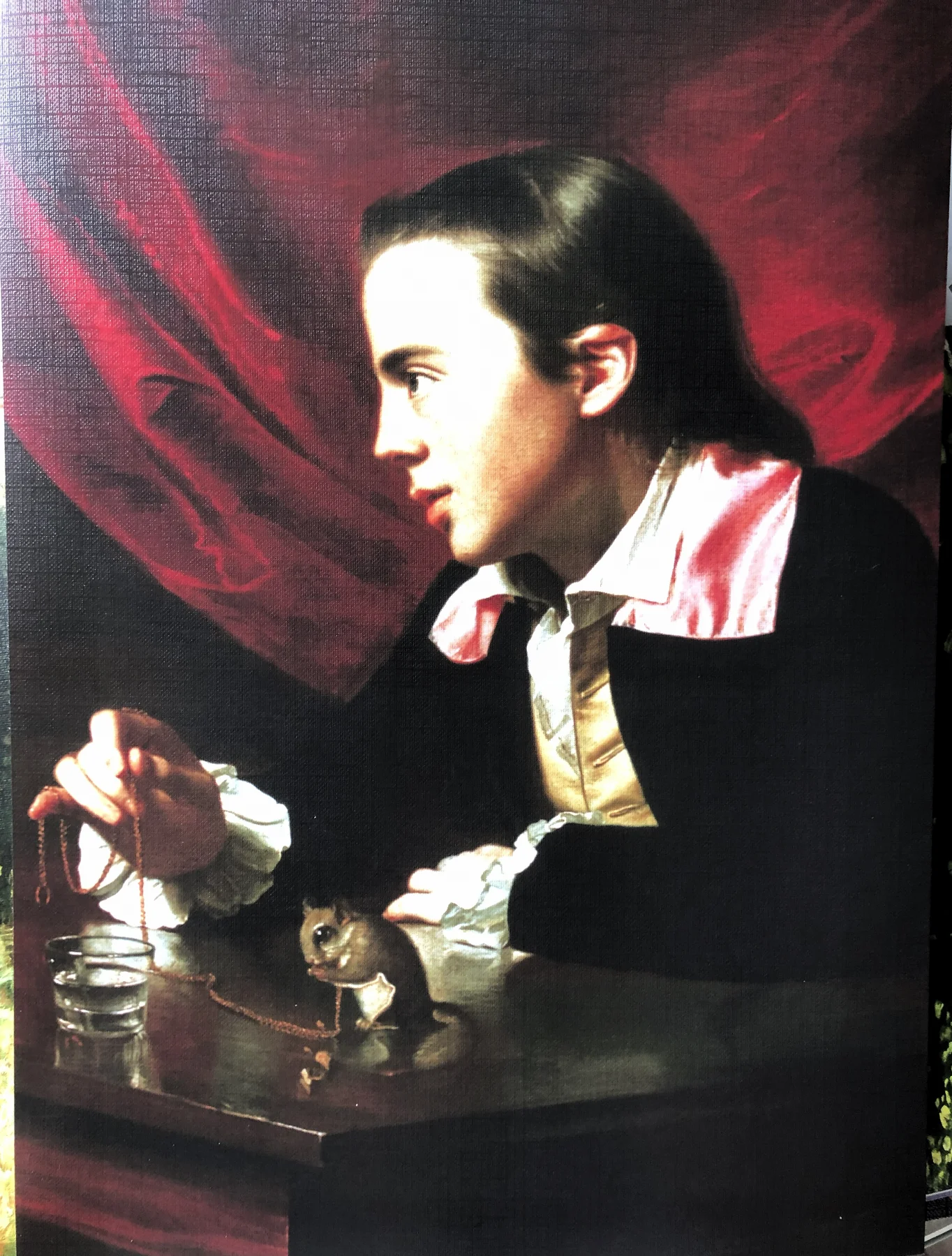
HENRY PELHAM (BOY WITH A SQUIRREL)
John Singleton Copley
- Artist
- John Singleton Copley (1738–1815)
- Date
- 1765
- Dimensions
- 77.15 x 63.82 cm
- Medium
- Oil on canvas
- Location
- Museum of Fine Arts, Boston
This painting is the one best suited to show the talent of the finest American painter of the period. Henry Pelham — often referred to as Boy with a Squirrel — testifies to the excellent gifts of John Singleton Copley, who was famous for the way he could depict light and texture, as well as the sitter’s personality, without the stuffiness characteristic of other contemporary portraits. He was able to capture the characteristics of his sitters and often used props to show their interests.
In the Spotlight
Copley made a name for himself with portrait painting, and even today he is regarded as the finest American painter of the period, but the artist longed to be accepted by the English art world too. Unlike many of his other portraits, Copley painted the portrait of his half-brother, Henry Pelham, primarily for an exhibition in London. In making this portrait Copley wanted to prove his craftsmanship, so he painted the picture in a way that displayed a wide variety of textures and surfaces — the soft fur of the squirrel, the reflection of the water in the glass, the mirror-polished table whose corner reaches towards the viewer, and the boy’s ornate clothing. What is more, the colours, mostly various shades of red, are improbably subtle. The pink collar, the red curtain and the boy’s ruby lips complement each other perfectly. The painting wants to make an impression on the viewer, and it succeeds. The picture is a true masterpiece.
Bound for London
In 1766 the painting was helped on its way to London by the surveyor of the port of London, Roger Hale. The picture was shipped without the artist’s name and nationality on it and was delivered to Benjamin West, an Anglo-American originally from Pennsylvania. West was enthusiastic and guessed the painter’s nationality, since the American squirrel in the picture did not escape his notice. Eventually he received a message from Copley, and the two artists began to correspond.
West also sent the painting to the annual exhibition of the Society of Artists, where it was a huge success. The most important English painter of the age, Joshua Reynolds, also took notice of Henry Pelham, calling the picture “a very wonderful performance”, but he also added that Copley was working in a second-rate country as far as art was concerned. This was a condescending remark, but Copley agreed with it. West and Reynolds — the latter also president of the Royal Academy — urged Copley to leave America and come to Europe for the sake of his artistic development. As Reynolds put it, “before his manner or style changes for the worse or becomes fixed, as he works within his own modest means in Boston.”
Copley was determined to go, and West’s letters only made him more aware that he was wasting his talent in colonial Boston, but he was anxious and cautious. Another eight years passed before he took the risk, and even then only because events occurred that he could not control.
Driven Out of Boston
Copley worked in an extraordinary period of American history, and his portraits reflect the optimism and openness of the ambitious colony burning with revolutionary fever. Copley, however, was loyal to the British Crown, and this hastened his departure for Europe. In the spring of 1774, as political tension mounted in Boston, Copley’s house was surrounded by an angry crowd demanding that he hand over a loyalist he was reportedly hiding. Fearing for his life and his family’s safety, Copley moved to Europe a few months later.
A Change of Style
The artist began the second period of his career in Italy, where he lived for a year. He then went to Germany and the Netherlands and studied the works of the old masters. In 1775 he settled in London, where he spent the rest of his life. His career in England flourished, and he turned to history painting, which at that time was considered the highest rank in the artistic hierarchy (and landscape painting the lowest). Copley’s 1778 painting Watson and the Shark, based on a true story, is a breathtakingly dramatic picture (now on view in the National Gallery in Washington D.C.). The Royal Academy rewarded him with membership in recognition of his merits. Copley concentrated on history painting for the rest of his career.
- Benjamin West
- Joshua Reynolds
- Engraving of the turmoil in Boston in 1774
- Copley’s painting, Watson and the Shark (1782)