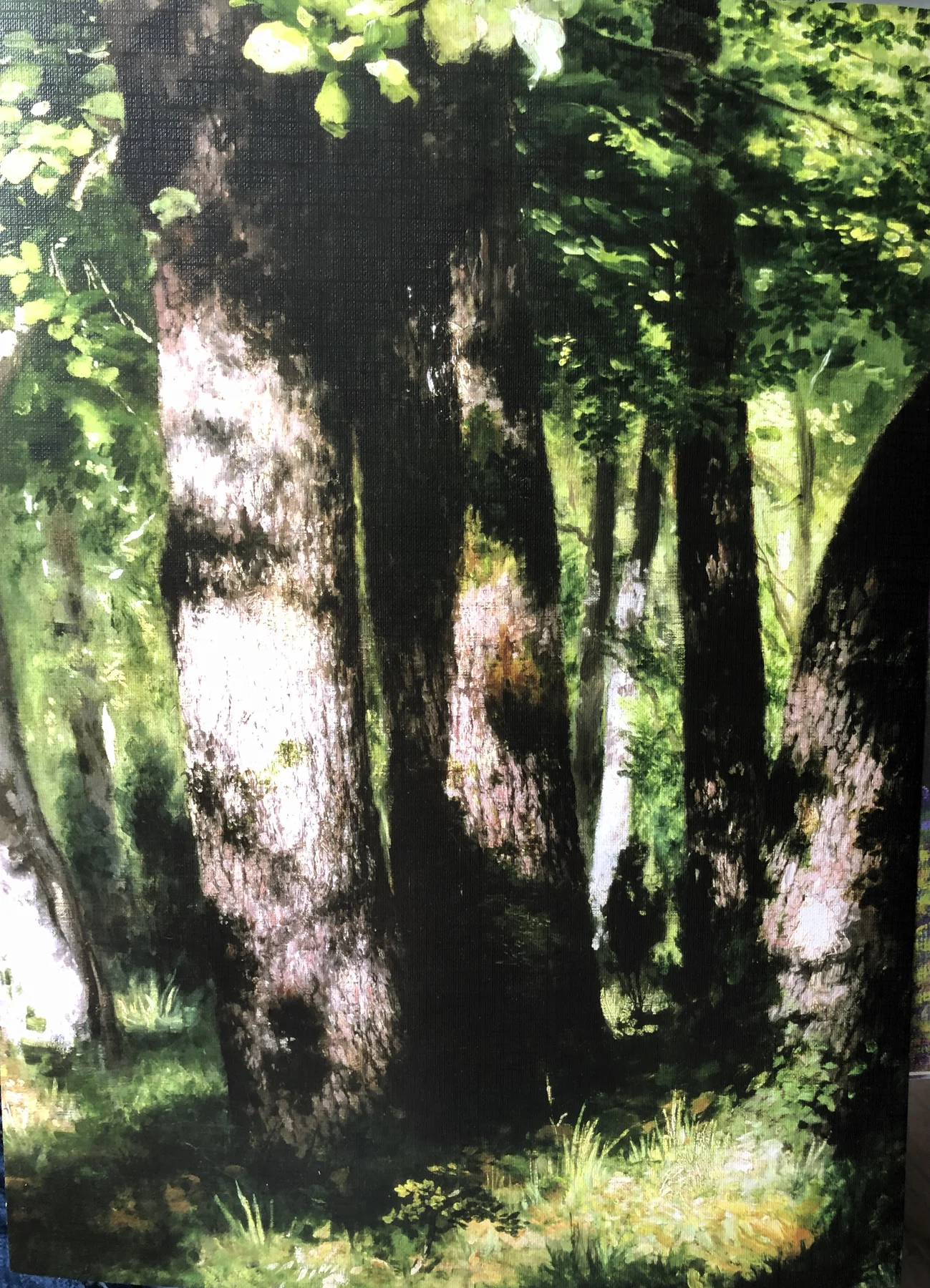
IN THE FOREST OF FONTAINEBLEAU
Pierre-Auguste Renoir
- Artist
- Pierre-Auguste Renoir (1841–1919)
- Date
- 1866
- Dimensions
- Unknown
- Medium
- Oil on canvas
- Location
- Private collection
Victor Hugo said: “A tree is a building, a forest is a city, and among forests Fontainebleau is a monument.” Long before Impressionism was born in the late 1800s, Renoir was already spellbound by Fontainebleau; he noticed and captured the subtle beauty of nature, its majestic oaks and dramatic gorges. Lying only 43 kilometres south-east of the French capital, the huge, undisturbed wilderness was a world away from the noisy boulevards, and it inspired many of Renoir’s early paintings.
Plein-Air Painting
When Renoir painted In the Forest of Fontainebleau, he was following in the footsteps of the great French landscape painters before him, above all Jean-Baptiste-Camille Corot. Corot was a painter who followed classical traditions but was also a realist, painting nature as he saw it. Corot played a major part in the development of plein-air, or open-air, painting, later favoured by the Impressionists. From the 1820s Corot [erroneously “Renoir” in the original] made Fontainebleau his own great open-air studio, in works such as The Little Easel-Bearer (1823) and The Bas-Bréau Road (c. 1830). Renoir’s early paintings, including In the Forest of Fontainebleau, reveal Corot’s influence in their naturalist approach and also recall the older master’s meticulously worked brushstrokes.
A Spiritual Home
Fontainebleau played an important part in Renoir’s artistic development, and at the beginning of his career the forest became a kind of spiritual home for him. Renoir always spoke fondly of “the straight trunks of the huge beech trees and the blue light filtering through the foliage that arches over them.” “You almost believe you are at the bottom of the sea, among the masts of sunken ships,” he said. These words describe almost perfectly the view that unfolds before us in In the Forest of Fontainebleau. The dramatically lit, gnarled oaks fill the picture, their canopy hiding the sky. Only a solitary figure gliding past behind the trees breaks the almost reverent silence, providing a point of reference whose presence conveys the grandeur of nature.
The Determined Artist
The forest was important to Renoir, but it was not easy for him to reach. By the 1860s the development of the French railway network had made the outskirts of Paris easily accessible, but Renoir was then an impoverished artist struggling to survive and could not afford the luxury of a train ticket. The determined artist instead pulled on sturdy boots and made the two-day journey on foot, spending the night in the village of Essonnes. At Fontainebleau he usually stayed at a small inn near Marlotte, where his friends Monet, Sisley, Pissarro and Bazille often accompanied him, and sometimes the reclusive Paul Cézanne joined him too. Fontainebleau was a magical place, and when Renoir painted there he became literally lost in his surroundings, shutting out everything else. His constant companion, Monet, often got tired of being ignored when he asked him for a cigarette, and would rather look for the tobacco pouch in Renoir’s pocket himself. Renoir did not even notice.
A Supportive Family
Although Renoir made many paintings at Fontainebleau, few have survived, because he destroyed several of his early works later in his career. But one famous picture of the area has survived, Jules Le Coeur in the Forest of Fontainebleau, also from 1866. The painting depicts one of the artist’s good friends, an architect turned painter, who played a significant part in Renoir’s life at the time. The two artists are said to have met by chance one day in 1864 while painting in the forest. Although Renoir did indeed once meet his idol, Narcisse Diaz, by chance, his acquaintance with Le Coeur probably began earlier, at the Académie des Beaux-Arts in Paris, where Renoir studied and Le Coeur worked. By 1865 the Le Coeur family had bought a house in Marlotte. When Renoir fell on hard times, they provided him with board and lodging and, what is more, supplied him with many portrait commissions, which enabled him to perfect his craft, eventually bringing him success as a portrait painter. Above all, however, they gave him a cost-free base from which to paint the forest. Renoir stayed there several times in 1866, and it was probably on one of these occasions that he made In the Forest of Fontainebleau.
The Spontaneity of Nature
Renoir’s later Impressionist paintings are today regarded as the most important works of his career, but it was his earlier pictures — including those he painted at Fontainebleau — that developed his instinctive naturalist outlook. His unaffected, modest pictures never depict the landscape in an idealised way; rather they delight in natural, simple details: the light falling on the foliage or the leaves dancing in the wind. As Renoir himself once said: “Give me an apple tree in a suburban garden. I have no need of Niagara Falls.”
- The forest today
- Jules Le Coeur in the Forest of Fontainebleau