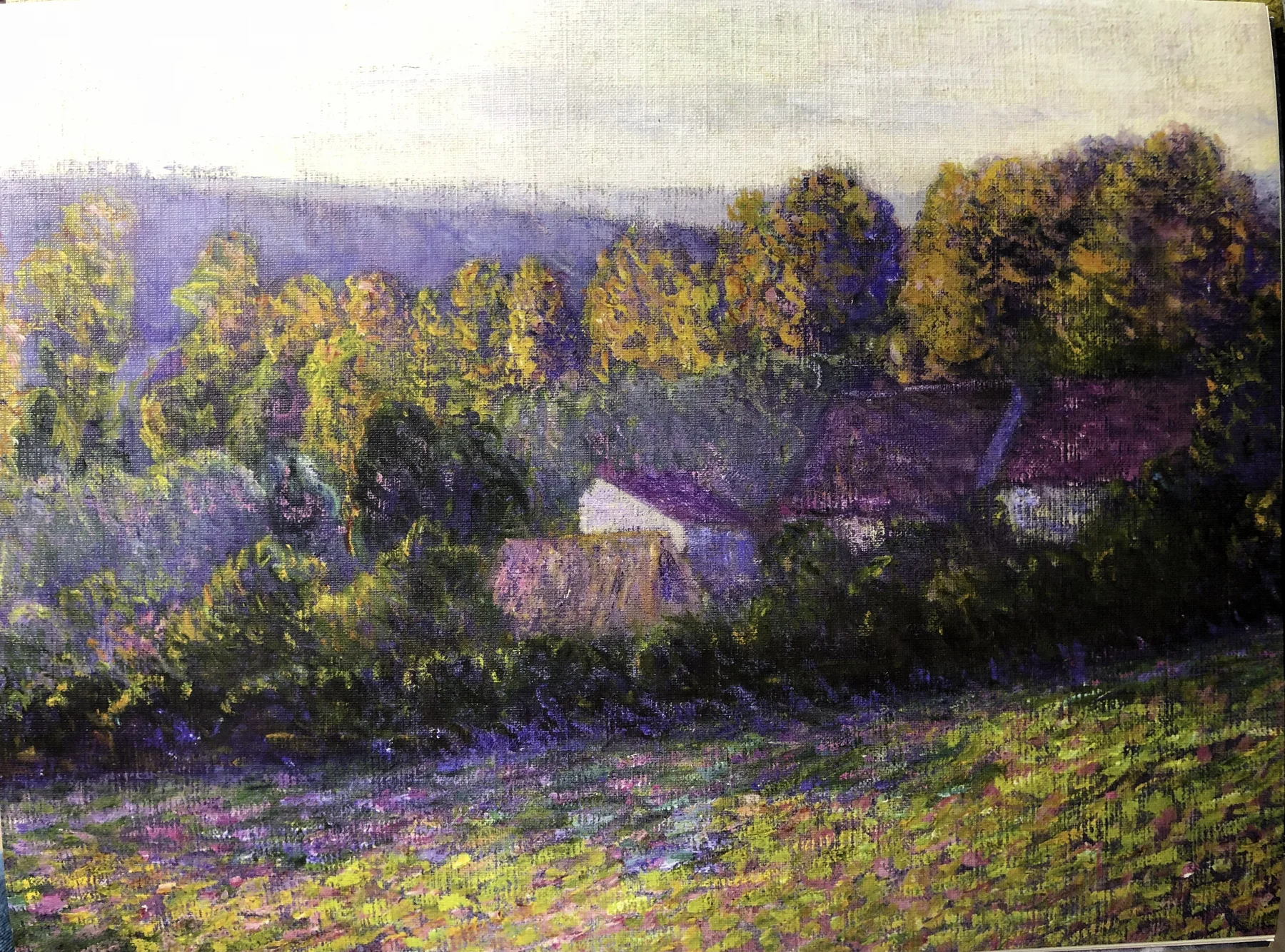
AUTUMN AFTERNOON, GIVERNY
Lilla Cabot Perry
- Artist
- Lilla Cabot Perry (1848–1933)
- Date
- Undated, probably between 1905 and 1907 or in 1909
- Dimensions
- 65.4 x 81 cm
- Medium
- Oil on canvas
- Location
- Terra Foundation for American Art, Chicago, Illinois, USA
In this atmospheric landscape by the American painter Lilla Cabot Perry, the late-afternoon sun casts a soft light on a cluster of farm buildings nestling among the trees beside a mown meadow. Working in a Monet-inspired Impressionist style, Perry fills her canvas with colour. The trees glow golden-green under the hazy sky, and the dark bushes cast lavender shadows on the field speckled with patches of gold and pink. The serene, uplifting scene is pervaded by a pleasant rustic mood, surely inspired by the happy summers Perry’s family spent in the countryside around Giverny in Normandy.
First Impressions
From the early 1880s the sleepy little village of Giverny could boast a famous resident — the French Impressionist painter Claude Monet. The story goes that Monet discovered Giverny in 1883 after glimpsing it from a train window. A few years later he bought his now-famous house and garden, and worked there until his death in 1926.
Perry first saw Monet’s paintings at an exhibition in 1889, towards the end of a two-year stay in Paris during which she studied painting at the Académie Colarossi and the Académie Julian. The encounter with the French master’s pictures completely changed her life and art. Monet’s vibrant colours, loose brushwork and light-drenched canvases made a great impression on Perry, who did not hesitate for long and went to see the painter. She rented a house in Giverny close to Monet’s property and moved her family there for the summer. The two artists formed a close friendship, and the Perry family spent the next nine summers in Giverny.
A Special Relationship
Although Monet never took pupils, he often gave Perry advice, and she was one of the few Americans he admitted to his inner circle. Monet’s treatment of form in the interplay of reflected light and colour made a deep impression on Perry’s painting, as can clearly be seen in Autumn Afternoon, Giverny. True to the Impressionist style, Perry applies the dramatically heightened tones of pink, purple, green and gold with sweeping, decisive brushstrokes to convey the fleeting effects of the atmosphere and light of the landscape.
Time Stands Still
Autumn Afternoon, Giverny is undated, but Perry may have painted it during one of her later stays in Giverny, in 1905–1907 or 1909, when she began to use even brighter colours in her outdoor works. By then Giverny had become a small international artists’ colony, painters being attracted by the enchanting landscape and the presence of Impressionism’s greatest artist. The spread of motoring brought a new flood of tourists to the village in the summer months. With this painting, however, Perry deliberately resisted the onslaught of modernisation. In her picture the countryside is cultivated but unspoiled, and the mood is calm and peaceful.
Champion of Impressionism
After her first visit to Giverny Perry returned to Boston with one of Monet’s works and several Impressionist landscapes by the American painter John Leslie Breck, whom she had met in Giverny. Embracing the new laws of painting, the following year Perry organised an exhibition of Breck’s landscapes, then showed her own Impressionist paintings and began giving lectures on the art of Claude Monet. Her public appearances contributed to the widespread acceptance of Impressionism and gave American Impressionist painters the opportunity to join the mainstream of the movement.
Eastern Influence
Before painting Autumn Afternoon, Giverny, Perry lived for several years — from 1898 to 1901 — in Japan, where her husband, Thomas, had been given a teaching post. Japanese art, especially ukiyo-e woodblock prints, played a significant part in the development of Impressionism. Monet himself owned a collection of more than 230 prints, which Perry could see in his house in Giverny. The collection included works by such masters of the genre as Utagawa Hiroshige and Katsushika Hokusai. Perry quickly absorbed Asian influences, and in her style and subjects East mingled with West. Like Monet, she found inspiration in the simple, restrained expression of Japanese prints, their scenes of everyday life, their unusual asymmetrical compositions and their perfect balance of colour, light and shadow, all of which can be discovered in her works. Perry played an active part in introducing Impressionism to Japan, where the movement is still extremely popular today.
- Giverny today
- Monet at his house in Giverny
- Perry: Hancock Landscape, New Hampshire, October 1923