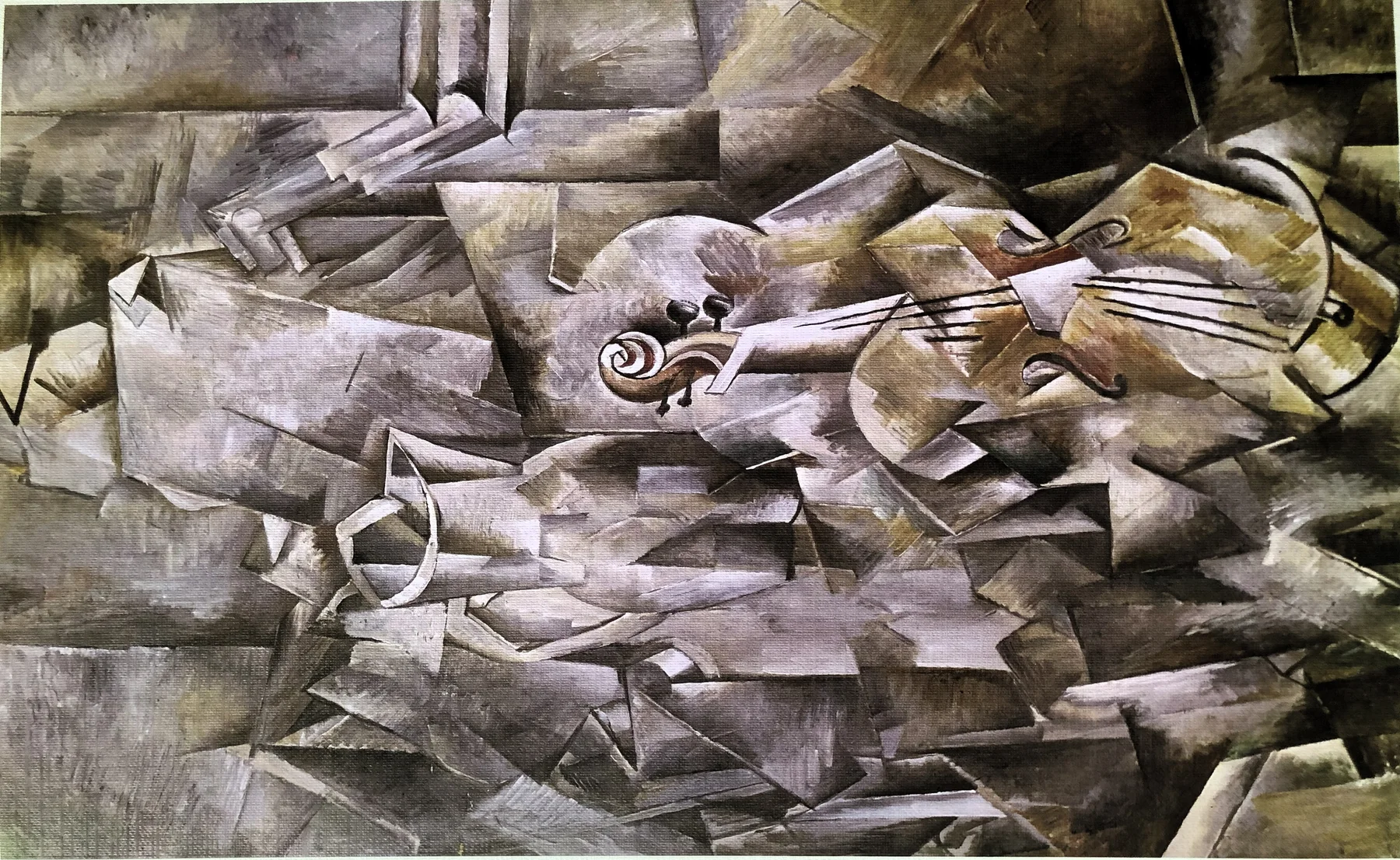
VIOLIN AND PITCHER
Georges Braque
- Artist
- Georges Braque (1882–1963)
- Date
- 1910
- Dimensions
- 117 x 73 cm
- Medium
- Oil on canvas
- Location
- Kunstmuseum Basel, Switzerland
“In art,” Georges Braque once said, “there is only one thing that counts: that which cannot be explained.” The feverish period of artistic searching with Pablo Picasso in Paris that began in 1907 led him from the anarchic gaudiness of Fauvism to the fragmented, monochrome world of Analytical Cubism. He began to dissect, or analyse, various objects and to show them from every possible angle at once. Violin and Pitcher represents the high point of Braque’s analytical period. From 1912 he was occupied with the similarly bold style of Synthetic Cubism.
Painting Space
During their close friendship Braque and Picasso worked together and experimented with the possibilities of their new style, Cubism. While Picasso drew inspiration from African art (at the time Paris was flooded with African artefacts from the French colonies), Braque was captivated by the landscapes in the posthumous Cézanne exhibition at the 1907 Salon d’Automne. He observed how Cézanne simplified masses into basic geometric forms and made the spaces between objects as important as the objects themselves.
That was Braque’s aim too: he attempted to paint the space between objects; he wanted to show their relationships to one another from every angle and transfer the whole onto the two-dimensional surface of the canvas. To do this he had to break the objects down into elements. Here, for example, we see the violin in pieces — some parts, such as the f-hole, from the front, others, such as the scroll, from the side. Similarly, we get a top view and a side view of the pitcher.
The still lifes from Braque and Picasso’s analytical period can baffle the uninitiated viewer. The subject of the painting is broken up into a tangled matrix of interlocking, vibrating planes, across which the eye restlessly searches for a focal point, in vain. Perspective is absent or minimal, and objects are seen through symbols or icons — strings, a bottle neck, a pitcher handle, a woman’s breast. These are all lined up in a grid or appear in a spatial field created by oblique, overlapping forms, where playful shading makes it hard to distinguish spaces from solids. Braque made it clear that he did not aim for pictorial likeness; instead he declared: “I want to create a new kind of beauty, beauty that appears to me in volume, line, mass and weight, and through this beauty I want to convey my impressions of the object.”
The Downgrading of Colour
Interestingly, Braque did not include colour in this “new kind of beauty”. Partly inspired by Cézanne’s restrained palette, he dramatically reduced his own use of colour — often limiting himself to just two shades, such as ochre and green — so that colour would not distract attention from the formal structure he regarded as the critical point of the painting. (The primacy of form over colour was one of the great changes compared with Fauvism, which Picasso explained like this: “Colour plays a part in the sense that it helps to represent volume.”)
The Nail
One of the most debated elements of Violin and Pitcher is the nail projecting from the wall at the top of the picture, painted in a traditional, illusionistic manner, as is the folded corner of the poster directly beneath it. Braque uses a similar trick in an earlier painting, Violin and Palette (1909), while playing an interesting game with the viewer: with its shading he not only delights in projecting a double view of the nail before us (à la Cubism) but also seems to ask: is the nail “more real”, or the violin?
Artistic Connection
The French poet and art writer Guillaume Apollinaire first took Braque to Picasso’s (pictured) studio at the end of 1907. Braque was stunned by the distorted bodies and faces of the five prostitutes in Picasso’s style-defining picture Les Demoiselles d’Avignon, objecting that the Spaniard was trying to make people “eat rope and drink kerosene.” Nevertheless he took up the subject himself and in 1908 made his own version, Large Standing Nude, in which the female figure is similarly, though less violently, distorted. From 1909 Braque and Picasso followed each other’s work closely, and by August 1911 their works had become so alike that they could hardly be told apart.
- Grand Palais – catalogue of the 1907 Salon d’Automne
- Paul Cézanne