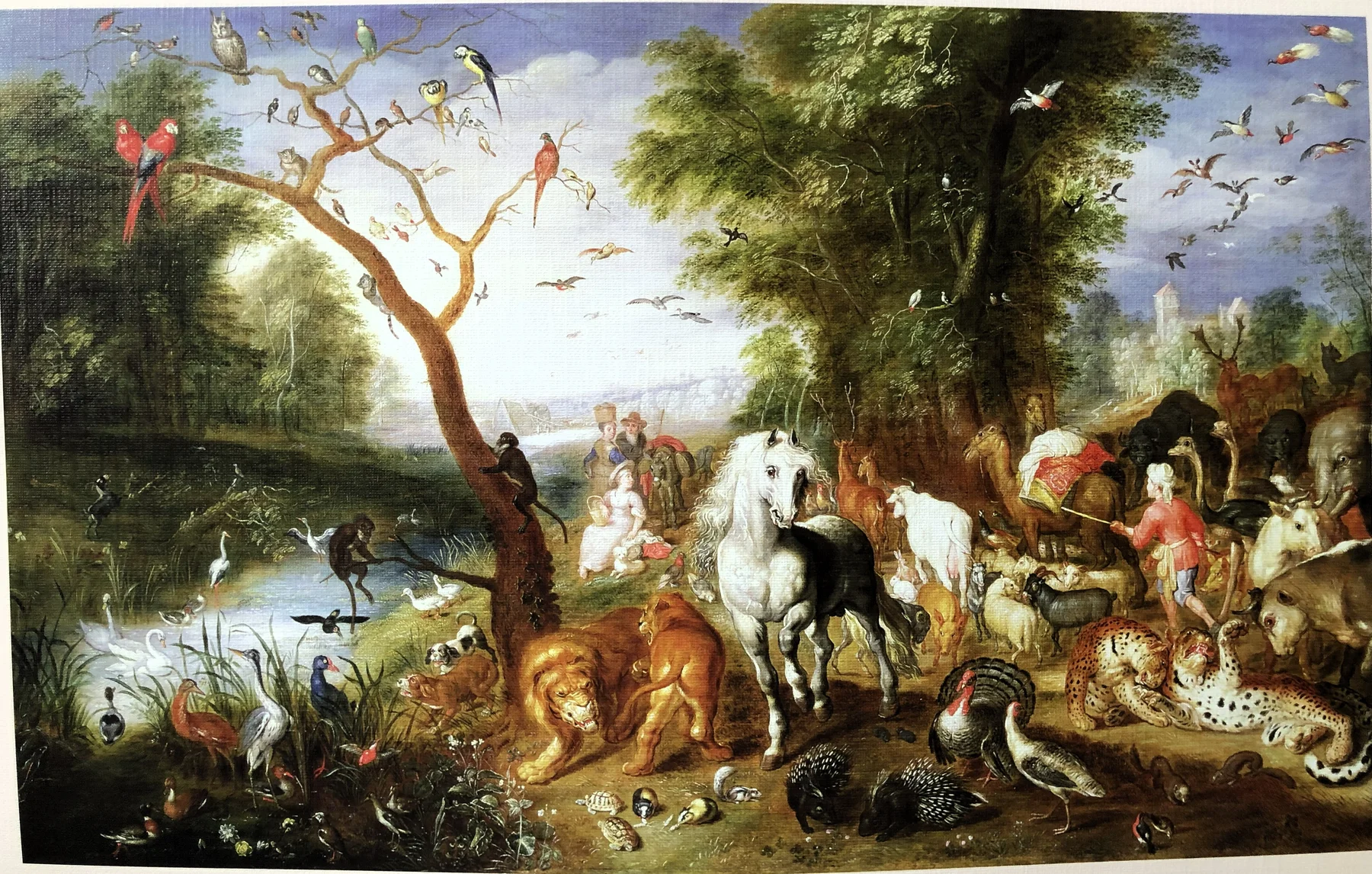
THE ANIMALS ENTERING NOAH’S ARK
Jan van Kessel the Younger
- Artist
- Jan van Kessel the Younger (1654–1708)
- Date
- c. 1670
- Dimensions
- 55.5 x 88.9 cm
- Medium
- Oil on panel
- Location
- Nature in Art Trust, Gloucester, England
Jan van Kessel the Younger was the last representative of perhaps the most important artistic dynasty in European history. Van Kessel was born in Antwerp in 1654, a descendant of the Flemish master Pieter Bruegel the Elder (c. 1525–1569), “the painter of the people” and the most popular genre painter his country ever had. A century after Bruegel’s time Van Kessel went down in art history as a portrait painter at the Spanish court, but with The Animals Entering Noah’s Ark he first paid tribute to his illustrious predecessors.
A Family Tradition
Van Kessel’s painting tells the well-known story of the biblical figure Noah, whom we can see on the right of the picture in a red robe with a staff in his hand. According to the Bible, God instructed Noah — who, unlike the other sinners, was a good man, and whom the Lord therefore wanted to save together with his family — to build an ark and take with him a male and a female of every kind of animal, thus saving them from the great flood that was about to destroy life on earth. The story had occupied artists for centuries, including Van Kessel’s family. The composition of the picture is in fact not the artist’s own creation but that of one of his great-grandfathers, Jan Brueghel the Elder, one of Pieter Bruegel’s sons.
Jan Brueghel the Elder painted the original version of the Old Testament scene in 1613, thereby unwittingly creating a family tradition. His painter descendants all made their own versions, perhaps spurred by a desire to prove themselves against the famous ancestor’s seminal work. Brueghel’s son, Jan the Younger, made his picture on the same subject in 1625, in which the appearance of a grey horse marks the change from the earlier work. This was followed by the version of Van Kessel’s father from around 1660, which is almost identical to the original, while Van Kessel’s own version, also showing great similarities, was made a decade later.
Master of Animal Painting
As the title suggests, The Animals Entering Noah’s Ark is a dizzying cavalcade of animal species, from huge elephants, wild cats and a majestic horse to birds of various sizes, monkeys, turtles and even guinea pigs scurrying about in the foreground. In the 17th century many such exotic animals may have surpassed the wildest imaginings of European artists such as the Brueghels and the Kessels, which makes the incredible detail of their paintings all the more remarkable. The family owed this valuable knowledge, too, to Jan Brueghel the Elder.
In 1609 Brueghel was appointed court painter to Archduke Albert of Austria and the Spanish Infanta Isabella. The couple jointly governed the Habsburg Netherlands from 1598 to 1621 from the flourishing royal court in Brussels, the capital of today’s Belgium. In the age of the conquest of the New World, Europeans came to know many varied animal species living far from their homeland, previously unknown and exotic to them. Albert and Isabella gathered a huge menagerie of newly discovered animals at the Coudenberg Palace in Brussels. Brueghel had free access to the royal zoo, where he could study its inhabitants from life, and he soon became highly skilled in their anatomy, which was also a great help to his descendants.
The Aspiring Artist
In the 1670s Brueghel’s great-grandson Jan van Kessel was an ambitious budding artist learning the craft under his father in Antwerp, then the centre of the art world. It was in this decade, and in surroundings reminiscent of his artistic heritage, that Van Kessel may have begun his own, highly effective version of The Animals Entering Noah’s Ark. By then he was already a technically well-trained artist, attentive to detail in the Flemish manner. But while his father, following in the footsteps of his predecessors, was a talented painter of flowers and animals, Van Kessel ended up in portrait painting. Very few of his works have survived; among them is one of his finest early works, the 1679 group portrait Family in a Garden, of a Flemish nobleman, his wife and children. Kessel’s father died that same year, and shortly after finishing the picture he struck out on his own, moving to Madrid in 1680.
The End of an Era
In 1686 Van Kessel entered the service of King Charles II of Spain and then painted portraits of the king’s wives, first Queen Marie Louise of Orléans and later Maria Anna of Neuburg. In Spain he became a portrait painter of good repute and, thanks to the king’s patronage, rose among the wealthy, but after the king’s death in 1700 his star began to wane. Although he continued to serve the new monarch, Philip V, towards the end of his life he was pushed into the background by up-and-coming younger and more fashionable French artists. His death in 1708 — he was only 54 — marked the end of a 180-year-old dynasty and closed an important chapter of Flemish art.
- Pieter Bruegel the Elder
- Jan Brueghel the Elder
- Jan Brueghel the Elder: The Animals Entering Noah’s Ark
- Archduke Albert of Austria
- King Charles II
- Jan van Kessel the Elder