THE WALK
Claude Monet
- Artist
- Claude Monet (1840–1926)
- Date
- 1875
- Dimensions
- 100 x 81 cm
- Medium
- Oil on canvas
- Location
- Musée d'Orsay, Paris
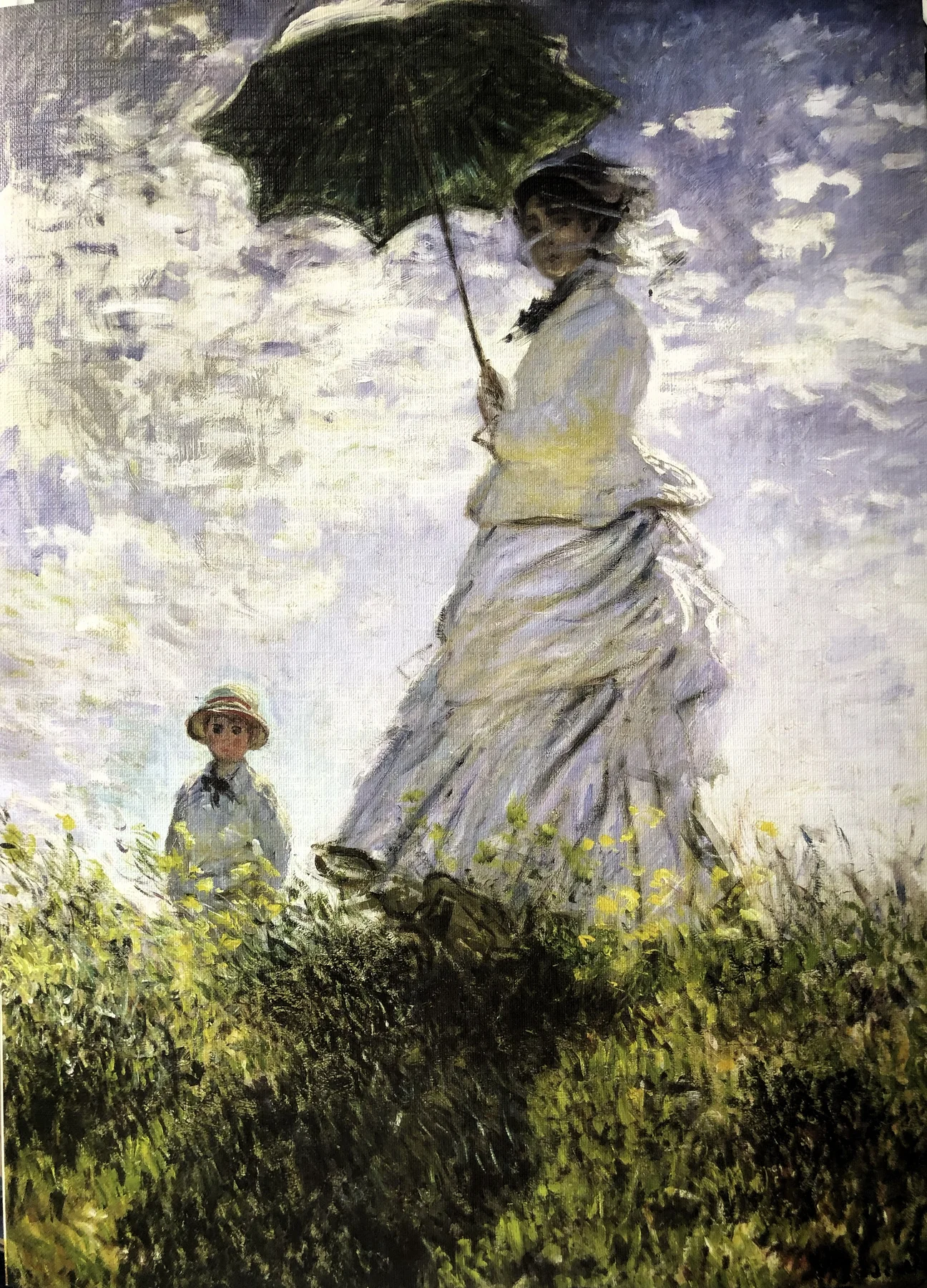
In this picture from the heyday of Impressionism, Monet depicts his wife, Camille, and his son, Jean, on a cheerful walk on a sunny day near their home in Argenteuil. In the 1870s paintings of elegant women made outdoors were popular, but here the artist did not strive for likeness: Camille’s face is so veiled that she becomes almost unrecognisable. The real protagonists of the picture are sunlight and nature, which continued to play a central role in Monet’s art for another half-century.
The Model of Argenteuil
Camille Monet (née Doncieux) regularly modelled for the painter from the late 1860s until her death in 1879. Camille and Jean appear several times in Monet’s Argenteuil landscapes of the early 1870s. The family often walked under the trees along the Seine. One example is Poppy Field at Argenteuil (1873), in which Jean is almost lost among the flowers and wears the same red-brimmed summer hat; another is Walk near Argenteuil (1875). On the walk Camille radiates a fashionable bourgeois air with her parasol and pretty white dress, the depiction of the light reflected from which posed a serious challenge for the artist.
In the Gentle Lap of Nature
Monet liked to depict his figures in harmonious balance with nature. He was a committed advocate of plein-air (open-air) painting, a practice he inherited from Camille Corot and the painters of the Barbizon School. Not all Impressionist painters were enthusiastic about works made outdoors. Degas once said of Monet: “His pictures were always too draughty for me!”
The Impressionists held the centuries-old view that the fairer sex represented the essence of natural beauty. Although they also depicted peasant women at work outdoors (as Jean-François Millet did, for example), it was considered highly improper for young bourgeois women to appear alone in rural landscapes, since their good name could suffer. Artists often got round this problem by painting young women in enclosed gardens or with their backs to nature. In this case Monet, observing the rules of propriety, also painted Jean into the picture, thereby indicating that Camille was a married woman.
Light, Space and Structure
The low viewpoint chosen by Monet eliminates from the picture the houses, bridges, boats and factories of the Seine bank and places the emphasis solely on the natural surroundings. Because of the viewpoint Camille towers above us, her stature emphasised by Jean’s tiny figure. The rays of the sun beating down from the upper right corner of the picture cast long shadows on the grass, providing a soaring vertical setting against the firm horizontal structure of the horizon and clouds.
The Walk clearly illustrates Monet’s spectacular handling of light. He painted Camille and Jean contre-jour — against the sunlight — so that their outlines glow brightly. They should therefore appear even more in silhouette, but instead of simply making them darker, Monet looks for the colours in the shadows: the butter yellow reflected by the flowers, the mauve and the green of the parasol. As a result the foreground is bathed in light, lending the composition an airy feel.
Virtuoso Brushstrokes
Monet’s bold brushwork transfers the energy of the wind onto the canvas. Short, quick brushstrokes bring the flowers and grass to life, while the tangled swirls of the sky are interrupted here and there by patches of the canvas’s ground. With her dress flapping around her feet and her veil fluttering in front of her face, Camille is visibly battling the wind, which almost wrenches the parasol from her hand. Jean again provides the contrast, a small statue of impassive calm.
Artistic Connection
In Second Empire France the parasol was an indispensable outdoor accessory for every pretty girl, and it appears frequently in Impressionist works of the 1860s and ’70s: examples include Monet’s Women in the Garden (1867, pictured) and Gladioli (1876), or several pictures by Renoir, such as Lise with a Parasol (1867), Girl Gathering Flowers (1872) and Woman with a Parasol in a Garden (1873).
- Poppy Field at Argenteuil
- Millet: Shepherdess with Her Flock
- Jean Monet