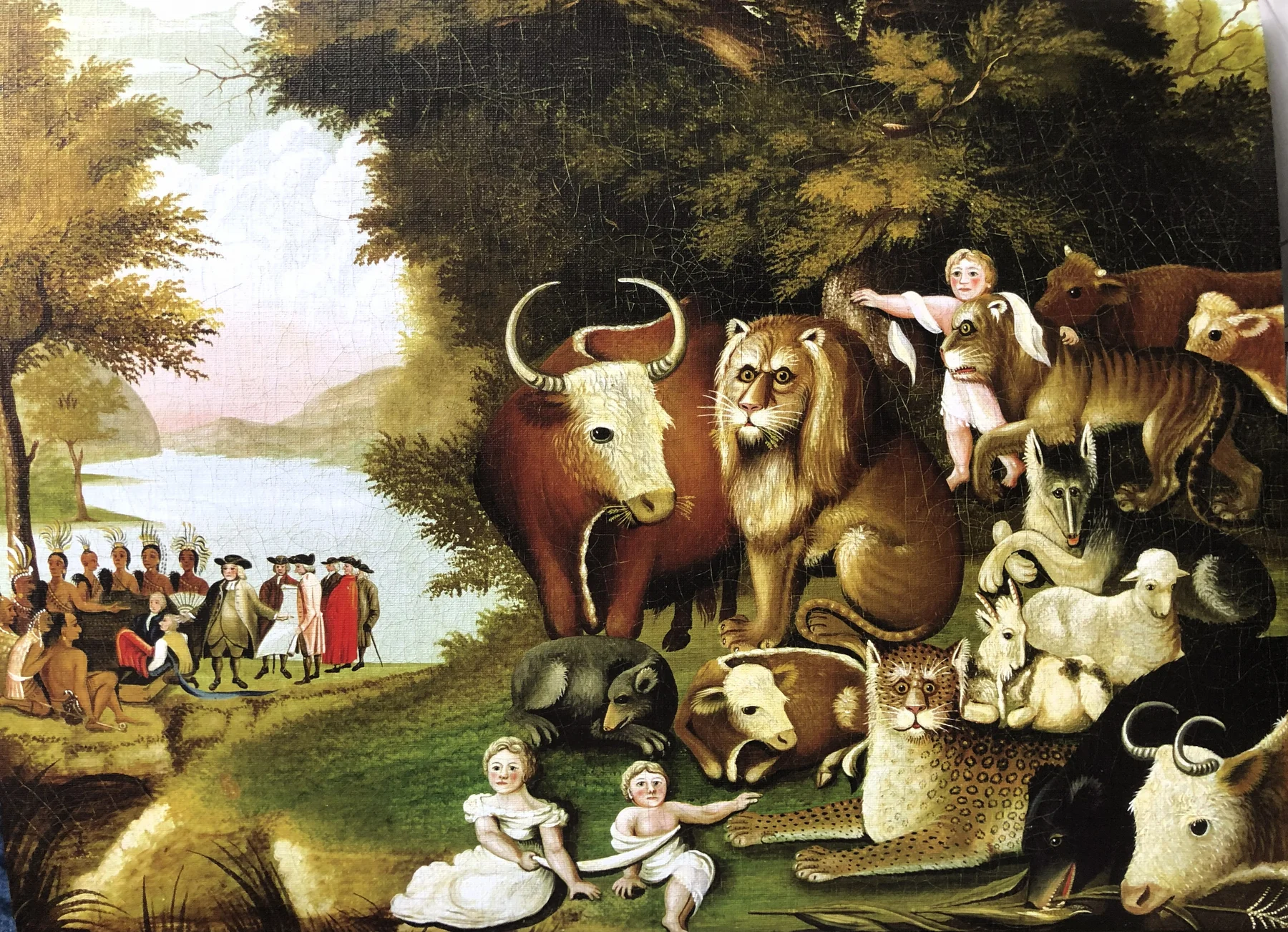
THE PEACEABLE KINGDOM
Edward Hicks
- Artist
- Edward Hicks (1780–1849)
- Date
- c. 1833
- Dimensions
- 44.5 x 60.2 cm
- Medium
- Oil on canvas
- Location
- Worcester Art Museum, Massachusetts, USA
The 19th-century American painter Edward Hicks was not only a talented exponent of folk art but also a devout Quaker minister, and in The Peaceable Kingdom he powerfully combines these two aspects of his life. Based on the prophetic writings of the biblical figure Isaiah, the painting projects a future in which people and animals will live together in peace and harmony. The simple, unaffected style makes the overall effect even more powerful. The painting and its message have become as famous as the artist himself, not least because Hicks, astonishing as it sounds, painted the picture 61 times over 30 years. Today several of these versions can be seen in leading galleries and museums in America and around the world.
A Contradictory Personality
Hicks was a complex, contradictory character whose painting career was not compatible with the rules of a strict religion that preached the simple life and rejected materialism. Hicks coped with these difficulties as best he could, financing his work as an itinerant preacher from the sale of his landscapes. Although he called painting “one of the trifling arts”, providing only the material means needed to sustain an “honest life”, these blunt words were belied by his evident talent and enthusiasm, but this came at a price. He began his working life as an apprentice at a coachmaking firm, decorating carriages and painting signs, but his attractive ornamental style was frowned upon by members of conservative Quaker society. For this reason around 1815 he gave up painting to try his hand at the more highly regarded occupation of farming. The attempt, however, ended in miserable failure, and in 1817, after heavy financial losses, he returned to the activity he knew best.
A Symbol of Peace
Hicks, the zealous moral preacher and one of the most popular ministers of his time, expressed in his art what he preached from his pulpit. He rejected portrait painting as a manifestation of vanity and concentrated instead on subjects that demonstrated his religious faith. The Peaceable Kingdom in its many versions faithfully illustrates everything Hicks believed in as a Quaker: peace, harmony and sincere brotherly love. The painting is based on chapter 11, verse 6 of the Book of Isaiah, which reads: “The wolf also shall dwell with the lamb, and the leopard shall lie down with the kid; and the calf and the young lion and the fatling together; and a little child shall lead them.” (King James Version) In the painting Hicks presents these animals, predators and prey, standing or sitting side by side, contented and undisturbed. Only the lion in the child’s care retains something of its natural ferocity, perhaps symbolising the fragility of the new order.
A Picture Within the Picture
In this version, as in many others, Hicks inserts a picture within the picture. On the left of the canvas, somewhat separated from the biblical vision, a more real scene takes shape. Here Hicks recalls the ceremony of the signing of the famous 1683 peace treaty between the Lenape Indian tribe and the European settlers led by William Penn (1644–1718). The English-born Penn founded Pennsylvania and is credited with introducing the Quaker way of life into the state. As an advocate of democracy and religious freedom, he maintained close relations with the local Indians. By inserting this event into the picture Hicks reinforces his message of peace and at the same time draws a parallel between the biblical prophecy and its realisation in the modern world.
Artistic Development
Hicks was an entirely self-taught painter, helped in his development by his imagination and by his earlier experience as a sign painter, which contributed to a better understanding of colour, composition, perspective and form. He painted the first version of The Peaceable Kingdom in 1820 and the last shortly before his death in 1849, and the pieces in the series made over these 30 years reveal considerable technical progress. The later versions are more naturalistic in effect and more polished, reflecting Hicks’ increasingly confident style. The long period also resulted in compositional changes. Some versions have a painted border containing Isaiah’s words, while in others the positions of the animals change. The landscape framing the action also differs from picture to picture. In some a huge chasm separates the biblical and historical scenes, while elsewhere a bridge connects them.
Art Imitating Life
Some versions, however, carry a more symbolic and personal meaning, offering insight into the artist’s inner world. In the late 1820s signs of division began to appear within the Quaker community, leading to discontent and internal strife. Hicks was deeply affected by these events, and this shows in his Peaceable Kingdom series. Over time his animals appear older and more weary, in places even more aggressive. In one version, made between 1835 and 1840, the lion snarls at the ox, an obvious allusion to the worldly strife behind the picture. Nevertheless peace is present throughout, and the final message of Hicks’ epic series, like that of all his paintings, is one of hope.
Artistic Connection
For his William Penn scene Edward Hicks used as his model an earlier work by the English-born American history painter and former president of the Royal Academy in London, Benjamin West (1738–1820). The painting Penn’s Treaty with the Indians, from 1771–72, shows the settlers in council with the natives at the moment of signing the agreement. West died in the year Hicks painted the first version of his famous work.
- One of the pieces in The Peaceable Kingdom series
- William Penn