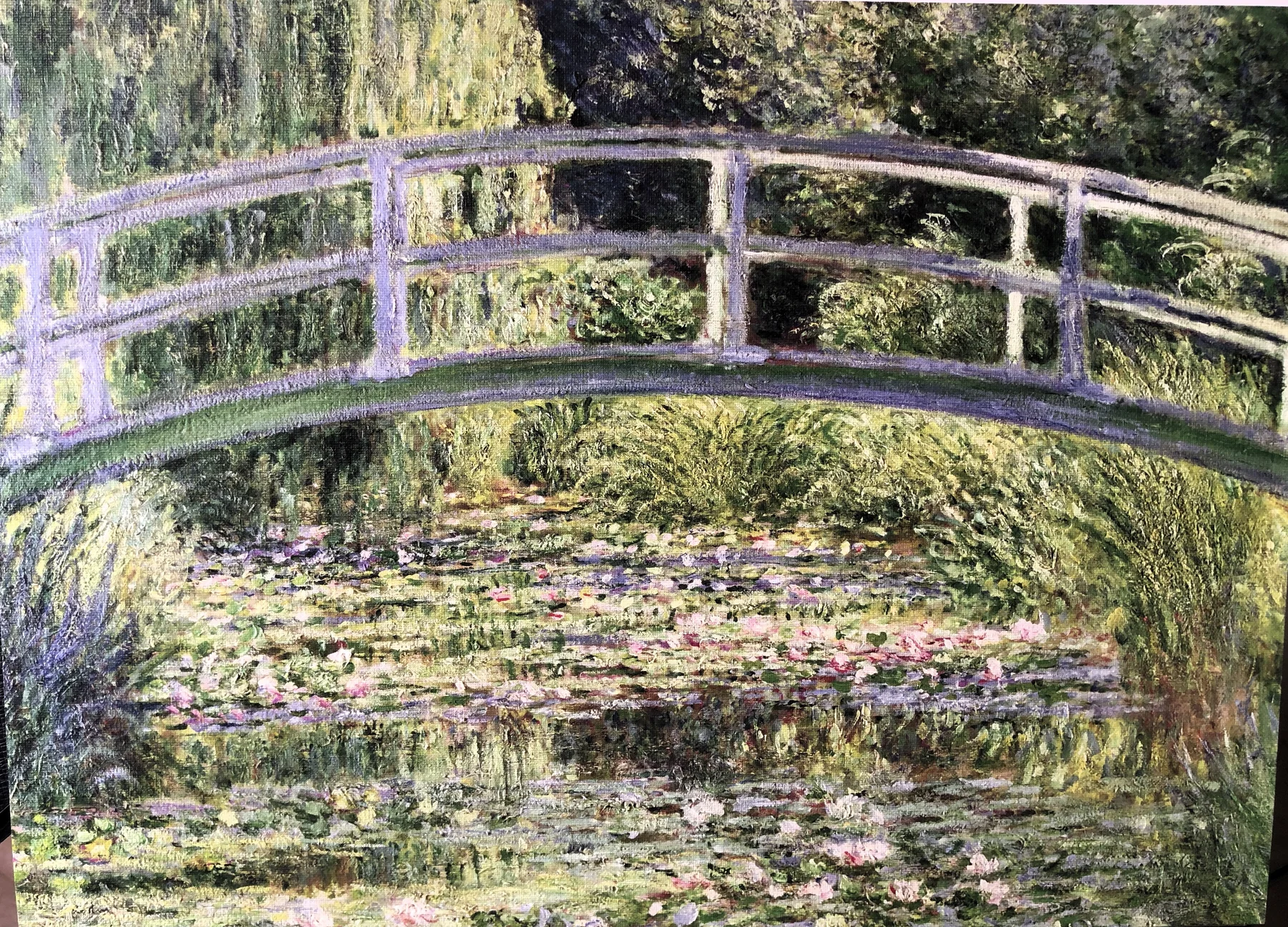
THE WATER-LILY POND
Claude Monet
- Artist
- Claude Monet (1840–1926)
- Date
- 1899
- Dimensions
- 88.3 x 93.1 cm
- Medium
- Oil on canvas
- Location
- Currently in the National Gallery, London, England
Claude Monet was one of the founders of French Impressionism. The movement actually took its name from one of his paintings, Impression, Sunrise. His series of pictures of the water garden at his home, including The Water-Lily Pond, is among the world’s most treasured works of art.
A Style Is Born
For years he experimented with a way of painting characterised by its focus on the immediate visual impression — for example, how light affects a view at a given moment. Monet wanted to perfect this way of seeing and creating. In 1891 he began working on a series of pictures, mainly of the garden pond in Giverny. He sat and watched the light and shadow on objects and painted what he saw in this way, not what he knew was there. For example, he depicted the water lilies on the pond only as blurred patches of colour; not every water lily can be clearly made out.
In the peaceful, colourful setting of the water-lily pond Monet succeeded in capturing the sunlight in a way that made the scene even more lifelike. We can almost smell the water lilies and hear the sounds of wildlife in and around the pond.
Monet often used several canvases at once in order to capture as fully as possible the ever-changing light, colours and weather. While he waited for the paint to dry on one, he worked on another.
Enormous Interest
In 1899, the year he painted The Water-Lily Pond, the works of Monet and his fellow Impressionist painters sold for extremely high prices. Monet’s water-lily series was first exhibited in Paris, at the gallery of the art dealer Durand-Ruel, in 1900. The Water-Lily Pond was later bought in 1927 by the National Gallery in London, where it is still one of the most valuable works of art.
An Enchanting Home
With the income from his popular paintings, Monet and his wife, Alice Hoschedé, bought a former cider farm in Giverny, north-west of Paris, and he spent the rest of his life there. The garden was originally just an area used for growing fruit, but Monet transformed the neglected two-hectare plot into a lush flower garden. He made sure it was beautiful, luxuriant and rampant in every season. He planted flowers by colour and size, highlighting the colours with arbours and arches. He told a friend that he had spent all his earnings on creating this wonderful garden.
In 1893 Monet bought the land across the road near the house, with a small pond on it, to plant water plants. The great artist was a passionate nature lover, and in the following years he set about meticulously creating the water world. He planted the pond around with many colourful flowers and shrubs, creating a veritable little Paradise, which we know well from almost 250 paintings. In the last 33 years of his life he hardly painted anything else.
Monet later donated his famous garden and house to the French state, and today they are open to the public.
Japanese Influence
The Impressionists, especially Monet, greatly admired Japanese art and culture, which had an enormous influence on them. Monet decorated his home in Giverny with more than 200 Japanese prints bought in Paris, and planted Japanese bamboo and peonies along the winding banks of the pond. He also had an arched wooden bridge built in the style typical of the Japanese bridges he had studied in the prints. It is this bridge that arches across the painting The Water-Lily Pond.
SIMILAR MASTERPIECES
In the summer of 1869 Monet and Pierre-Auguste Renoir worked side by side on the banks of the Seine, and each created his own picture of the same place, La Grenouillère, the so-called “frog pond” (Monet: La Grenouillère, Metropolitan Museum of Art, New York; Renoir: La Grenouillère, 1869, Nationalmuseum, Stockholm).
- Further examples of Monet’s water lilies
- The National Gallery in London
- Monet’s house in Giverny