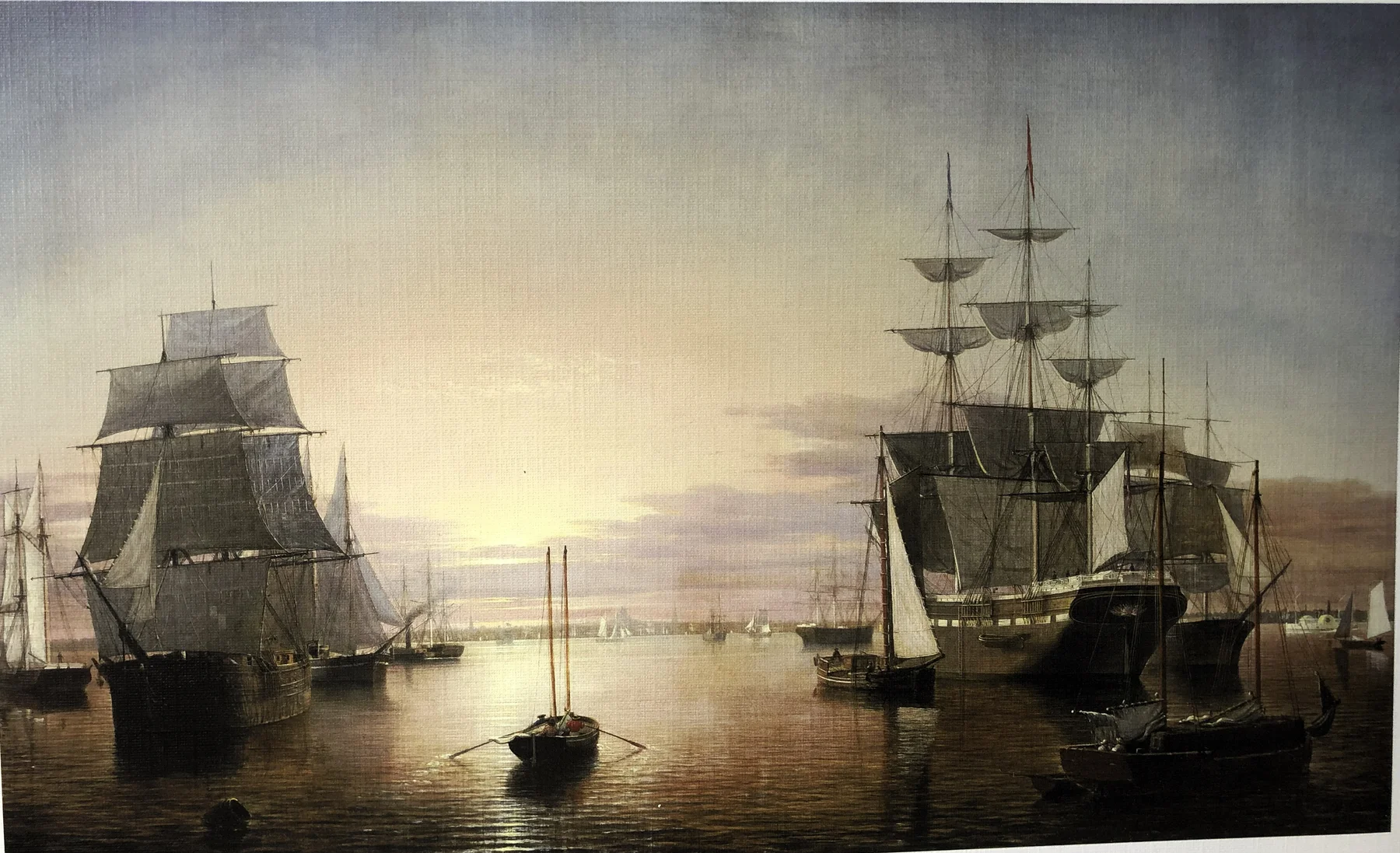
BOSTON HARBOR
Fitz Hugh Lane
- Artist
- Fitz Hugh Lane (1804–1865)
- Date
- Between 1850 and 1855
- Dimensions
- 66.04 x 106.68 cm
- Medium
- Oil on canvas
- Location
- Museum of Fine Arts, Boston, USA
The work of the American Fitz Hugh Lane focused above all on the depiction of nature. He was one of the finest marine painters of his time, and in this spectacular work, made of Boston’s bustling inner harbour, he gives of his very best. The scene perfectly balances a realistic depiction of the location and the meticulous detail of the ships with an idealistic image of the calm water surface and the elegantly lined-up vessels. The busy harbour presented by Lane exudes an air of complete tranquillity.
Harbour Master
This view of the harbour was familiar to everyone, appearing in many popular prints of the time. Lane set up his observation post on a hill in the eastern part of the city. Easily recognisable buildings, such as the Old State House, are just visible on the horizon, which Lane placed lower to heighten the sense of the harbour’s vast expanse. We see many different ships on the canvas, yet the composition does not feel overcrowded or chaotic, because Lane leaves a wide thoroughfare in the middle of the picture, along which a small rowing boat heads towards the horizon. The boat gives the painting scale and creates a subtle illusion of movement in the otherwise peaceful scene.
Meticulous Detail
Lane was a masterly draughtsman. During his long apprenticeship at Pendleton’s lithographic firm in Boston he had the opportunity to develop his innate drawing skills by making first-rate prints. Lane grew up by the water, in the nearby port of Gloucester, and breathed in the sea air in his father’s sail-making loft. He had a natural feel for maritime subjects. He probably also studied books on shipbuilding, to which he had ample access.
Lane famously depicted every kind of ship with precision, from the huge sailing ships lined up on the right and left of the canvas to the smaller craft and the rowing boat in the middle. Interestingly, in the background on the right he also painted a white steamer just entering the harbour — a nod to the expanding world of steam power that would soon banish sailing ships to the past.
A Changing World
Lane’s painting has an elegiac mood — it depicts the harbour not only at the end of a day but as the close of an era. The new age was not due solely to the use of steam engines. The hugely important Erie Canal opened in 1825, providing a water connection between the Hudson River in the east and Lake Erie in the west, at the same time linking the two parts of New York State. The canal opened up a vast, previously hard-to-reach area west of the Appalachian Mountains, offering a simple and cheap way of transporting goods across the state. Since the Hudson River flows into the ocean at New York Bay, New York soon became by far America’s most important passenger and freight port, attracting much of Boston’s shipping traffic.
Fantastic Light
Like many of Lane’s other seascapes, Boston Harbor glows with wonderful light. The artist loved the play of light on the water, which he observed from his upstairs studio. From there a wide panorama opened onto Gloucester’s harbour, teeming with schooners. Lane’s habit was to make on-the-spot sketches of his subject and then use them to paint the picture in his studio.
Lane is often counted among the so-called “Luminist” painters of his time. This style placed great emphasis on light effects, the thorough working-out of detail and the careful concealment of brushstrokes. Lane’s quietly reflecting water surface and blurred, hazy sky bear the characteristic marks of the style.
The Russian Admirer
Boston Harbor first belonged to the Pierce family of New Bedford and was handed down through generations. In the early 1960s the picture was acquired by the extravagant Russian opera singer and collector Maxim Karolik, who had married into one of Boston’s richest families and from the 1930s had begun collecting early-19th-century American paintings, which were not very popular at the time. He developed a special relationship with the Museum of Fine Arts, Boston: under their agreement the museum exhibited the works he discovered, bought or donated. As one critic put it, Karolik offered the institution a non-existent collection, then went after it and acquired it. Boston Harbor was one of the paintings that caught Karolik’s eye: the picture still enriches the collection of the Museum of Fine Arts, Boston.
- Boston Harbor
- Lane: The Steamer Britannia