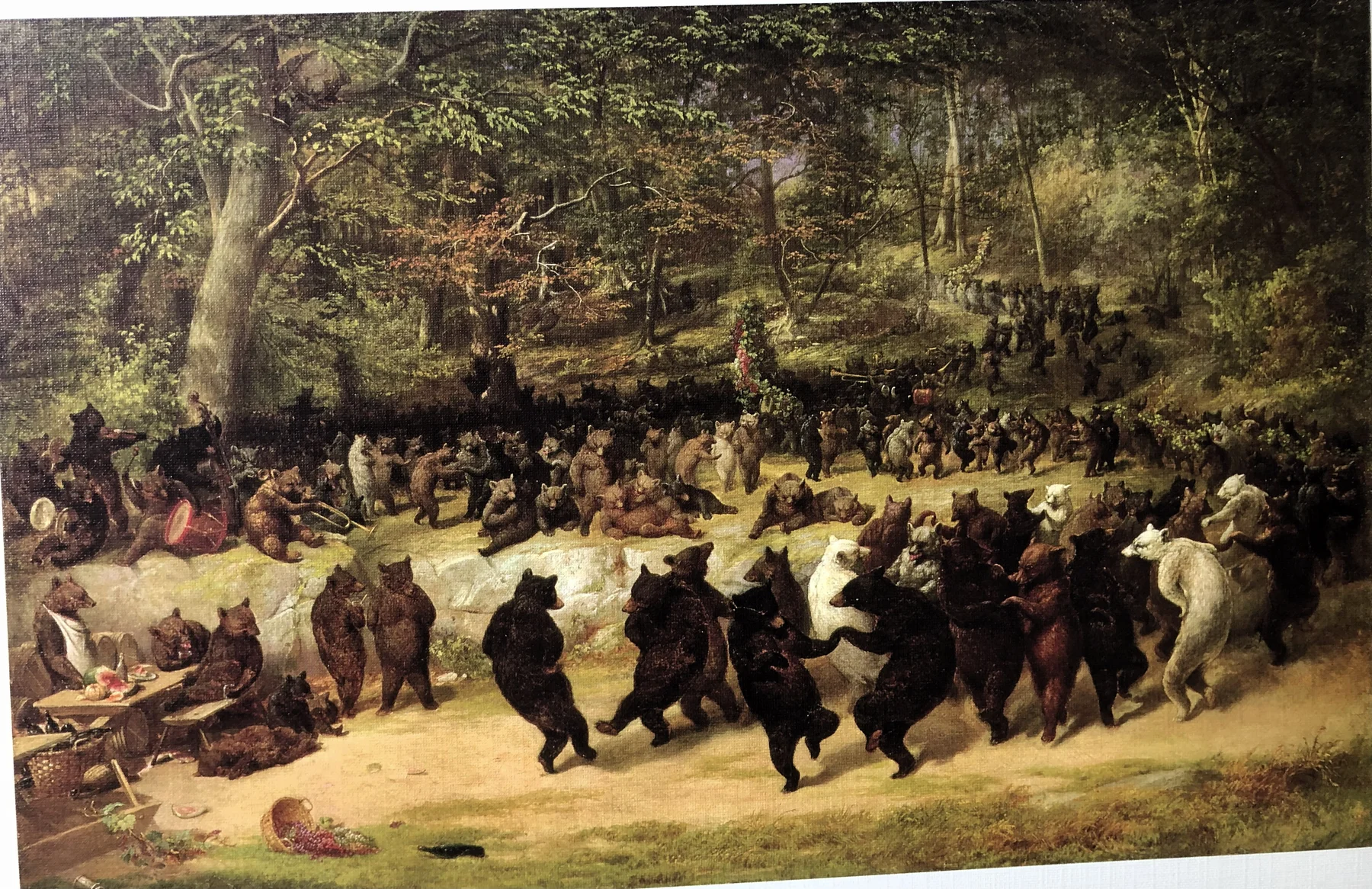
THE BEAR DANCE
William Holbrook Beard
- Artist
- William Holbrook Beard (1824–1900)
- Date
- Mid-to-late 1860s
- Dimensions
- 102 x 156.2 cm
- Medium
- Oil on canvas
- Location
- New-York Historical Society, New York City, USA
In late-19th-century America William Beard enjoyed three decades of popularity as a kind of “American Aesop” with his bizarre, sometimes sinister paintings showing animals in situations typical of humans. This picture of tipsy bears making merry in the forest was a pleasant satire on the wild revels of the Wall Street “bear traders”.
Bear Faces
Beard’s animal period actually began around 1861 [the year is hard to read in the photograph], after his move to New York. In his day animals were an everyday sight on the streets, from dancing bears and stray dogs to draught horses.
Along with monkeys, owls and squirrels, bears were among Beard’s favourite animals. He painted them true to nature but used them to depict human traits and failings, from drunkenness (Bears on a Spree, 1861) through gluttony (Bears in the Watermelon Patch, 1871) to budding love (So You Want to Get Married, Eh?, 1886).
The turbulent period after the Civil War was ripe for Beard’s somewhat unsettling humour, which offered people an escape from the chaos of national reconstruction and rapid industrialisation. His satirical tone fed on social tensions, heightened by the break-up of the old order and newly perceived threats such as immigration. His bears, of course, proved perfectly suited to lampooning the Wall Street money market.
Money Madness
On Wall Street “bulls” are those who buy cheap shares in the hope that their value will rise. “Bears”, on the other hand, sell shares they do not yet own, in the hope that their value will fall by the time they reach the buyer. (The term probably comes from bearskin traders, who sold the bear’s skin before they had killed the animal.)
Founded in 1817, the New York Stock Exchange was one of the growth industries of 19th-century America, helped by the invention of the telegraph (1844) and the stock ticker (1867), so that the money market became one of the most important factors in national and international business and greatly supported the rapid spread of the railway network after the Civil War.
To ordinary Americans, however, the stock exchange seemed a wild place at the heart of civilisation, a bears’ den in the middle of ordered society. They witnessed the bestial, unscrupulous behaviour of the brokers, roaring like animals and wielding fearsome power over the nation’s wealth during and after the war, and the wild speculation of greedy traders, which caused more than one devastating financial crisis, the most serious being the “Great Panic” of 1873. To many it seemed that unbridled stock-market behaviour could bring about the collapse of the whole of society.
If You Go Down to the Woods…
The Bear Dance is undated, but a dealer’s stamp suggests a date between 1859 and 1869. The painting is also known as The Bears of Wall Street Celebrating a Drop in the Market and The Wall Street Jubilee. In a forest clearing bears of various colours gather for a great party; dozens dance to the music of the band playing percussion, string instruments and horn on the left. In the foreground on the left a table laden with refreshments offers watermelon, grapes and grog. One dazed young bear has evidently given in to its temptation. In the background an endless line of bears approaches with more music, grapes and garlands of flowers. Above, a “real bear” peers down timidly from the safe hiding place of the branches.
The Beast Beneath the Surface
The revelry depicted in The Bear Dance is perfectly harmless merrymaking, but Beard knew it would cause a stir — as he also did with The Bulls and Bears in the Market (1879). The painting depicts a huge commotion on New York’s Broad Street, in front of the old stock exchange building (demolished in 1901). Here utter barbarism triumphs, as bulls and bears tear each other apart in a wild orgy of violence. Beard’s message is terrifying: beneath the surface of respectability we human beings are capable of behaving like animals when our instincts get the better of us.
“Too Coarse to Last”
Beard’s grotesque animal paintings mixed high art with caricature; they did not suit everyone’s taste and did not stand the test of time. One critic described his works as “too coarse to last”, adding that when an artist who had so far allowed himself crude but innocent humour “thus abuses the trust of his admirers, he commits a grave offence against society”.
Masterpiece Connection
Like Beard, the Bavarian caricaturist Thomas Nast (1840–1902, pictured), who worked as an illustrator for Harper’s Weekly for some 25 years, also loved to make animals human (and vice versa). His picture The Greatest Scare and Joke Ever! (Harper’s, 6 February 1875) depicts journalists as a bizarre, bayonet-headed menagerie running loose in the streets, following the embarrassing incident in which the New York Herald thoughtlessly published a hoax report that several citizens had been killed in a rampage by wild animals in Central Park. Further examples of the anthropomorphic genre are the New York painter Cassius Coolidge’s (1844–1934) pictures of dogs playing poker and the charming cats of the English illustrator Louis Wain (1860–1939).
- The Great Panic of 1873
- The Bulls and Bears in the Market