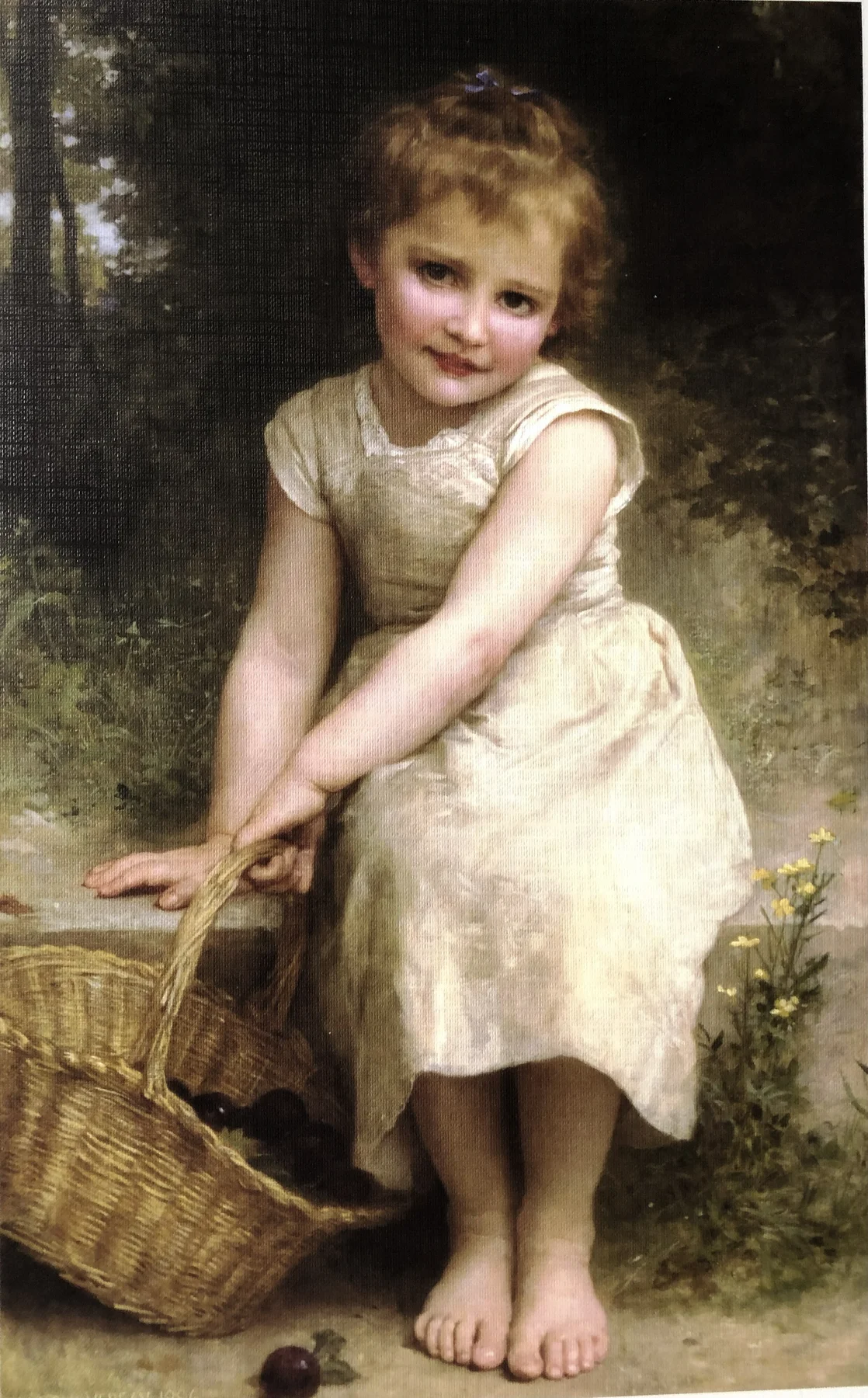
PLUMS
William-Adolphe Bouguereau
- Artist
- William-Adolphe Bouguereau (1825–1905)
- Date
- 1896
- Dimensions
- 96.5 x 61 cm
- Medium
- Oil on canvas
- Location
- Private collection
For a time William Bouguereau was France’s most successful painter, thanks largely to his enormous reputation overseas. He painted this charming study of a little girl shyly offering her basket of fruit in the mid-1890s, when he was extremely popular in the United States and his works could only be obtained after a waiting list of several years.
Yvonne, the Favourite
Why did his buyers love Bouguereau so much? The artist was able to capture childlike innocence, charm and hope, and conjured up an idealistic picture of village life. He grew up in the countryside, and although he worked mostly in Paris, every summer he returned to his home town of La Rochelle and brought models from the surrounding villages to his studio there.
Plums depicts one of his favourite models from the 1890s, a girl from La Rochelle named Yvonne. (Not all his child models were so obliging in his studio. One scandalised eyewitness reported how “the children rolled about on the floor having thrown off their clothes, playing, arguing or crying.”) Characteristically for Bouguereau, the figure occupies the centre of the canvas. The painting shows that he had an excellent feel for depicting children, as can be seen in his rendering of their velvety, translucent skin and tender expressions.
Sales in America
Bouguereau, who taught at the Académie Julian from 1875, took advantage of the flood of Francophile Americans who poured into the country at the end of the century: between 1882 and 1889 he had 220 overseas pupils. A former French student recalled that Bouguereau enjoyed “demigod status” at the Académie, adding: “It is hard to believe what relics the American students send home: the most treasured was the broken matchstick the great man had used…”
From 1866 to 1887 Bouguereau had an exclusive contract with the art dealer and publisher Adolphe Goupil, to whom he supplied 10–12 paintings a year. Most of these were bought by Michael Knoedler of New York, whose showroom presented the world of new European art to wealthy collectors with authority. Bouguereau’s sweet-faced peasant children and shepherdesses, evoking the nostalgic mood of Europe of old, and his playfully teasing nude nymphs and satyrs were received with delight by the newly minted industrial magnates and bankers. His works were so popular that Goupil could sell them before they reached the annual exhibition of the Paris Salon. To satisfy those who could not afford the originals, the dealer (who always bought the reproduction rights as well) printed copies by the million.
Plums was curiously an exception: the picture was never popularised through prints, perhaps because Bouguereau was by then represented by the firm Boussod, Valadon & Cie. Plums was sold directly to a London dealer in 1896, and the same year the painting passed to Knoedler; later it enriched for a time the collection of the influential Pittsburgh industrialist J. H. Reed.
Fortune Is Fickle
Tastes, however, change. Partly owing to his sharp opposition to the Impressionists, but also as an opponent of the advance of modernism, Bouguereau quickly fell out of favour after the 1890s. Most museums crammed his works into basement storerooms, art books reduced him to a footnote, and his polished pictures were identified with the disreputable daubs seen on the walls of Wild West saloons. When the collector Mrs Chester Dale organised a Bouguereau exhibition in the early 1930s, Time magazine remarked acidly: “For all its technical excellence, the proper perspective on a Bouguereau nude is always through the bottom of a beer mug.”
The New York painter Robert Henri, who had studied under the master, struck a more indulgent note: “Seen from Bouguereau’s point of view, a Manet always looks unfinished; seen from Manet’s point of view, a Bouguereau looks as if it had never been begun.”
The end of the 20th century proved Henri’s witty observation right: renewed interest in Bouguereau’s paintings blew the dust off his works and their prices soared. Celebrities also played a part in his revival: his Pietà of 1876 was owned by both Sylvester Stallone and Mel Gibson. At an auction in October 2000 Plums changed hands for more than half a million dollars. It seems Bouguereau is once again worth his weight in gold on the art market.
- La Rochelle, 1890
- Students of the Académie Julian, 1885
- Bouguereau in his studio