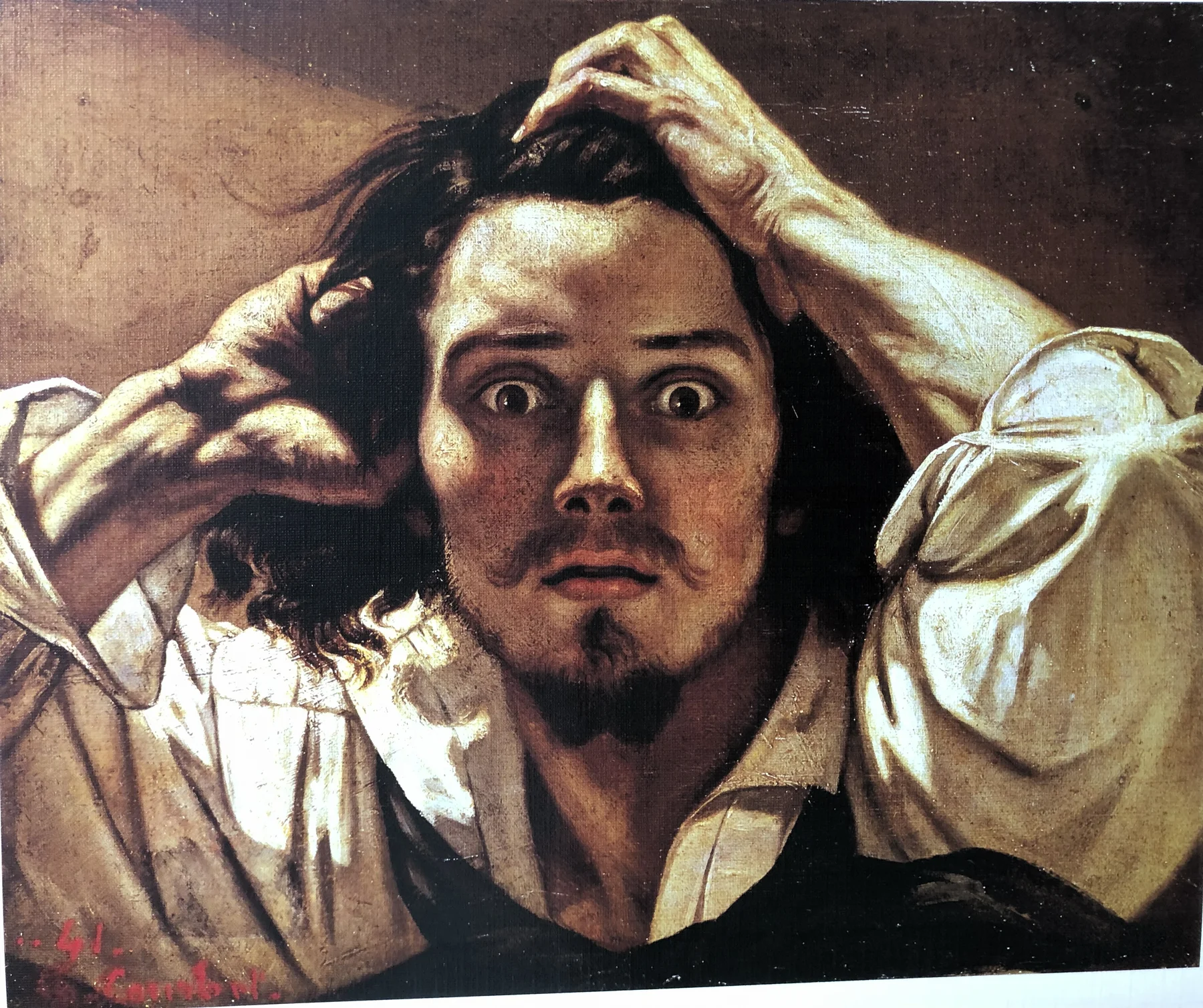
THE DESPERATE MAN
Gustave Courbet
- Artist
- Gustave Courbet (1819–1877)
- Date
- c. 1843–45
- Dimensions
- 45 x 54 cm
- Medium
- Oil on canvas
- Location
- Private collection
The 19th-century French artist Gustave Courbet played a key role in the development of modern painting: he rebelled against the traditional schools, turned away from Romanticism and became the leader of the Realist movement. Inspired by his native region, Franche-Comté in eastern France, Courbet was an innovative landscape painter whose later seascapes paved the way for Impressionism. He was also a significant portrait painter, and many of his early self-portraits, including The Desperate Man, reveal his excellent technical ability and offer a glimpse into the artist’s inner world.
Portrait of a Young Artist
Gustave Courbet was famous for painting a great many self-portraits, most of which date from the early part of his career. The mirror was of course always at hand, but the sheer number of self-portraits suggests the young artist’s vanity and search for identity. In Self-Portrait with Black Dog (1842–44), made at about the same time as The Desperate Man, Courbet — accompanied by his black English spaniel — presents himself as a romantic, rustic artist figure in fashionable clothes and a wide-brimmed hat, his head tilted in a self-assured, disdainful pose.
In his recurring self-portraits Courbet later also mostly slips into some kind of theatrical role. Although The Desperate Man bears the date 1841 next to his signature — whether by mistake or deliberately is not known — its authenticity is disputed, since it is generally believed that he painted the picture between 1843 and 1845, at around the age of 25. The young Courbet adopts another startling pose reflecting a particular state of mind, but this (masked) face reflected from the mirror and painted in this way is an extremely powerful and memorable likeness. Courbet was strongly preoccupied with this psychological situation in several other pictures too, and used a strikingly similar composition in another self-portrait, The Man Made Mad by Fear (c. 1843–45), in which a figure in a striped waistcoat, red cape and slippers is about to plunge headlong into the abyss.
Dramatic Lighting
Courbet’s superb self-portrait The Desperate Man is regarded by many as a kind of artistic execution of an expressive head following the guidelines of the French academic painter and theorist Charles Le Brun (1619–90). Courbet achieves a suggestive effect not only through his choice of the troubled facial expression depicted in the self-portrait but also heightens its expressive power with dramatic lighting. In his painting he uses vivid contrasts: the highlight falls on the middle and right side of the forehead and on the nose, which is lit from directly in front. The lighter tones of the artist’s left forearm and the hand raised to his head contrast with the shadowy areas in shade. The folds of the billowing white shirt produce a similar chiaroscuro effect. Courbet gives pink and red tints to the face and the slightly parted lips expressing astonishment, bringing colour and excitement to his composition. The expression is startling even though the artist does not reveal the cause of the desperation.
Expressive Power and Immediacy
Courbet’s work presents a significant psychological moment or state of mind, perhaps a moment of creative or personal crisis. The artist looks out of the picture wide-eyed, tearing at his hair, astonished, anxious, or perhaps battling demons, terrified, spellbound by hallucination. The still enigmatic painting owes much of its expressive power to Courbet’s compositional skill. The artist’s anxious face is framed by his thick white shirt and his two raised arms, which at the same time form the two sides of a triangle, with the fingers of his left hand running through his hair forming its apex. Some critics have pointed to the similarity with Rembrandt’s Self-Portrait with Wide-Open Eyes (1630). The direct gaze of Courbet, depicted exactly from the front, radiates the same immediacy as the Dutch master’s work. Others believe he may have been influenced by Jacques-Louis David’s painting The Intervention of the Sabine Women (1796–99), whose dynamic scene depicts the distressed Sabines in the grip of Roman soldiers — the central female figure in a red dress has a similar pose to Courbet in his self-portrait.
The painting’s landscape format, unusual for portraits, suits the likeness better than the traditional upright format. The tight framing, also used in modern photography, lends the work further expressive power and immediacy. There are no superfluous elements or props in the picture, only the dramatic head framed by the forearms. Characteristically of Courbet’s life and philosophy, the painting challenges the viewer and compels them to take a stand.
- Self-Portrait with Black Dog
- Nicolas de Largillière: Portrait of Charles Le Brun
- Jacques-Louis David: The Intervention of the Sabine Women